


















Lesson 34 of 44 · Rigid Bodies and Small Oscillations
Chapter 8 Overview: Rigid Bodies and Small Oscillations
Preview of chapter 8: normal modes of coupled oscillators, the inertia tensor, Euler's equations and why a tennis racket tumbles when you spin it about one axis.
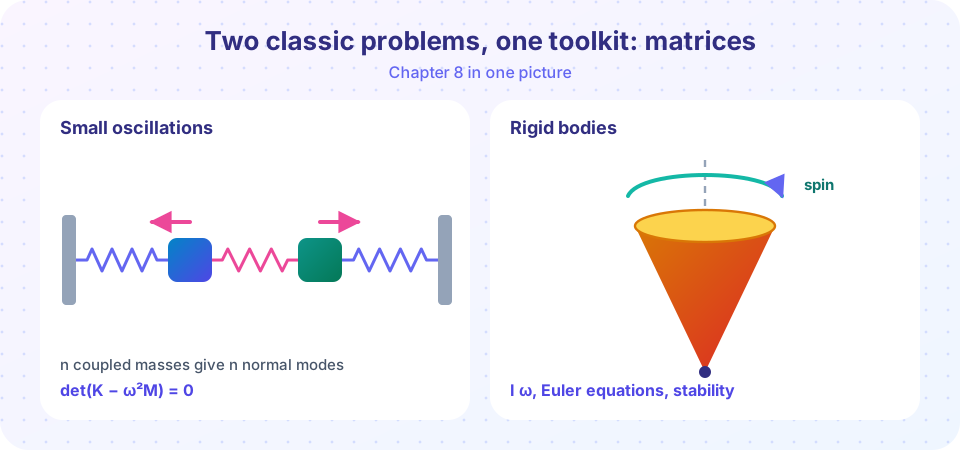
Two of the most useful applications of Lagrangian mechanics live in this chapter. The first is small oscillations: near any stable equilibrium, a complicated system behaves like a set of independent harmonic oscillators called normal modes. This is how engineers analyze bridges, how chemists understand molecular vibrations, and how physicists first treat a crystal.
The second is rigid-body rotation. A spinning top, a satellite and a thrown book all obey Euler's equations, and the equations hold a surprise: rotation about one of the three principal axes is unstable, which you can feel when you toss a book into the air.
Both topics are, underneath, the same piece of linear algebra: diagonalizing a symmetric matrix.
What you will learn
- How to turn a nonlinear system near equilibrium into
Mη̈ + Kη = 0. - What normal modes and normal frequencies are and how to find them.
- What the inertia tensor is and how it differs from a single moment of inertia.
- Why rotation about the middle principal axis is unstable.
The chapter at a glance
Near equilibrium, everything is a spring
Normal modes
Rotation needs a tensor
Euler's equations
What each lesson covers
- Small oscillations and normal modes: the matrix method, coupled masses and the double pendulum.
- The inertia tensor and Euler's equations: principal axes, torque-free rotation and the tennis-racket effect.
- Chapter review: a one-page picture and ten questions.
A first look: beats
Two identical masses joined by a weak coupling spring show beats: if you pull one aside and release, it swings, passes its energy to the other, and gets it back later. The reason is that the motion is a mix of two normal modes with slightly different frequencies. In the TryIt (m = 1 kg, wall springs k = 1 N/m, coupling κ = 0.05 N/m) mass 1 starts displaced and the plot shows both positions. The formula used is exact for this linear model: x₁ = ½(cos ω₁t + cos ω₂t) and x₂ = ½(cos ω₁t − cos ω₂t) with ω₁ = √(k/m) and ω₂ = √((k + 2κ)/m).
Press Run (or Ctrl + Enter) to see the result here.
Program input · what you'd type while the program runs
Type the answers before you press Run, one per line. Each time the program reads a line (with input()), it gets the next line from this box.
Check your understanding
Quick check · 4 questions
of 4 answered You scored / 4 · perfect!
-
1. What is a normal mode?
In a normal mode every coordinate oscillates with the same frequency and fixed relative amplitudes. -
2. How many normal modes does a system with n coupled coordinates have near a stable equilibrium?
n coordinates give an n × n eigenvalue problem and so n normal modes. -
3. Which two objects does the inertia tensor generalize?
The moment of inertia becomes a 3 × 3 symmetric matrix. -
4. When you toss a book spinning about its middle axis, what happens?
Rotation about the intermediate principal axis is unstable.
Summary
- Near equilibrium,
T ≈ ½ η̇ᵀMη̇andV ≈ ½ ηᵀKη; the normal modes solvedet(K − ω²M) = 0. - A rigid body needs an inertia tensor; torque-free motion follows Euler's equations.
- Rotation about the smallest and largest principal axes is stable, about the middle one unstable.
Track your progress
Create a free account to tick off lessons and pick up where you left off on any device.
of Classical Mechanics: Lagrangian and Hamiltonian lessons completed