


















Lesson 9 of 44 · Newtonian Mechanics Revisited
Conservative Forces, Potential Energy and Energy Diagrams
Learn what makes a force conservative, how F = −∇V works, how to read energy diagrams with turning points and equilibria, and how to compute a period from energy.
Many forces in mechanics have a hidden simplicity: they can be derived from a single scalar function of position, the potential energy V. Gravity, springs and electrostatic forces all work this way. When they do, the force is called conservative, mechanical energy is conserved, and one-dimensional problems can be solved by reading a graph. Lagrange's method is built on the very same V, so this lesson prepares the ground for L = T − V.
What you will learn
- The definition of a conservative force and the test for it.
- How
F = −∇Vlinks force and potential, and what energy conservation says. - How to read turning points and equilibria from an energy diagram.
- How to compute a period from energy alone.
Key terms
A force is conservative when the work it does between two points does not depend on the path. The potential energy V(r) satisfies F = −∇V. A turning point is where E = V(x) and the particle stops. An equilibrium is a point with V′(x) = 0: stable if V″ > 0, unstable if V″ < 0.
Conservative forces
The work done by a force along a path is W = ∫ F · dr. A force is conservative if W between two points is the same along every path, equivalently if the work around any closed loop is zero. In three dimensions the practical test, for smooth F on a simply connected region, is ∇ × F = 0.
Then there is a scalar function V with
F = −∇V i.e. Fₓ = −∂V/∂x, F_y = −∂V/∂y, F_z = −∂V/∂z
Examples:
| Force | Potential energy |
|---|---|
Uniform gravity F = −m g ŷ |
V = m g y |
Spring F = −k x |
V = ½ k x² |
Gravity of a point mass F = −G M m / r² |
V = −G M m / r |
| Coulomb force | V = k q₁ q₂ / r |
Friction and drag are not conservative; they depend on velocity and dissipate energy.
Energy conservation
With F = −∇V the work-energy theorem becomes dT = −dV, so
E = T + V = ½ m v² + V(r) = constant
For one-dimensional motion this is all you need to find the speed at every position: v(x) = ±√(2(E − V(x))/m).
Reading an energy diagram
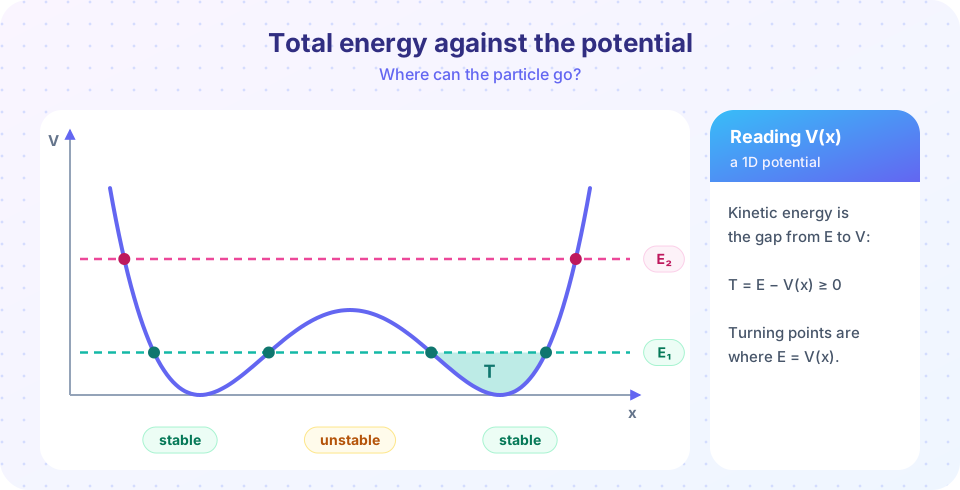
Plot V(x) and draw a horizontal line at the total energy E.
- The particle can only be where
E ≥ V(x), sinceT = E − V ≥ 0. - Where
E = V(x)the speed is zero: a turning point. - Minima of
Vare stable equilibria; maxima are unstable equilibria. - If
Eis below a barrier, the motion is trapped in one well; above it, the particle crosses.
In the picture above, the lower line E₁ traps the particle in the right well between two turning points; E₂ is above the barrier and lets the particle oscillate across both wells.
The period from energy
Since dx/dt = v(x), the time between two turning points a and b is ∫ₐᵇ dx / v(x), and one full period is
T = 2 ∫ₐᵇ dx / √(2 (E − V(x)) / m)
Chapter 5 will show the same integral as an application of the conserved energy, and chapter 6 will interpret it as an area in phase space.
Worked examples with numbers
A spring. For F = −kx, the potential is V = ½kx². With k = 200 N/m, stretching by x = 0.10 m stores V = 1.0 J. If a 0.5 kg block attached to it is released from that point, its speed at the center follows from ½ m v² = 1.0 J, so v = 2.0 m/s. No equation of motion was solved: energy gave the speed directly.
Testing for conservative. In a simply connected region a force is conservative when its curl vanishes. Compare F = (2xy, x²), with ∂F_y/∂x − ∂F_x/∂y = 2x − 2x = 0, and F = (−y, x), with curl 1 − (−1) = 2. The first has potential V = −x²y. The second does not: carrying a particle once around a circle of radius 2 does work ∮F·dr = 2π r² = 8π ≈ 25.1 J, so you could gain energy on every lap, which is why no V exists.
Equilibria. Let V(x) = x⁴ − 2x² (in joules, x in meters). Then V′ = 4x³ − 4x = 4x(x² − 1), with roots x = 0, ±1. The second derivative V″ = 12x² − 4 equals −4 at 0 (unstable, a hilltop) and +8 at ±1 (stable wells). For small motion about x = 1 with a mass of 2 kg, the frequency is ω = √(V″/m) = √(8/2) = 2 rad/s, a period of π ≈ 3.14 s. The well depth is V(0) − V(1) = 1 J: a particle with total energy E < 0 is trapped in one well, and with E > 0 it crosses between them.
Why the sign in F = −∇V?
Force points toward decreasing potential: a ball rolls downhill. The minus sign is a convention that makes energy conservation T + V = E come out right, and V is only defined up to an additive constant (choose the zero wherever it is convenient). Only differences of potential energy are physical. The idea took shape over the 18th and 19th centuries: Lagrange (1788) used a potential function for gravity, and William Rankine coined the term "potential energy" in 1853.
Common misconceptions
"Potential energy has an absolute value." Only differences matter, since adding a constant to V leaves F = −∇V unchanged. Both V = m g y and V = m g y + 5 J are acceptable.
"Energy conservation means the force is constant." It means the force is conservative, not constant. A spring force changes with x, yet its energy is conserved.
"A particle at a potential maximum will stay there." It is an equilibrium, but an unstable one; the smallest push sends it away.
Try it
Simulate a particle in the double well V(x) = (x² − 1)² (mass 1 and units chosen so that numbers are simple). The program checks energy conservation, prints the turning points for E = 0.5, and plots both motions.
Press Run (or Ctrl + Enter) to see the result here.
Program input · what you'd type while the program runs
Type the answers before you press Run, one per line. Each time the program reads a line (with input()), it gets the next line from this box.
The next program computes the period of the trapped motion twice: by integrating the energy formula T = 2∫ dx / √(2(E − V)) and by timing a simulation. The two agree.
Press Run (or Ctrl + Enter) to see the result here.
Program input · what you'd type while the program runs
Type the answers before you press Run, one per line. Each time the program reads a line (with input()), it gets the next line from this box.
Check your understanding
Quick check · 5 questions
of 5 answered You scored / 5 · perfect!
-
1. Which force is NOT conservative?
Kinetic friction depends on velocity direction and dissipates energy; the work depends on the path. -
2. If V(x) = ½ k x², the force is:
F = −dV/dx = −kx. -
3. On an energy diagram, the kinetic energy at position x equals:
T = E − V, which must be non-negative. -
4. A point where V′ = 0 and V″ < 0 is:
A maximum of V is unstable: any displacement is pushed further away. -
5. A particle has E = 1.6 in the double well V = (x² − 1)², whose barrier height is 1. What does it do?
E exceeds the barrier at x = 0, so the particle passes over it.
Summary
- A conservative force satisfies
F = −∇V; thenE = T + Vis constant. - The test
∇ × F = 0identifies conservative forces; friction is not conservative. - Energy diagrams show allowed regions, turning points and the stability of equilibria.
- The period between turning points is
2 ∫ dx / v(x).
Next: Chapter 2 Review
Track your progress
Create a free account to tick off lessons and pick up where you left off on any device.
of Classical Mechanics: Lagrangian and Hamiltonian lessons completed