


















Lesson 8 of 44 · Newtonian Mechanics Revisited
Constraints and the Pendulum: The Newtonian Way
Solve the simple pendulum with Newton's laws, find the tension, see when a string goes slack, and learn why unknown constraint forces motivate the Lagrangian approach.
A constraint is a restriction on where a particle may be: on a rod, on a wire, on a surface. The material that enforces it pushes on the particle with a force you do not know in advance. Newton's method then has two jobs at once: find the motion and find the constraint force. In this lesson we do the pendulum completely, with all its forces, to see exactly how much work the Lagrangian method will save.
What you will learn
- How to resolve forces on a pendulum into radial and tangential parts.
- How to find the tension and the motion
θ(t)from Newton's laws. - When a string constraint stops being valid.
- Why unknown constraint forces are the real difficulty.
Key terms
Constraint force: the force that enforces a constraint (tension, normal force). Radial / tangential: along or across the line from the pivot. Small-angle approximation: sin θ ≈ θ for small θ in radians. Period: the time of one full swing.
Newton's equations for the pendulum
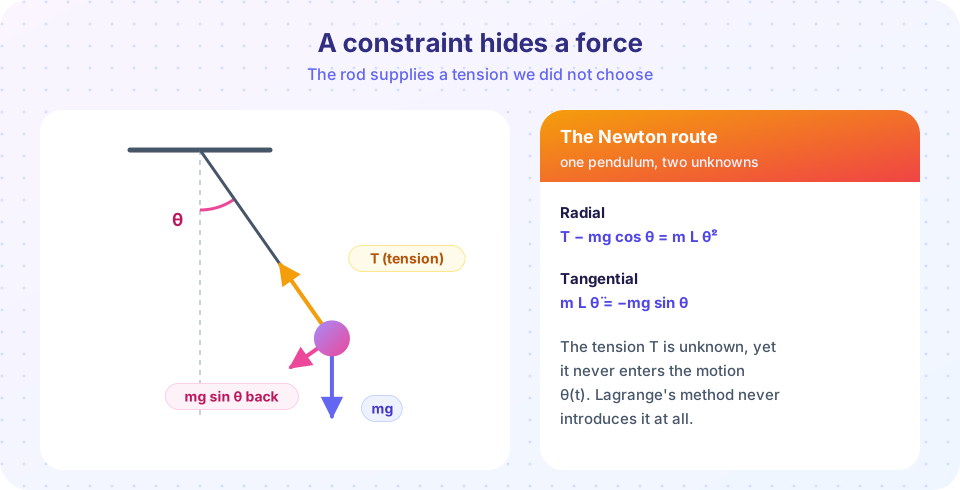
A bob of mass m hangs from a pivot by a massless rod of length L. Use the angle θ from the downward vertical. The bob moves on a circle, so use polar directions.
- Tangential direction (along the motion): the only force component is gravity,
−m g sin θ, and the acceleration isL θ̈:
m L θ̈ = −m g sin θ ⇒ θ̈ = −(g/L) sin θ
- Radial direction (toward the pivot): tension
Tpulls inward, gravity's componentm g cos θpulls outward, and the centripetal acceleration isL θ̇²inward:
T − m g cos θ = m L θ̇² ⇒ T = m g cos θ + m L θ̇²
The tangential equation does not contain T, so the motion can be found first and the tension afterwards. That is lucky. For a bead on a general moving wire you cannot separate the equations like this, and you must solve for the unknown forces simultaneously.
For small angles sin θ ≈ θ and we get simple harmonic motion θ̈ = −(g/L) θ with angular frequency ω = √(g/L) and period T₀ = 2π √(L/g). For a 1 m pendulum on Earth, T₀ ≈ 2.006 s.
The exact period for amplitude θ₀ is T = 4 √(L/g) K(k) with k = sin(θ₀/2) and K the complete elliptic integral. It increases with amplitude: at θ₀ = 60° the period is about 7% longer than T₀.
When a string goes slack
With a rigid rod the formula T = m g cos θ + m L θ̇² is always valid, and T may be negative (the rod pushes). A string cannot push: the constraint is |r| ≤ L, an inequality. If you release a bob on a string from rest at θ₀ = 100°, the formula gives T = m g cos 100° < 0 at the start, so the string would have to push. In reality the bob simply falls freely until the string tightens again. Such inequality constraints are outside ordinary Lagrangian mechanics; we treat them by checking the sign of the tension afterwards.
Why this is the real difficulty
The pendulum was easy because the rod's force is perpendicular to the motion, so it disappears from the tangential equation. That is no accident: constraint forces are perpendicular to the allowed displacements, so they do no work. Lagrange's method uses that perpendicularity from the start. The next chapters show how to apply it so that you never write T at all, but you can still recover it later if you want it, as the numerical example below does.
Numbers for a real pendulum
Take a pendulum of length L = 1.00 m on Earth (g = 9.81 m/s²). The small-angle period is T₀ = 2π√(L/g) = 2.006 s, which is why a "seconds pendulum" (one second per half-swing) is about 0.994 m long. Tradition says Galileo noticed the near-constant period around 1583 by timing a swinging lamp against his pulse, and Huygens used the idea in the first pendulum clock (1656).
The small-angle formula fails for big swings. For release from θ₀ = 60° the exact period is T = T₀ · (2/π) K(sin(θ₀/2)), where K is the complete elliptic integral of the first kind. With sin 30° = 0.5, the factor is about 1.073, so T ≈ 2.153 s: a 7% longer swing, because the restoring force mg sin θ is weaker than mg θ. At 90° the factor is about 1.18, and near 170° it is above 2.
The tension, step by step
Let the bob have m = 0.5 kg and be released from rest at 60°. Energy conservation gives the speed at the bottom: v² = 2gL(1 − cos θ₀) = 2 · 9.81 · 1 · 0.5 = 9.81 m²/s², so v = 3.13 m/s. At the bottom the radial equation is T − mg = m v²/L, so T = mg + m v²/L = 4.905 + 4.905 = 9.81 N, exactly twice the weight. In general the bottom tension is T = mg(3 − 2cos θ₀), which is 3mg for release from 90° and mg for a bob that was never lifted. These are the numbers a string or rod must withstand, and the Lagrangian method does not produce them automatically: the constraint force is exactly what it hides.
Reading the slack-string case
A string can only pull. If the radial equation gives T < 0, the string goes slack and the bob becomes a projectile until the string tightens again. For a bob to swing a full vertical circle on a string, the minimum speed at the top is √(gL), so at the bottom it needs v ≥ √(5gL) ≈ 7.0 m/s for L = 1 m. A rigid rod can push as well as pull, so it needs only v > 0 at the top, a difference that appears constantly in exam questions.
Common misconceptions
"The tension equals the weight." Only when the bob is at rest at the bottom. At the bottom of a swing the tension is m g + m L θ̇², greater than the weight.
"The period depends on the mass." It does not: m cancels in θ̈ = −(g/L) sin θ. It also depends only weakly on amplitude, which is why pendulum clocks work.
Try it
Compare the exact nonlinear pendulum with the small-angle approximation, and print the period for several amplitudes using the elliptic integral formula.
Press Run (or Ctrl + Enter) to see the result here.
Program input · what you'd type while the program runs
Type the answers before you press Run, one per line. Each time the program reads a line (with input()), it gets the next line from this box.
Now recover the tension that the tangential equation never needed. For a rod we may follow it all the way; for a string, negative values mean the string has gone slack.
Press Run (or Ctrl + Enter) to see the result here.
Program input · what you'd type while the program runs
Type the answers before you press Run, one per line. Each time the program reads a line (with input()), it gets the next line from this box.
Check your understanding
Quick check · 5 questions
of 5 answered You scored / 5 · perfect!
-
1. Which force component makes the pendulum bob accelerate along its arc?
Tension is perpendicular to the arc and gravity's radial part is balanced by it; only the tangential part moves the bob. -
2. A 1 m pendulum swings through small angles on Earth. Its period is about:
T₀ = 2π√(L/g) = 2π√(1/9.81) ≈ 2.006 s. -
3. Compared with the small-angle period, the exact period for a large amplitude is:
The restoring force grows more slowly than the linear approximation, so the swing takes longer. -
4. At the bottom of the swing (θ = 0) the tension is:
Centripetal acceleration requires T − mg = mLθ̇². -
5. Why can a string constraint break the formula T = mg cos θ + mLθ̇²?
The string constraint is an inequality; when the formula gives T < 0 the constraint no longer holds.
Summary
- The pendulum's tangential equation
θ̈ = −(g/L) sin θis free of the tension. - The tension follows afterwards:
T = m g cos θ + m L θ̇². - A string gives an inequality constraint and can go slack; a rod cannot.
- Constraint forces do no work on allowed motions, the fact that Lagrange will exploit.
Track your progress
Create a free account to tick off lessons and pick up where you left off on any device.
of Classical Mechanics: Lagrangian and Hamiltonian lessons completed