


















Lesson 13 of 44 · Calculus of Variations
The Brachistochrone and Other Classic Paths
Solve the brachistochrone (fastest descent) problem with the Beltrami identity, discover the cycloid, compare slide times numerically, and meet the tautochrone.
In 1696 Johann Bernoulli challenged the mathematicians of Europe with a puzzle: a bead slides without friction from point A down to a lower point B. Along which wire does it arrive soonest? The name brachistochrone means "shortest time". The answer is not the straight line. Newton, Leibniz, l'Hôpital and Jakob Bernoulli all solved it, and Johann's brother's solution helped launch the calculus of variations. In this lesson you do it yourself with the tools of the last lesson.
What you will learn
- How to set up the descent time as a functional.
- How the Beltrami identity gives a first integral.
- Why the solution is a cycloid, and what its parametric form is.
- How to check by computer that the cycloid beats other tracks.
Key terms
The brachistochrone is the curve of fastest frictionless descent. A cycloid is the curve traced by a point on the rim of a rolling wheel. The tautochrone is a curve along which the descent time to the bottom is the same from any starting point.
Setting up the functional
Put the origin at A with y measured downward, x horizontal. The bead starts at rest. By energy conservation, after falling a depth y its speed is
v = √(2 g y)
(the wire does no work). A small arc length is ds = √(1 + y′²) dx, so the descent time is
T[y] = ∫ ds / v = ∫₀ˣᴮ √(1 + y′²) / √(2 g y) dx
The integrand has no explicit x, so the Beltrami identity applies: L − y′ ∂L/∂y′ = constant. With L = √((1 + y′²)/(2 g y)),
L − y′ ∂L/∂y′ = 1 / √(2 g y (1 + y′²)) = constant
which can be written as
y (1 + y′²) = 2R (a constant, called 2R for convenience)
Solving: the cycloid
Try the parametrization y = R(1 − cos t). Then 1 + y′² = 2R/y gives y′² = (2R − y)/y = (1 + cos t)/(1 − cos t) = cot²(t/2). So dy/dx = cot(t/2) and dx = tan(t/2) dy = tan(t/2) · R sin t dt. Using sin t = 2 sin(t/2) cos(t/2), this becomes dx = 2R sin²(t/2) dt = R(1 − cos t) dt. Integrate:
x = R (t − sin t) y = R (1 − cos t)
This is a cycloid: the path of a point on the rim of a wheel of radius R rolling along a horizontal line (turned upside down here, since y points down). The constant R is fixed by demanding the curve pass through B.
For the endpoint B at t = π the coordinates are (π R, 2R) and the time of descent from rest is
T = π √(R / g)
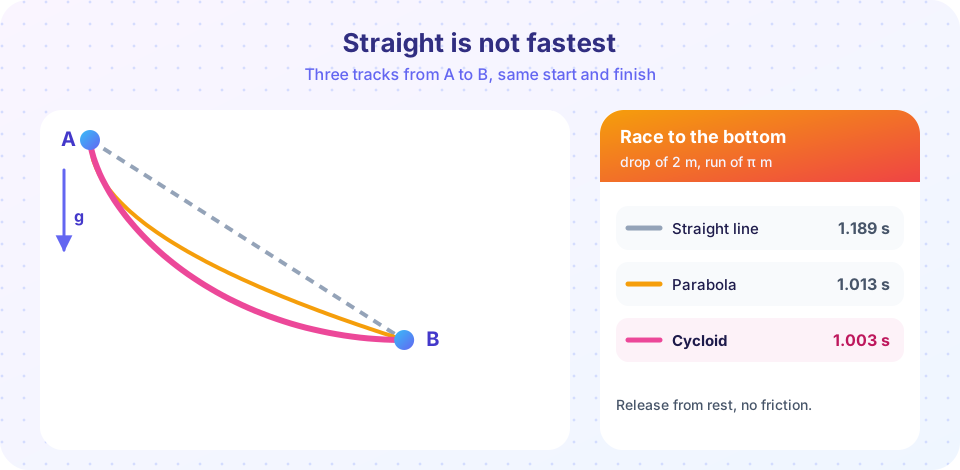
Worked example. Take R = 1 m: the bead falls 2 m over a horizontal run of π m, and T = π √(1/9.81) = 1.003 s. The straight line between the same points has length √(π² + 4) = 3.724 m and a constant acceleration g · 2/3.724, so T = 1.189 s. The cycloid is about 16% faster.
The cycloid is also a tautochrone
Huygens had earlier shown that a bead released from rest at any height on a cycloidal bowl takes the same time, π√(R/g), to reach the bottom. That is why cycloidal pendulum clocks, in which the bob is guided by cycloidal cheeks, keep time independent of amplitude. Because the Euler-Lagrange method treats this effortlessly, it is worth running a numerical check.
The race, with numbers
Take a start at the origin and an end 2 m to the right and 1 m below. A bead sliding without friction on a straight wire between them has acceleration g/√5 along a length √5 = 2.236 m, so t = √(2s/a) ≈ 1.010 s. The cycloid through the same two points has radius a = 0.517 m and end parameter θ = 3.508 rad (a little beyond π, so the curve dips slightly below the end height before rising to it), and the descent time is θ √(a/g) = 0.806 s. The cycloid beats the straight line by about 20%, even though it is longer. Falling steeply at the start buys speed early, and speed is what pays for the extra distance.
Why the curve is the way it is
The speed after dropping a vertical distance y is v = √(2gy) (energy conservation, so the mass cancels). Time is ∫ ds/v = ∫ √(1 + y′²) / √(2gy) dx. This functional has no explicit x, so the Beltrami identity gives 1/√(y(1 + y′²)) = const. A substitution in terms of the slope angle leads to the parametric cycloid x = a(θ − sin θ), y = a(1 − cos θ).
A historical contest
Johann Bernoulli published the problem in 1696 as a public challenge to the mathematicians of Europe. A solution reached him anonymously in 1697; he is said to have recognized the author by the style ("the lion is known by his claw"), and it was Isaac Newton, who had solved it in a single evening. Leibniz, Jakob Bernoulli (Johann's older brother and rival) and l'Hôpital also solved it. Johann's own solution used Fermat's principle of least time: slice the medium into layers of different speed, apply Snell's law, and let the layers become infinitely thin. Jakob's solution was more general and pointed the way to the calculus of variations that Euler then developed.
The tautochrone
Christiaan Huygens had shown in 1659 that a bead on an inverted cycloid reaches the bottom in the same time wherever it starts. The time is π√(a/g), which is 0.709 s for a = 0.5 m. Huygens tried to use it in clock design, hoping to make pendulum timekeeping independent of amplitude. It is a remarkable coincidence that the fastest-descent curve and the equal-time curve are the same one.
Common misconceptions
"The shortest path is also the fastest." The straight line minimizes length, not time. The fastest path dips steeply at the start to build speed.
"The curve must stay above the endpoint." The cycloid goes below the end height when B is far to the side, if the horizontal run is more than π R.
"Friction does not matter." The solution assumes a frictionless wire. With friction, the problem changes.
Try it
Compute the descent times for three tracks between the same points. Each time is ∫ ds/v; we integrate it numerically and compare with the exact cycloid result.
Press Run (or Ctrl + Enter) to see the result here.
Program input · what you'd type while the program runs
Type the answers before you press Run, one per line. Each time the program reads a line (with input()), it gets the next line from this box.
Next, verify two classical facts by computer: the cycloid satisfies y(1 + y′²) = 2R exactly, and the time to reach the bottom is the same from different starting points (the tautochrone property).
Press Run (or Ctrl + Enter) to see the result here.
Program input · what you'd type while the program runs
Type the answers before you press Run, one per line. Each time the program reads a line (with input()), it gets the next line from this box.
Check your understanding
Quick check · 5 questions
of 5 answered You scored / 5 · perfect!
-
1. What is the speed of a bead that has fallen a depth y from rest, with no friction?
Energy conservation: ½ m v² = m g y. -
2. Why can the Beltrami identity be used for the brachistochrone?
L depends on y and y′ but not explicitly on x, so L − y′∂L/∂y′ is constant. -
3. What curve is the brachistochrone?
x = R(t − sin t), y = R(1 − cos t). -
4. For R = 1 m on Earth, the descent time from the cusp to the lowest point of the cycloid is about:
T = π√(R/g) = π√(1/9.81) ≈ 1.003 s. -
5. What is the tautochrone property?
Huygens showed this for the cycloid: the time to the bottom is π√(R/g) wherever you start.
Summary
- The descent time
T = ∫ √(1 + y′²)/√(2 g y) dxis a functional with no explicitx. - Beltrami gives
y(1 + y′²) = 2R, whose solution is the cycloidx = R(t − sin t),y = R(1 − cos t). - The cycloid beats the straight line and the parabola in time (1.003 s, 1.189 s and 1.013 s for the example).
- The same curve is the tautochrone.
Track your progress
Create a free account to tick off lessons and pick up where you left off on any device.
of Classical Mechanics: Lagrangian and Hamiltonian lessons completed