


















Lesson 10 of 44 · Newtonian Mechanics Revisited
Chapter 2 Review: Newtonian Mechanics Revisited
Review Newton's laws, systems of particles, constraint forces and conservative forces with a one-page poster, a recap table and a ten-question quiz.
This chapter slowed down Newton's mechanics to examine what it does well, and where unknown constraint forces make it clumsy. Below is a one-page summary, a recap table and a quiz mixing all four lessons. If something feels shaky, return to the linked lesson before moving on to calculus of variations.
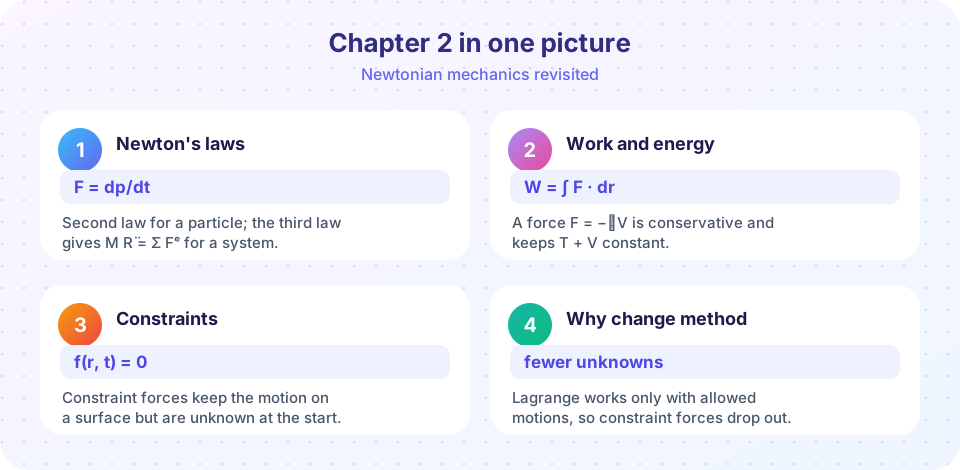
Recap table
| Topic | Key facts | Lesson |
|---|---|---|
| Laws and quantities | F = dp/dt; p, T, ℓ defined from r, v |
Overview |
| Systems | M R̈ = Fᵉ_total; internal forces cancel |
Systems of particles |
| Splitting | T = ½MV² + Σ ½mᵢvᵢ′², L = R × P + Σ mᵢrᵢ′ × vᵢ′ |
Systems of particles |
| Constraints | forces unknown, perpendicular to allowed motion | Constraints and the pendulum |
| Pendulum | θ̈ = −(g/L) sin θ, T = mg cos θ + mLθ̇² |
Constraints and the pendulum |
| Conservative forces | F = −∇V, E = T + V constant |
Conservative forces |
| Energy diagrams | turning points where E = V, equilibria where V′ = 0 |
Conservative forces |
Try it
Press Run (or Ctrl + Enter) to see the result here.
Program input · what you'd type while the program runs
Type the answers before you press Run, one per line. Each time the program reads a line (with input()), it gets the next line from this box.
Press Run (or Ctrl + Enter) to see the result here.
Program input · what you'd type while the program runs
Type the answers before you press Run, one per line. Each time the program reads a line (with input()), it gets the next line from this box.
Check your understanding
Quick check · 10 questions
of 10 answered You scored / 10 · perfect!
-
1. What is the total external force on a system whose center of mass moves at constant velocity?
M R̈ = Fᵉ_total, so constant velocity means zero net external force. -
2. Which statement about constraint forces is correct?
That perpendicularity is why they do no work and why Lagrange's method can ignore them. -
3. A 0.5 kg bob swings on a 1 m rod. At the bottom its speed is 2 m/s. What is the rod tension (g = 9.81 m/s²)?
T = mg + mv²/L = 4.905 + 0.5·4/1 = 6.905 N. -
4. Which condition guarantees a force is conservative (on a simply connected region)?
Zero curl means F = −∇V for some scalar V. -
5. In an energy diagram with total energy E, the particle is allowed at positions where:
Kinetic energy E − V cannot be negative. -
6. Two bodies exert equal and opposite forces on each other. This is:
That is Newton's third law. -
7. What is the center of mass of masses 1 kg at x = 0 and 4 kg at x = 5 m?
R = (1·0 + 4·5)/5 = 4 m. -
8. A particle has V′(x₀) = 0 and V″(x₀) > 0. The equilibrium is:
A minimum of V is stable. -
9. Why does the pendulum's tangential equation not contain the tension?
The rod's force acts along the radius, perpendicular to the arc, so it has no tangential component. -
10. Which is the correct split of the kinetic energy of a system?
The cross term vanishes because Σ mᵢ vᵢ′ = 0.
Summary
- Newton's laws give
M R̈ = Fᵉ_totalfor systems, with internal forces cancelling. - Constraint forces are unknown but perpendicular to allowed motion, so they do no work.
- Conservative forces come from a potential, and energy diagrams reveal turning points and stability.
- Next we learn the mathematics of finding a function that makes an integral stationary.
Track your progress
Create a free account to tick off lessons and pick up where you left off on any device.
of Classical Mechanics: Lagrangian and Hamiltonian lessons completed