


















Lesson 35 of 47 · Quantum Simulations
Wave packets and tunneling
Evolve a quantum wave packet with the split-step Fourier method, watch it hit a barrier, and check the transmitted fraction against the exact tunneling formula.
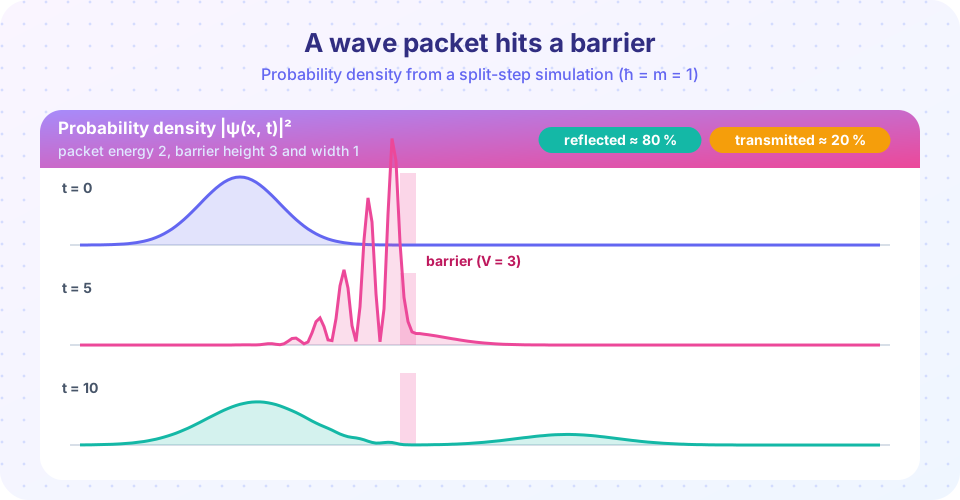
Throw a ball at a wall and it bounces back. Fire an electron at a thin barrier that is higher than its energy and, a fraction of the time, it appears on the other side. This is quantum tunneling, and it makes the Sun shine (nuclear fusion), lets flash memory store bits, and gives scanning tunneling microscopes their atomic resolution. In this lesson you will watch it happen: you will build a moving wave packet and push it through a barrier with a simulation that conserves probability exactly.
What you will learn
- How the time-dependent Schrödinger equation is solved by the split-step Fourier method.
- Why the method is unitary and what makes it fast.
- How to build a Gaussian wave packet with a chosen momentum.
- How to check a tunneling simulation against the exact transmission formula.
Key terms
Time evolution operator: U(Δt) = exp(−iHΔt/ħ), which advances ψ by Δt.
Split-step (Strang splitting): apply half a step of the potential, a full step of the kinetic energy and another half step of the potential.
FFT: the fast Fourier transform, which switches between position and momentum representations.
Transmission coefficient T: the probability that a particle passes the barrier.
Tunneling: passing through a region where the particle's energy is lower than the potential.
The time-dependent Schrödinger equation
In natural units (ħ = m = 1):
i ∂ψ/∂t = H ψ, H = −½ ∂²/∂x² + V(x)
Formally the solution is ψ(t + Δt) = exp(−iHΔt) ψ(t). The trouble is that H is a sum of two pieces that do not commute: the potential is simple in position space, the kinetic energy is simple in momentum space. Neither space makes both easy.
The split-step Fourier method
The idea: since V is just a multiplication in position space, and −½ ∂²/∂x² is just a multiplication by k²/2 in momentum space, do each in the space where it is easy.
1.  ψ ← exp(−i V Δt / 2) ψ                 (position space, half step)
2.  ψ̃ ← FFT(ψ);  ψ̃ ← exp(−i k² Δt / 2) ψ̃;  ψ ← IFFT(ψ̃)   (momentum space, full step)
3.  ψ ← exp(−i V Δt / 2) ψ                 (position space, half step)
The symmetric arrangement makes the error second order in Δt. Every factor has magnitude 1, so the method is exactly unitary: the total probability stays 1 to machine precision no matter how large the step. Cost per step is two FFTs, O(N log N).
Two practical points. The FFT treats the grid as periodic, so the domain must be large enough that the packet never wraps around. And the largest momentum on the grid is π/Δx; the packet's momentum must lie well below it.
Building a packet
A Gaussian packet centered at x₀ with width σ and mean momentum k₀:
ψ(x, 0) = (2πσ²)^(-1/4) · exp(−(x − x₀)² / (4σ²)) · exp(i k₀ x)
Its mean energy is about k₀²/2 (natural units), and its momentum spread is 1/(2σ): a wide packet has a sharp momentum, which is needed when you want to compare with a formula that assumes a single energy.
The exact answer to compare with
For a square barrier of height V₀ and width a, a plane wave with energy E < V₀ is transmitted with probability
T = 1 / (1 + V₀² sinh²(κa) / (4E(V₀ − E))), κ = √(2(V₀ − E))
For E > V₀, replace sinh by sin and κ by q = √(2(E − V₀)), and use E(E − V₀) in the denominator. A wave packet contains many energies, so its transmitted fraction is the average of T(E) weighted by the packet's momentum distribution.
Common misconceptions
- "The particle digs a tunnel through the barrier." There is no path. The wave function simply has a non-zero amplitude beyond the barrier, and a measurement finds the particle there with probability T.
- "The packet splits into two particles." There is still only one particle: the probability is split, and a detector finds it either left or right.
- "Tunneling needs a high-energy particle." It happens at energies below the barrier. Thinner barriers and lighter particles tunnel much more.
- "A bigger time step only makes the picture blurrier." In the split-step method it limits accuracy, not stability; the norm is preserved at any step.
Try it
Build the simulation. We send a packet with k₀ = 2 (energy about 2) at a barrier of height 3 and width 1. The program prints the conserved norm, the transmitted fraction and the analytic prediction averaged over the packet's momentum distribution.
Press Run (or Ctrl + Enter) to see the result here.
Program input · what you'd type while the program runs
Type the answers before you press Run, one per line. Each time the program reads a line (with input()), it gets the next line from this box.
A packet in free space spreads: even with no force, a localized wave contains a range of momenta and the faster components run ahead. The exact width at time t (natural units) is σ(t) = σ₀·√(1 + (t/(2σ₀²))²). We verify it with the same integrator.
Press Run (or Ctrl + Enter) to see the result here.
Program input · what you'd type while the program runs
Type the answers before you press Run, one per line. Each time the program reads a line (with input()), it gets the next line from this box.
Finally, the transmission as a function of energy. For each of five packet energies we run a simulation with a very wide packet (narrow in momentum) and compare the transmitted fraction with the exact curve T(E).
Press Run (or Ctrl + Enter) to see the result here.
Program input · what you'd type while the program runs
Type the answers before you press Run, one per line. Each time the program reads a line (with input()), it gets the next line from this box.
The agreement is close because the grid spacing is 1/16, so the barrier covers exactly 16 cells. With a spacing that does not divide the width evenly, the simulated barrier comes out slightly thicker or thinner than intended, and because T depends exponentially on the width, the transmitted fraction can be off by several percent. Always check that your grid represents the potential you meant.
Check your understanding
Quick check · 5 questions
of 5 answered You scored / 5 · perfect!
-
1. Why is the split-step Fourier method called unitary?
Both the potential and kinetic factors are pure phases, so the norm of ψ is exactly preserved. -
2. The FFT is used in the split-step method to...
The kinetic term is a multiplication by k²/2 in momentum space. -
3. A packet has width σ = 5. Its momentum spread is about...
σ_k = 1/(2σ) = 0.1 in natural units. -
4. What happens to T when the barrier is made thicker (E < V₀)?
T contains sinh²(κa), which grows exponentially with the width a, so T falls. -
5. Why must the simulation box be large?
If probability reaches one edge it re-enters from the other and corrupts the result.
Summary
- Time evolution
ψ(t+Δt) = exp(−iHΔt)ψis done by the split-step method: half potential step, kinetic step in Fourier space, half potential step. - The method is unitary (norm conserved) and costs
O(N log N)per step; the box must be big enough to avoid wrap-around. - A Gaussian packet is a bump times
exp(i k₀ x); its energy is aboutk₀²/2and its momentum spread1/(2σ). - Compare simulations with the exact barrier formula
T(E)averaged over the packet's momentum distribution.
Next: The variational method
Track your progress
Create a free account to tick off lessons and pick up where you left off on any device.
of Computational Physics lessons completed