


















Lesson 45 of 47 · Projects and Practice
Glossary and units
A reference glossary of the terms, symbols and units used in numerical PDEs, molecular dynamics, quantum simulation and data analysis, with flashcards.
Computational physics borrows words from physics, mathematics and computing, and the same symbol sometimes means different things in different chapters. This glossary collects the terms and symbols of chapters 5 to 8 in one place, together with the units and constants you will meet most often. Use it as a reference while coding, and as a revision sheet with the flashcards below.
What you will learn
- The precise meaning of the key terms of each chapter.
- The symbols and their units, so formulas read without effort.
- Which physical constants a simulation needs, and how to get them from
scipy.constants.
Glossary of terms
Partial differential equations (chapter 5)
| Term | Meaning |
|---|---|
| Boundary condition | Value (Dirichlet) or slope (Neumann) the solution must have at the edge |
| CFL condition | cΔt/Δx ≤ 1; information may not cross more than one cell per step |
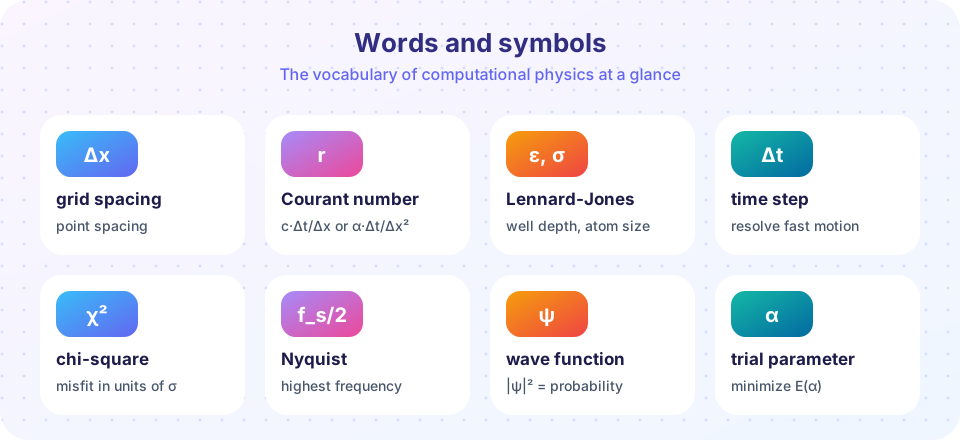
Courant number r |
Dimensionless step ratio: cΔt/Δx (wave) or αΔt/Δx² (heat) |
| Crank-Nicolson | Implicit scheme averaging old and new time levels; stable for any r |
| FTCS | Forward in Time, Centred in Space; explicit, needs r ≤ 1/2 for heat |
| Grid / mesh | The set of points where the solution is stored |
| Leapfrog | Central-in-time scheme for the wave equation, uses two time levels |
| Relaxation | Iterating a local averaging rule until values stop changing |
| SOR | Successive over-relaxation, with factor 1 < ω < 2 |
| Stencil | The pattern of neighbors used to update one point |
Molecular dynamics (chapter 6)
| Term | Meaning |
|---|---|
Cut-off r_c |
Distance beyond which pair forces are ignored |
| Equilibration | Initial period discarded so the system forgets its artificial start |
| Lennard-Jones potential | 4ε[(σ/r)¹² − (σ/r)⁶] |
| Minimum image | Use the nearest periodic copy of each neighbor |
| NVE / NVT | Constant number, volume and energy / temperature |
| Periodic boundaries | The box is surrounded by copies of itself |
Radial distribution g(r) |
Pair density at distance r relative to an ideal gas |
| Reduced units | σ = ε = m = k_B = 1 |
| Symplectic | Integrator that keeps the energy error bounded |
| Velocity Verlet | Kick-drift-kick integrator, second order |
Quantum simulation (chapter 7)
| Term | Meaning |
|---|---|
| Eigenstate | State with sharp energy: Hψ = Eψ |
Hamiltonian H |
The energy operator −½ d²/dx² + V (natural units) |
| Local energy | E_L = Hψ/ψ |
| Natural units | ħ = m = 1 |
| Split-step method | Half potential step, kinetic step in Fourier space, half potential step |
Transmission T |
Probability that a particle passes a barrier |
| Tunneling | Passing through a region where E < V |
| Unitary | Preserves the norm of ψ |
| Variational principle | ⟨H⟩ ≥ E₀ for any normalized trial state |
| Wave packet | Localized superposition of momenta |
Data analysis (chapter 8)
| Term | Meaning |
|---|---|
| Aliasing | A frequency above Nyquist appears falsely at a lower one |
| Bootstrap | Uncertainty from refitting resampled data |
χ² |
Σ((y − f)/σ)², the misfit in units of the uncertainty |
| Degrees of freedom | Points minus fitted parameters |
| Leakage | Peak energy spread across bins by an abrupt record end |
| Nyquist frequency | f_s/2, the highest frequency the samples can show |
| Residual | Data minus model |
| Systematic error | A bias that does not average away |
| Window function | Smooth taper applied before an FFT |
Symbols and units
| Symbol | Quantity | SI unit |
|---|---|---|
Δx, Δt |
grid spacing, time step | m, s |
α |
thermal diffusivity | m²/s |
c |
wave speed | m/s |
ε, σ |
LJ well depth, atom size | J, m |
k_B |
Boltzmann constant | J/K |
ħ |
reduced Planck constant | J·s |
f_s, Δf |
sampling rate, frequency resolution | Hz |
Try it
Flashcards: click a card to flip it, then press Next. The deck is a quick drill of ten terms from this glossary.
The constants most simulations need are available in SciPy. This program prints them with their units and converts a few common energy scales.
Press Run (or Ctrl + Enter) to see the result here.
Program input · what you'd type while the program runs
Type the answers before you press Run, one per line. Each time the program reads a line (with input()), it gets the next line from this box.
Check your understanding
Quick check · 4 questions
of 4 answered You scored / 4 · perfect!
-
1. What does the Courant number r = cΔt/Δx measure?
c·Δt is the distance travelled per step; dividing by Δx counts cells. -
2. What is the Nyquist frequency?
The highest representable frequency is f_s/2. -
3. In natural units with ħ = m = 1, the Hamiltonian is...
The kinetic term is −ħ²/(2m) d²/dx², which becomes −½ d²/dx². -
4. A systematic error is one that...
A bias remains no matter how many samples you take.
Summary
- Learn the symbols together with their units; most formula mistakes are unit mistakes.
- Key rules to memorize:
r ≤ 1/2(heat FTCS),r ≤ 1(wave),Δf = 1/T,f_max = f_s/2,⟨H⟩ ≥ E₀. scipy.constantsgives you the constants; convert to reduced or natural units at the start and back at the end.
Next: One-page cheat sheet
Track your progress
Create a free account to tick off lessons and pick up where you left off on any device.
of Computational Physics lessons completed