


















Lesson 47 of 47 · Projects and Practice
Where to go next
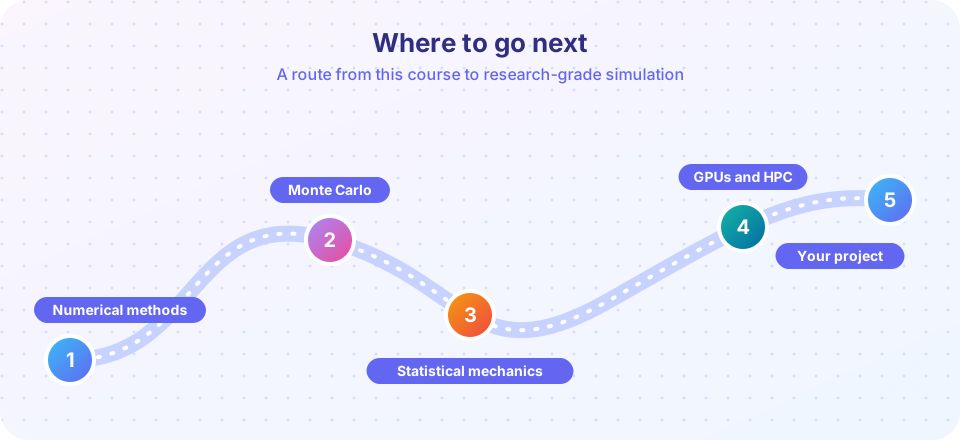
A roadmap from this course to research-grade simulation: numerical methods, Monte Carlo, statistical mechanics, GPUs and your own project, with a scaling calculator.
You can now solve the classic partial differential equations on a grid, run a molecular dynamics simulation, compute quantum energy levels and tunneling, and analyze the output with fits and spectra. That is a real toolkit. This final lesson shows how to deepen it: which topics to study next, how the tracks on this site connect, and how to think about scaling a simulation from a toy to something that tackles research-sized problems.
What you will learn
- Where each topic of this course leads.
- Which tracks on this site continue the story.
- How the cost of a simulation grows with its size.
- How to choose and scope a first project of your own.
Key terms
Scaling: how run time or memory grows with problem size N.
Vectorization: expressing loops as whole-array operations so optimized libraries do the work.
Sparse matrix: a matrix stored by its few non-zero entries, which makes big PDE problems feasible.
Parallelism: splitting work across cores, machines or GPU threads.
Reproducibility: someone else can rerun your code and get your numbers.
Where each topic leads
- Differential equations and numerical methods. Adaptive step sizes, stiff problems, implicit and multi-step integrators, finite elements and spectral methods. See Numerical Methods and Differential Equations, and for the linear algebra behind every solver, Linear Algebra.
- Monte Carlo and statistics. Sampling, importance sampling, the Metropolis algorithm for equilibrium systems and error analysis of correlated data. See Monte Carlo Simulation and Statistics and Probability.
- Statistical mechanics. The theory that tells you what molecular dynamics and Monte Carlo are sampling: ensembles, free energy, phase transitions. See Statistical Mechanics.
- Quantum mechanics. More particles, more dimensions, density functional theory and quantum Monte Carlo. See Quantum Mechanics and Advanced Quantum Mechanics.
- Classical dynamics. Lagrangian and Hamiltonian methods lead to better integrators. See Classical Mechanics: Lagrangian and, for continuum flows, Fluid Dynamics.
- Solids and materials. Molecular dynamics and quantum simulation meet in Condensed Matter Physics.
- Tools. Faster arrays and plots with NumPy, SciPy and Matplotlib; compiled speed with Julia or Fortran; GPUs with CUDA.
How cost grows
Almost every method in this course has a characteristic cost in the number of unknowns N:
- Explicit grid updates (heat, wave):
Nper step, but the stability limit makes the number of steps grow when you refine the grid. - Pair forces without tricks:
N²per step; with cell lists or neighbor lists: aboutN. - FFT:
N log N. - Dense matrix diagonalization:
N³; tridiagonal: aboutNfor a few eigenvalues; sparse iterative methods: in between. - Relaxation for the Laplace equation: Jacobi needs about
N²sweeps (for anN × Ngrid); optimal SOR needs aboutN.
Knowing these scalings tells you in advance whether doubling the system is feasible, and where optimizing pays off.
Choosing a first project
A good first project has three properties: a question you are curious about, a known limit to test against, and a scope you can finish in a month. Some examples that reuse this course: how does the transmission through a double barrier depend on the spacing (resonant tunneling); how does the diffusion constant of a Lennard-Jones liquid change with temperature (from the mean squared displacement); how does a plucked string with a stiff term sound (wave equation plus a fourth-derivative term, analyzed with the FFT).
Common misconceptions
- "I need a supercomputer to do real work." Most published methods papers start with a laptop-sized prototype.
- "Optimize first." Get a correct, tested, slow program first; measure; then optimize the part that matters.
- "A simulation is a replacement for theory." It answers specific questions; theory and simulation test each other.
- "Results do not need to be reproducible if the plot is pretty." Keep your code, random seeds, parameters and versions.
Try it
A scaling calculator: it compares operation counts for several methods as N grows and converts them to rough run times at one billion simple operations per second. It is a model of cost, not a benchmark.
Press Run (or Ctrl + Enter) to see the result here.
Program input · what you'd type while the program runs
Type the answers before you press Run, one per line. Each time the program reads a line (with input()), it gets the next line from this box.
Vectorization is the first speed-up you will use in practice. The same sum is computed with a Python loop and with a single NumPy call. The program measures both and prints their ratio.
Press Run (or Ctrl + Enter) to see the result here.
Program input · what you'd type while the program runs
Type the answers before you press Run, one per line. Each time the program reads a line (with input()), it gets the next line from this box.
Check your understanding
Quick check · 4 questions
of 4 answered You scored / 4 · perfect!
-
1. A pair-force calculation without neighbor lists scales like...
There are N(N−1)/2 pairs. -
2. Which topic explains what molecular dynamics and Monte Carlo are sampling?
Ensembles, partition functions and free energy come from statistical mechanics. -
3. What is a good first project?
A test against a known limit and a finite scope are the best protection against both bugs and burnout. -
4. Why vectorize code?
NumPy executes the loop in C, avoiding Python's per-item overhead.
Summary
- This course leads to numerical methods, Monte Carlo, statistical mechanics, quantum many-body methods and high-performance computing.
- Know the scaling of each method to predict what is feasible.
- Build a correct, tested prototype first; optimize what you measure to be slow.
- Choose a first project with a known test case and a one-month scope, and keep it reproducible.
Back to the course: Computational Physics
Track your progress
Create a free account to tick off lessons and pick up where you left off on any device.
of Computational Physics lessons completed