


















Lesson 29 of 47 · Molecular Dynamics
Forces and boundaries: Lennard-Jones and the minimum image
Compute Lennard-Jones forces in Python, apply a cut-off, and use periodic boundaries with the minimum image convention to simulate a bulk fluid.
Two neutral atoms attract each other when they are a little apart and repel strongly when they get too close. The attraction comes from fluctuating electric charge (the London dispersion force); the repulsion comes from overlapping electron clouds and the Pauli principle. In 1924, John Lennard-Jones proposed a simple formula that captures both. It is still the standard model for noble gases and the first potential every simulator learns.
What you will learn
- The Lennard-Jones potential, its two parameters and the position of its minimum.
- How to get the force from the potential, and how to write it without square roots.
- Why we cut the potential off and how to shift it.
- How periodic boundaries and the minimum image convention work in code.
Key terms
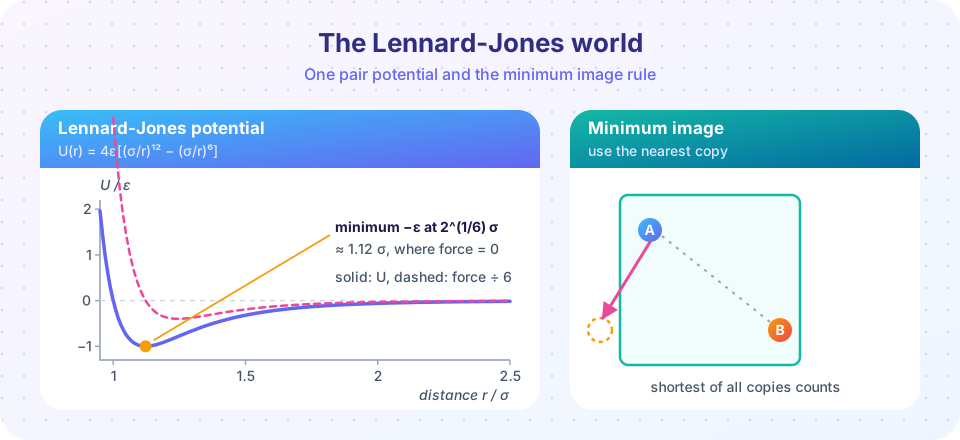
Lennard-Jones potential: U(r) = 4ε[(σ/r)¹² − (σ/r)⁶].
σ (sigma): the distance at which U = 0, roughly the atom's diameter.
ε (epsilon): the depth of the potential well.
Cut-off radius (r_c): beyond this distance the pair interaction is ignored; 2.5 σ is a common choice.
Minimum image convention: each atom interacts only with the nearest periodic copy of every other atom.
The potential and the force
U(r) = 4ε [ (σ/r)¹² − (σ/r)⁶ ]
The r⁻¹² term is a steep repulsive wall. It is chosen for computational convenience (it is the square of the other term) and is not derived from theory. The r⁻⁶ term is the physical long-range attraction. Setting dU/dr = 0 gives the minimum at
r_min = 2^(1/6) σ ≈ 1.1225 σ, U(r_min) = −ε
The force along the line between the atoms is F(r) = −dU/dr:
F(r) = (24ε / r) [ 2 (σ/r)¹² − (σ/r)⁶ ]
Positive means repulsive, negative attractive. To get the force vector on atom i due to atom j, multiply F/r by the displacement r_i − r_j. Notice the trick: compute everything from r², and you never need a square root, which is the cheapest way to program it:
inv6 = 1 / r2**3
F_over_r = 24 * (2 * inv6**2 - inv6) / r2
force_on_i = F_over_r * (r_i - r_j)
By Newton's third law force_on_j = −force_on_i.
Cutting off the potential
At r = 2.5σ the potential is only about −0.016ε, around 1.6 percent of the well depth. Pairs further apart barely matter, but computing them costs time. So we ignore all pairs beyond a cut-off r_c. This introduces a small jump in the energy where the potential suddenly drops to zero. To avoid spurious energy changes when a pair crosses r_c, shift the potential: use U(r) − U(r_c) inside the cut-off. The forces are not changed by a constant shift.
Periodic boundaries
A simulation box of a few hundred atoms has most atoms close to a wall; the results would describe a tiny droplet, not a liquid. The standard remedy is to surround the box by copies of itself in every direction. When an atom leaves through the right face, it re-enters through the left face. Two things follow:
- Wrapping positions:
pos = pos % Lkeeps every coordinate in[0, L). - Minimum image: the distance between atoms is measured to the nearest copy:
d = d − L · round(d / L). Each component ofdthen lies in[−L/2, L/2].
The minimum image convention only works if the cut-off is at most L/2; otherwise an atom could interact with two copies of the same neighbor.
Common misconceptions
- "Periodic boundaries make the system a ring or torus in real space." The atoms live in ordinary space; the torus is just a bookkeeping trick that removes walls.
- "The r⁻¹² term is exact physics." It is a convenient model. Real repulsion is closer to exponential.
- "A bigger cut-off is always better." Past about 2.5 σ the gain is tiny while the cost grows with the cube of the radius in 3D.
- "The box can be any size." If
Lis smaller than twice the cut-off, the minimum image rule breaks.
Try it
First check the mathematics of the potential numerically: the minimum is at 2^(1/6), the depth is −1, the force vanishes there and U(σ) = 0.
Press Run (or Ctrl + Enter) to see the result here.
Program input · what you'd type while the program runs
Type the answers before you press Run, one per line. Each time the program reads a line (with input()), it gets the next line from this box.
Next, an interactive picture. Move the sliders to change σ and ε in real argon units (nanometers and kelvin) and watch the well move. This is a visualization of the formula, not a simulation.
Finally, the periodic box. We place two atoms close to opposite walls and compare the direct distance with the minimum-image distance. Then we check that the force on each atom is equal and opposite.
Press Run (or Ctrl + Enter) to see the result here.
Program input · what you'd type while the program runs
Type the answers before you press Run, one per line. Each time the program reads a line (with input()), it gets the next line from this box.
Check your understanding
Quick check · 5 questions
of 5 answered You scored / 5 · perfect!
-
1. Where is the minimum of the Lennard-Jones potential?
Setting dU/dr = 0 gives r = 2^(1/6) σ ≈ 1.12 σ, where U = −ε. -
2. Why is the force usually computed from r² and not r?
Both the potential and F/r depend only on r², so no square root is needed. -
3. A box has side L = 8σ. What is the largest allowed cut-off for the minimum image convention?
The cut-off must not exceed L/2 = 4σ. -
4. Atoms at x = 0.5 and x = 9.2 in a periodic box of length 10. What is the minimum-image separation along x?
The direct difference is −8.7; adding L = 10 gives 1.3. -
5. Why shift the potential at the cut-off?
Without a shift, the total energy jumps whenever a pair moves across the cut-off distance.
Summary
U(r) = 4ε[(σ/r)¹² − (σ/r)⁶]: minimum−εatr = 2^(1/6)σ; the force isF = (24ε/r)[2(σ/r)¹² − (σ/r)⁶].- Compute from
r²to avoid square roots; apply Newton's third law to save half the work. - Cut the potential at about 2.5 σ and shift it so the energy is continuous.
- Periodic boundaries remove walls; the minimum image rule
d − L·round(d/L)picks the nearest copy, valid forr_c ≤ L/2.
Track your progress
Create a free account to tick off lessons and pick up where you left off on any device.
of Computational Physics lessons completed