


















Lesson 37 of 47 · Quantum Simulations
Chapter 7 review: quantum simulations
One-picture recap of grid eigenvalue solvers, split-step wave packet evolution and the variational principle, with a recap table and a ten-question quiz.
This chapter gave you three complementary tools for one-dimensional quantum problems. One finds the stationary levels, one follows a wave packet in time, and one gives a guaranteed upper bound on the ground-state energy. Together with natural units they cover a surprising share of what you will meet in quantum simulation.
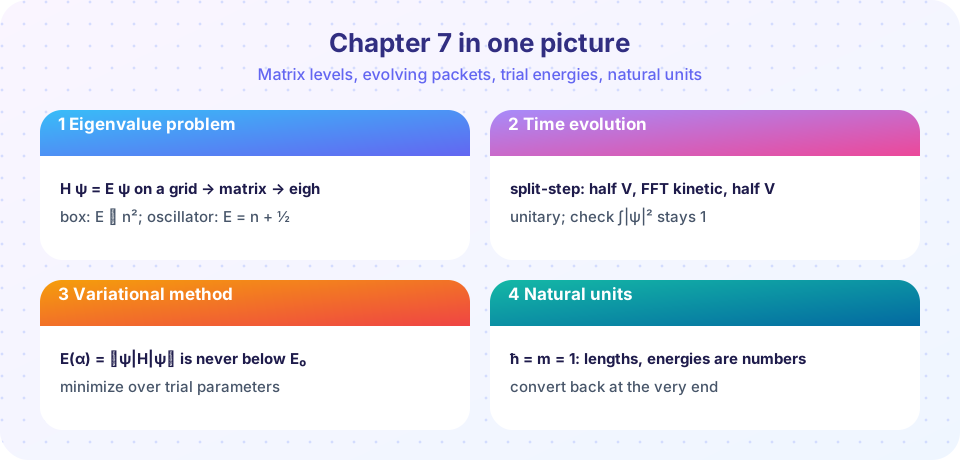
Recap table
| Tool | Equation | Key facts and checks |
|---|---|---|
| Grid eigenvalues | Hψ = Eψ, tridiagonal H |
box E = n²π²/2; oscillator E = n + ½; error ∝ Δx² |
| Split-step Fourier | ψ ← e^{−iVΔt/2} · FFT⁻¹ e^{−ik²Δt/2} FFT · e^{−iVΔt/2} ψ |
unitary; keep the box large; second order in Δt |
| Barrier tunneling | T = 1/(1 + V₀² sinh²(κa)/(4E(V₀ − E))) |
falls exponentially with a; packet needs momentum average |
| Variational | E(α) = ⟨H⟩ ≥ E₀ |
quartic: 0.681 vs 0.668; hydrogen Gaussian: −0.424 vs −0.5 |
| Natural units | ħ = m = 1 |
H = −½ d²/dx² + V; convert at the end |
Choosing the right tool
- "What are the levels?" Build the matrix and call
eigh_tridiagonal. - "What happens over time?" Split-step Fourier.
- "I cannot solve it and just need a good energy." Variational, then compare with a matrix result if the problem is one-dimensional.
- "Is my code right?" Test against box, oscillator, free-packet spreading and the exact barrier formula.
Check your understanding
Quick check · 10 questions
of 10 answered You scored / 10 · perfect!
-
1. The ground-state energy of a particle in a box of length 1 (ħ = m = 1) is...
E₁ = π²/2 ≈ 4.9348. -
2. When Δx is halved, the error of the matrix method falls by about
The scheme is second order: error ∝ Δx². -
3. In the split-step method, the potential factor is applied for...
The symmetric arrangement V/2, T, V/2 gives second-order accuracy. -
4. What does a wave-function norm that drifts away from 1 during a split-step run indicate?
All factors are phases; the norm should stay at 1 to machine precision. -
5. A trial energy is below the exact ground-state energy. Then...
The variational principle forbids ⟨H⟩ < E₀ for a legitimate trial state. -
6. Which change makes tunneling much less likely?
T falls roughly exponentially with barrier width. -
7. A packet of width σ has momentum spread...
For a Gaussian packet, σ_x σ_k = 1/2. -
8. Why divide eigenvectors by √Δx?
eigh returns vectors with unit sum of squares; dividing by √Δx gives the normalized wave function. -
9. At α = 1/2 in the harmonic oscillator VMC example, the local energy...
The trial function is the exact ground state, so E_L = E₀ everywhere. -
10. The mean energy of a packet with k₀ = 3 in natural units is about...
E ≈ k₀²/2 = 4.5 (plus a small contribution from the packet's finite width).
Summary
- Matrix diagonalization finds levels; split-step evolves packets; the variational principle bounds the ground state.
- Use natural units and test every code on known cases.
- Tunneling probability falls roughly exponentially with barrier width and rises with energy.
- A well-chosen grid (the barrier must be an exact number of cells) matters as much as the algorithm.
Track your progress
Create a free account to tick off lessons and pick up where you left off on any device.
of Computational Physics lessons completed