


















Lesson 46 of 47 · Projects and Practice
One-page cheat sheet
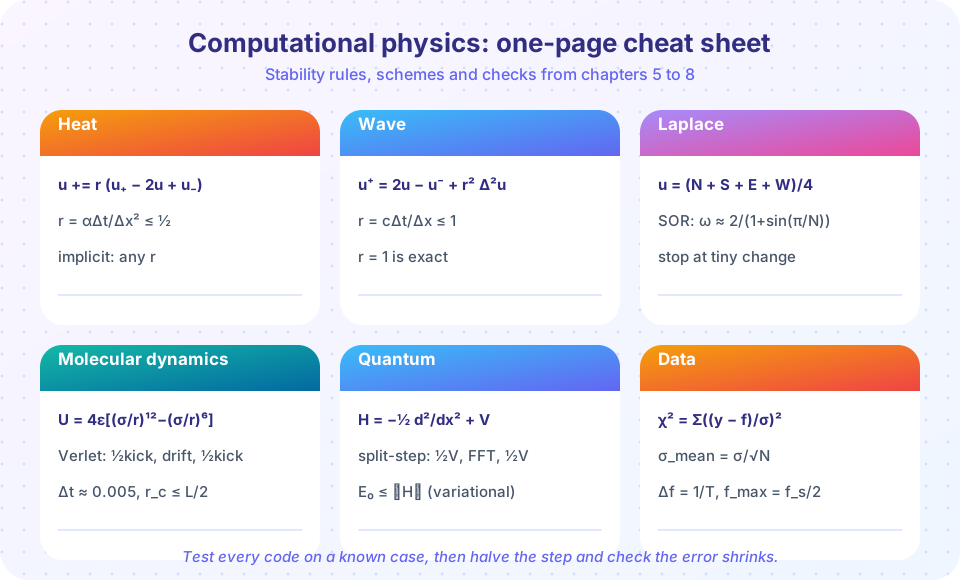
A one-page recap with a poster of the key schemes, stability rules and checks, plus a tested mini-library of reference implementations in Python.
This page is the recap you keep open while coding: six panels with the formulas that matter, then a small library of reference implementations that you can copy into your own programs. Every function in the library is tested against a known answer in the same editor, so you can trust it as a starting point.
What you will learn
- The one formula or rule to remember for each method.
- Which known case tests each method.
- How to organize the methods as small, reusable functions.
Key terms
Scheme: a rule that turns an equation into a computable update.
Stability limit: the largest step for which errors do not grow.
Known case: a situation with an exact answer used to test the code.
Reference implementation: the simplest correct version of a method, kept as a baseline.
Regression test: a check that a function still returns the right answer after you change the code.
The six rules
- Heat (FTCS):
u[j] += r (u[j+1] − 2u[j] + u[j−1]),r = αΔt/Δx² ≤ 1/2. Test:sin(πx)decays asexp(−π²αt). Implicit schemes remove the limit. - Wave (leapfrog):
u⁺ = 2u − u⁻ + r² Δ²u,r = cΔt/Δx ≤ 1. Test: a pulse splits into two half-height pulses;r = 1is exact. - Laplace: each interior value is the average of its four neighbors; SOR uses
ω ≈ 2/(1 + sin(π/(N−1))). Test: center of a square with one edge at 1 is 0.25. - Molecular dynamics:
U = 4ε[(σ/r)¹² − (σ/r)⁶], velocity Verlet,Δt ≈ 0.005,r_c ≤ L/2. Test: energy fluctuation scales likeΔt²and does not drift. - Quantum:
H = −½ d²/dx² + V. Eigenvalues from a tridiagonal matrix; time evolution by split-step Fourier;⟨H⟩ ≥ E₀. Tests: boxE = n²π²/2, oscillatorE = n + ½, free-packet widthσ√(1 + (t/2σ²)²). - Data:
χ² = Σ((y − f)/σ)²,χ²/dof ≈ 1;σ_mean = σ/√N;Δf = 1/T,f_max = f_s/2.
A final habit: halve and compare
For any scheme with a step h, run with h and h/2 and compute the observed order p = log₂(e(h)/e(h/2)). If p does not match the theory (2 for the central differences used here), something is wrong, even when the pictures look fine.
Common misconceptions
- "A cheat sheet replaces understanding." The formulas are a memory aid. If you cannot explain why
r ≤ 1/2, go back to the lesson. - "The stability limit is a rule of thumb." It is a mathematical condition; crossing it makes the error grow without bound.
- "Reference implementations are production code." They are baselines for clarity. Real codes add neighbor lists, parallelism and sparse solvers.
Try it
A mini-library of reference implementations with one test per function. If everything is right, the program ends with "all checks passed".
Press Run (or Ctrl + Enter) to see the result here.
Program input · what you'd type while the program runs
Type the answers before you press Run, one per line. Each time the program reads a line (with input()), it gets the next line from this box.
Check your understanding
Quick check · 4 questions
of 4 answered You scored / 4 · perfect!
-
1. Which stability rule applies to the explicit FTCS heat scheme?
FTCS for the heat equation needs r = αΔt/Δx² at most 1/2. -
2. What is the cheapest test of a Laplace solver on a square with one edge at 1?
By symmetry the four rotated solutions add to a constant 1, so each contributes 0.25 at the center. -
3. You halve the step and the error falls by 8. The observed order is...
p = log₂(8) = 3. -
4. What should the norm of ψ stay at during split-step evolution?
The method is unitary, so the norm is conserved.
Summary
- One rule per method:
r ≤ 1/2(heat),r ≤ 1(wave), average of neighbors (Laplace), Verlet withΔt ≈ 0.005(MD), unitary split-step (quantum),χ²/dof ≈ 1(data). - Test every function on a known case and compare
hwithh/2. - Keep reference implementations small; grow them only when a test demands it.
Next: Where to go next
Track your progress
Create a free account to tick off lessons and pick up where you left off on any device.
of Computational Physics lessons completed