


















Lesson 10 of 47 · Numerical Foundations
Chapter 2 Review: Numerical Foundations
Review chapter 2: floating point and round-off, derivatives and integrals on a grid, root finding and linear systems, with a recap table and a ten-question quiz.
This chapter built your numerical instincts. You learned that numbers carry about 16 digits, that calculus on a grid has measurable error, and that equations are solved by iteration. Use this page to consolidate before time stepping begins in chapter 3.
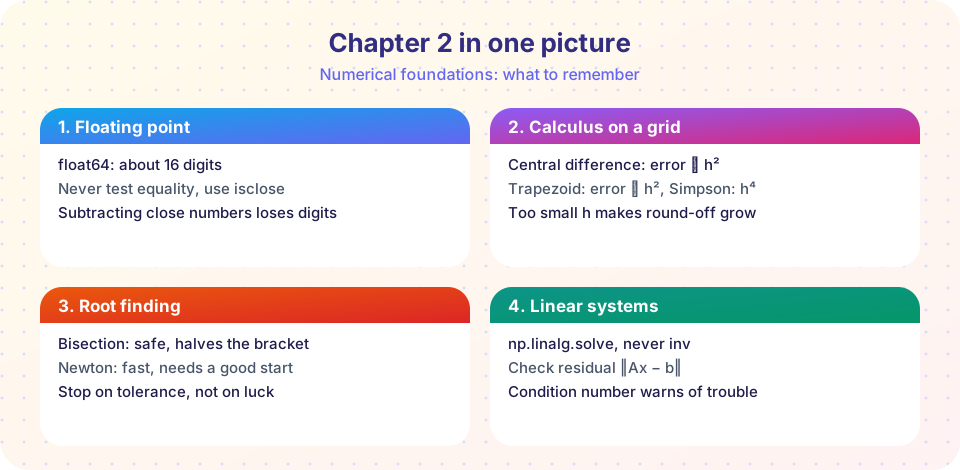
What you will review
- Floating point facts and the cancellation trap.
- Orders of accuracy and the error floor.
- Bisection, Newton and the condition number.
Recap table
| Topic | Key facts | Typical mistake |
|---|---|---|
| Floating point | 53 bits, ε ≈ 2.2e-16, gaps grow with size | Comparing floats with == |
| Derivatives and integrals | Central difference and trapezoid are order 2, Simpson order 4 | Making h smaller than the round-off sweet spot |
| Roots | Bisection linear, Newton quadratic, brentq robust |
Starting Newton where f′ ≈ 0 |
| Linear systems | solve, residual, cond(A) |
Using inv(A) @ b |
A convergence study
The best habit from this chapter is the convergence study: run the same computation with several step sizes, tabulate the error, and fit the slope on a log-log plot. The slope is the order of the method. If it does not match theory, either the code has a bug or the function is not smooth enough.
Press Run (or Ctrl + Enter) to see the result here.
Program input · what you'd type while the program runs
Type the answers before you press Run, one per line. Each time the program reads a line (with input()), it gets the next line from this box.
Chapter review quiz
Quick check · 10 questions
of 10 answered You scored / 10 · perfect!
-
1. Which number is closest to machine epsilon for float64?
Double precision relative spacing near 1 is 2^-52. -
2. Which rewrite avoids cancellation in 1 - cos(x) for small x?
The identity 1 - cos x = 2 sin^2(x/2) involves no subtraction of nearly equal numbers. -
3. The forward difference error is proportional to
It is a first order method; the leading Taylor error is -h f''(x)/2. -
4. You halve h and an integral error drops from 1.6e-3 to 1.0e-4. The order is about
The ratio is 16 = 2^4, so the order is 4. -
5. The total error of a finite-difference derivative as a function of h typically
Truncation falls with h, round-off rises; the sum has a minimum. -
6. Which method needs a bracket with a sign change?
Bisection relies on the intermediate value theorem. -
7. Newton's method fails most likely when
A nearly flat tangent sends the next guess far away. -
8. Why is inv(A) @ b discouraged?
Factorization-based solvers are both cheaper and more accurate. -
9. A condition number of 1e8 means about how many double-precision digits remain in x?
You lose roughly log10 of the condition number, 8 digits, leaving about 8. -
10. What does a tiny residual guarantee for an ill-conditioned system?
Ill-conditioned systems can have small residuals and large solution errors.
Summary
- Floating point gives 16 digits; subtract carefully and compare with tolerances.
- Measure the order of a method with a convergence study on a log-log plot.
- Pick a root finder for safety (bisection,
brentq) or speed (Newton). - Solve, do not invert, and read the condition number.
Track your progress
Create a free account to tick off lessons and pick up where you left off on any device.
of Computational Physics lessons completed