


















Lesson 16 of 47 · Ordinary Differential Equations
Chapter 3 Review: Ordinary Differential Equations
Review chapter 3: initial value problems, Euler, Runge-Kutta, symplectic leapfrog and solve_ivp, with a method comparison table and a ten-question quiz.
You now know the standard time-stepping methods of computational physics and, more importantly, how to choose between them. This review collects the methods in one picture, compares them side by side, and tests your understanding with a long quiz.
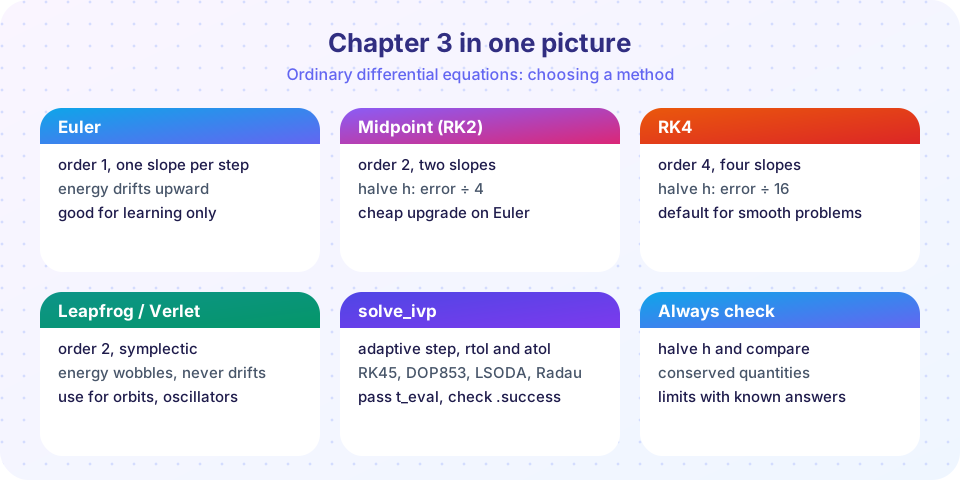
What you will review
- First-order systems and initial value problems.
- Order, cost and stability of Euler, midpoint, RK4 and leapfrog.
- Using
solve_ivp, events and tolerances.
Recap table
| Method | Order | Evaluations per step | Energy behavior | Use it for |
|---|---|---|---|---|
| Explicit Euler | 1 | 1 | Grows on oscillators | Learning, quick sketches |
| Semi-implicit Euler | 1 | 1 | Bounded (symplectic) | Simple long mechanical runs |
| Midpoint (RK2) | 2 | 2 | Slow drift | Cheap upgrade over Euler |
| RK4 | 4 | 4 | Slow drift | Smooth, short-to-medium runs |
| Leapfrog / Verlet | 2 | 1 (reused) | Bounded (symplectic) | Orbits, oscillators, molecular dynamics |
solve_ivp RK45 |
4(5) | 6 | Drifts like RK | General purpose with error control |
solve_ivp LSODA, Radau |
varies | varies | Drifts | Stiff problems |
Lessons: overview, Euler, Runge-Kutta, oscillators and energy, projectile with drag.
A decision guide
- Do you need long-term energy behavior (planets, vibrating atoms, many oscillations)? Use leapfrog/Verlet with a fixed step.
- Do you need high accuracy over a modest time with smooth forces? Use RK4 or
solve_ivpwith tight tolerances. - Is the system stiff (fast and slow time scales mixed, or a very small step is forced by stability)? Use an implicit method:
solve_ivp(..., method="Radau")or"LSODA". - Do you need to stop at an event (landing, collision)? Use
solve_ivpevents. - Whatever you chose: check a known limit, a conserved quantity and a halved step.
Putting it together: the pendulum with all methods
The final example runs a pendulum for 20 time units with Euler, RK4, leapfrog and solve_ivp, then compares each method's energy drift on one plot.
Press Run (or Ctrl + Enter) to see the result here.
Program input · what you'd type while the program runs
Type the answers before you press Run, one per line. Each time the program reads a line (with input()), it gets the next line from this box.
Over this run RK4 is still the most accurate of the fixed-step methods, but its error grows steadily with time, while the leapfrog error stays inside a band no matter how long you run. Choose by the length of the run and by what must be conserved.
Chapter review quiz
Quick check · 10 questions
of 10 answered You scored / 10 · perfect!
-
1. A mass-spring system is written x'' = -(k/m) x. In first-order form the state is
Adding v = x' as an unknown turns one second-order equation into two first-order ones. -
2. Which method has global error proportional to h?
Euler is first order. -
3. How many times does the error shrink when h is halved for a 4th-order method?
2^4 = 16. -
4. For dy/dt = -5y, Euler is stable if
Stability needs |1 - 5h| < 1, so h < 2/5 = 0.4. -
5. Which pair of properties best describes leapfrog?
Leapfrog is second order and symplectic, hence bounded energy error. -
6. A simulated planet's orbit slowly spirals outward over many orbits. A likely cause is
A conservative system should not gain energy; the integrator is to blame. -
7. What does an event with terminal = True do in solve_ivp?
That is how you stop at ground impact or a collision. -
8. Setting the drag coefficient to zero in a projectile code should reproduce
The no-drag limit is the standard verification test. -
9. Why is RK4 compared per function evaluation and not per step?
The cost of expensive forces is the number of evaluations. -
10. A stiff problem is best attacked with
Implicit methods stay stable at steps far larger than explicit methods allow.
Summary
- Rewrite higher-order ODEs as first-order systems, then choose a stepper.
- Euler teaches the ideas; RK4 delivers accuracy; leapfrog and Verlet protect energy;
solve_ivpgives adaptive control and events. - Always verify: known limit, conserved quantity, halved step.
- Chapter 4 changes the question: what if the system, or the method, is random?
Track your progress
Create a free account to tick off lessons and pick up where you left off on any device.
of Computational Physics lessons completed