


















Lesson 27 of 47 · Partial Differential Equations
Chapter 5 review: partial differential equations
A one-picture recap of the heat, wave and Laplace solvers, their stability rules, and a ten-question quiz covering the whole chapter.
You can now solve the three model PDEs on a grid. This review ties them together in one picture and one table, and then tests the details that cause the most mistakes: stability limits, boundary handling and choice of method.
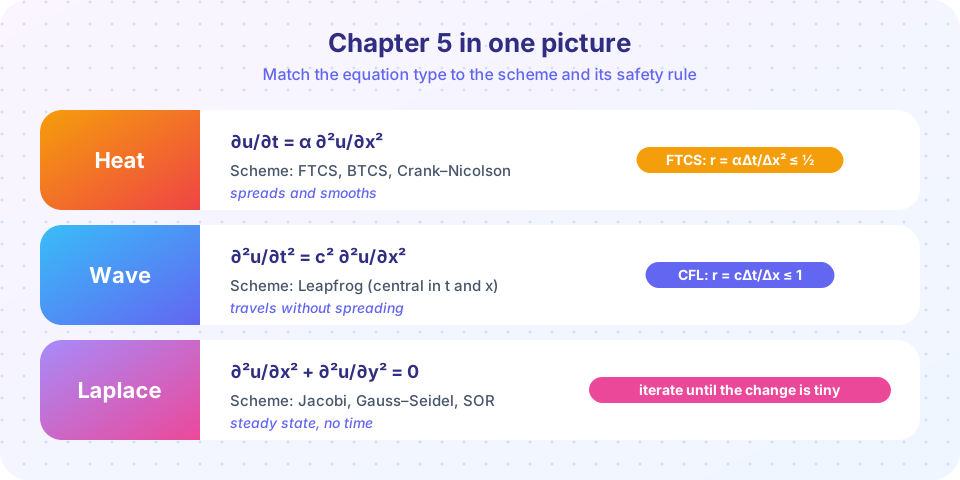
Recap table
| Equation | Type | Scheme | Rule to remember |
|---|---|---|---|
u_t = α u_xx |
parabolic | FTCS (explicit) | r = αΔt/Δx² ≤ 1/2 |
u_t = α u_xx |
parabolic | Crank-Nicolson (implicit) | stable for any r; solve a tridiagonal system |
u_tt = c² u_xx |
hyperbolic | leapfrog | r = cΔt/Δx ≤ 1; r = 1 is exact |
∇²u = 0 |
elliptic | Jacobi, Gauss-Seidel, SOR | iterate to a tolerance; ω_opt = 2/(1 + sin(π/(N−1))) |
Habits worth keeping
- Test on a known answer first (decaying sine, d'Alembert pulse, symmetry value 0.25).
- Check stability before accuracy. A solver that blows up has no accuracy to discuss.
- Refine and compare. Halve the spacing and see whether the error falls by the expected factor.
- Match the method to the physics. Information that travels at a finite speed needs a scheme that respects it.
Check your understanding
Quick check · 10 questions
of 10 answered You scored / 10 · perfect!
-
1. You use FTCS with α = 1e-4 m²/s and Δx = 0.01 m. What is the largest stable Δt?
Δt ≤ Δx²/(2α) = 1e-4/(2e-4) = 0.5 s. -
2. Which scheme is exact on the grid for the 1D wave equation when r = 1?
At r = 1 the leapfrog update reproduces d'Alembert's solution exactly on the grid points. -
3. Which method would you pick for a diffusion problem that must run for a very long physical time?
An implicit method allows large time steps without losing stability. -
4. Halving Δx while keeping FTCS stable makes the work grow by about...
Twice as many points, and Δt must drop by 4, so the work grows by 2 × 4 = 8. -
5. Which statement about the Laplace equation is true?
An elliptic problem is fixed by what happens on the boundary of the region. -
6. Which ω can SOR use and still converge?
SOR converges for 0 < ω < 2; useful values lie between 1 and 2. -
7. A narrow pulse on a coarse grid with r = 0.5 leaves ripples behind it. This is...
Short wavelengths travel slightly slower on the grid; the ripples shrink as you refine it. -
8. What does the CFL condition ensure?
If a wave can move more than one cell per step, the stencil misses information it needs. -
9. The classification B² − 4AC < 0 identifies which type of equation?
A negative discriminant gives an elliptic equation such as Laplace's. -
10. Why is the maximum principle useful for checking a Laplace solver?
Any interior value outside the boundary range reveals a bug.
Summary
- Heat: explicit FTCS needs
r ≤ 1/2; implicit schemes remove this limit. - Wave: leapfrog needs
r ≤ 1; watch for numerical dispersion at coarse resolution. - Laplace: relax until the change is tiny; SOR is the fast classic choice.
- Validate with exact cases and refine to see the error fall.
Track your progress
Create a free account to tick off lessons and pick up where you left off on any device.
of Computational Physics lessons completed