


















Lesson 8 of 47 · Numerical Foundations
Derivatives and Integrals on a Grid
Learn finite-difference derivatives, the trapezoid and Simpson rules, orders of accuracy and the error floor from round-off, with runnable Python examples.
Physics is full of derivatives (velocity, force from energy, field from potential) and integrals (work, charge, probability). A computer sees neither limits nor continuous curves; it sees function values on a grid. This lesson turns the two operations of calculus into simple formulas on grid points and shows how to measure their accuracy.
What you will learn
- Forward, backward and central difference formulas, and their orders of accuracy.
- Where the error comes from, using a Taylor series.
- The trapezoid rule and Simpson's rule.
- Why the derivative error has a floor, and how to find the best step.
Key terms
Finite difference: an approximation of a derivative using function values at nearby points.
Taylor series: f(x+h) = f(x) + h f′(x) + h² f″(x)/2 + h³ f‴(x)/6 + …
Order of accuracy p: the error scales as h^p; halving h divides it by 2^p.
Quadrature: numerical integration.
Derivatives from Taylor series
Start with the Taylor series f(x+h) = f(x) + h f′(x) + h² f″(x)/2 + … and solve for f′(x):
f′(x) = (f(x+h) − f(x))/h − h f″(x)/2 + …
The forward difference (f(x+h) − f(x))/h therefore has a leading error −h f″(x)/2, proportional to h: it is first order.
Write the series also for f(x−h) and subtract the two. The even-power terms cancel:
f(x+h) − f(x−h) = 2h f′(x) + h³ f‴(x)/3 + …
The central difference (f(x+h) − f(x−h)) / (2h) has leading error h² f‴(x)/6, so it is second order. Halving h cuts the error by 4 rather than 2. Its cost is two function values, the same as forward difference with a fresh start point.
| Formula | Expression | Order |
|---|---|---|
| Forward | (f(x+h) − f(x)) / h |
1 |
| Backward | (f(x) − f(x−h)) / h |
1 |
| Central | (f(x+h) − f(x−h)) / (2h) |
2 |
| Second derivative | (f(x+h) − 2f(x) + f(x−h)) / h² |
2 |
Press Run (or Ctrl + Enter) to see the result here.
Program input · what you'd type while the program runs
Type the answers before you press Run, one per line. Each time the program reads a line (with input()), it gets the next line from this box.
Each halving of h divides the forward error by about 2 and the central error by about 4. A ratio near 2^p is the practical way to measure the order of any method.
The error floor
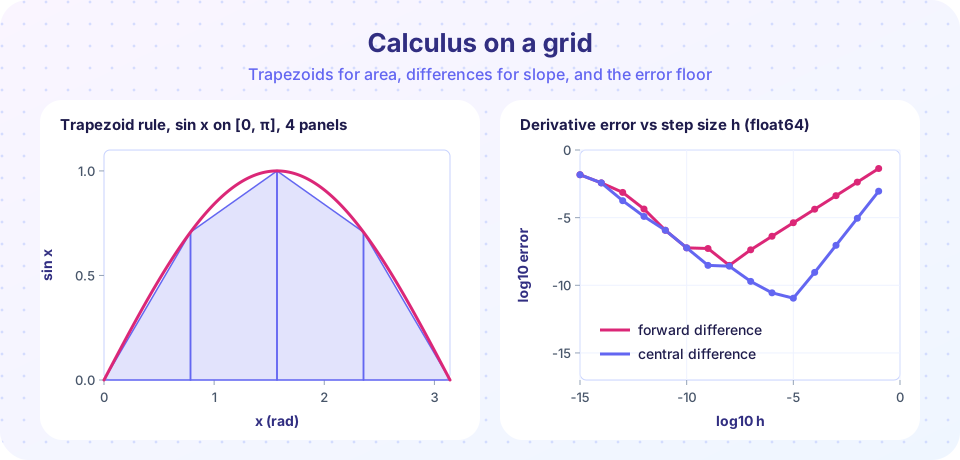
If truncation error shrinks as h falls, why not take h = 1e-15? Because the numerator f(x+h) − f(x) suffers cancellation. Each function value has a rounding error near ε |f|, so the difference has an absolute error near ε and the quotient has an error near ε/h. The total error is roughly
error(h) ≈ C h^p + ε/h.
The first term falls with h, the second rises. For forward difference the minimum is near h ≈ √ε ≈ 1e-8; for central difference near h ≈ ε^(1/3), a few times 1e-6 (the run below finds about 1e-6 for sin). Below those values accuracy gets worse.
Press Run (or Ctrl + Enter) to see the result here.
Program input · what you'd type while the program runs
Type the answers before you press Run, one per line. Each time the program reads a line (with input()), it gets the next line from this box.
Integrals: trapezoids and Simpson
To approximate ∫ f(x) dx from a to b, split the interval into n strips of width h = (b − a)/n. The trapezoid rule replaces each curve piece by a straight line:
T = h [ f₀/2 + f₁ + f₂ + … + f_{n−1} + f_n/2 ]
Its error scales like h² (second order). Simpson's rule fits a parabola through three points. With n even:
S = (h/3) [ f₀ + 4f₁ + 2f₂ + 4f₃ + … + 4f_{n−1} + f_n ]
Simpson's error scales like h⁴ (fourth order), so it is far more accurate for smooth functions at the same cost. For an integral that must be right to many digits, scipy.integrate.quad chooses points adaptively.
Press Run (or Ctrl + Enter) to see the result here.
Program input · what you'd type while the program runs
Type the answers before you press Run, one per line. Each time the program reads a line (with input()), it gets the next line from this box.
Doubling n divides the trapezoid error by 4 and Simpson's by 16. Use these ratios to confirm that your own code achieves the expected order.
Derivatives and integrals of data
When your function is a table of data, use np.gradient(y, x), which applies central differences in the interior and one-sided differences at the ends. For noisy data, differentiating amplifies noise (it divides small differences by h), so smooth first or fit a model. Integration, by contrast, averages noise down, which is why integrating is the safer direction.
Common misconceptions
"Smaller h always gives a better derivative." Round-off error grows like ε/h; there is an optimal step.
"Higher order is always better." Higher-order formulas need smooth functions. For a function with a kink, Simpson's rule is no better than the trapezoid rule near the kink.
"The trapezoid rule is exact for straight lines only." True, and that is exactly what makes it second order: the error comes from the curvature f″.
Check your understanding
Quick check · 5 questions
of 5 answered You scored / 5 · perfect!
-
1. The central difference (f(x+h) - f(x-h)) / (2h) has order
The even Taylor terms cancel, leaving an error proportional to h squared. -
2. You halve h and the error of a method drops by a factor of about 16. The order is
2^p = 16 gives p = 4, the order of Simpson's rule. -
3. Why does the derivative error rise again for very small h?
Cancellation in the numerator is divided by h, so it grows as h shrinks. -
4. Which rule uses parabolas through triples of points?
Simpson's rule fits a quadratic to every pair of strips. -
5. Roughly where is the best step for a forward difference in double precision?
Balancing h against epsilon/h gives h near the square root of epsilon, about 1e-8.
Summary
- Finite differences follow from the Taylor series; central difference is second order, forward only first.
- Measure the order by halving
hand looking at the error ratio. - Derivative error has a floor near
h ≈ ε^(1/(p+1))because of round-off. - Trapezoid is second order, Simpson fourth;
quadis adaptive. - Differentiating noisy data amplifies noise; integrating averages it.
Next: Roots and Linear Systems
Track your progress
Create a free account to tick off lessons and pick up where you left off on any device.
of Computational Physics lessons completed