


















Lesson 33 of 47 · Quantum Simulations
Chapter overview: quantum simulations
A map of numerical quantum mechanics: solving the Schrödinger equation on a grid, evolving wave packets, and using the variational principle, in natural units.
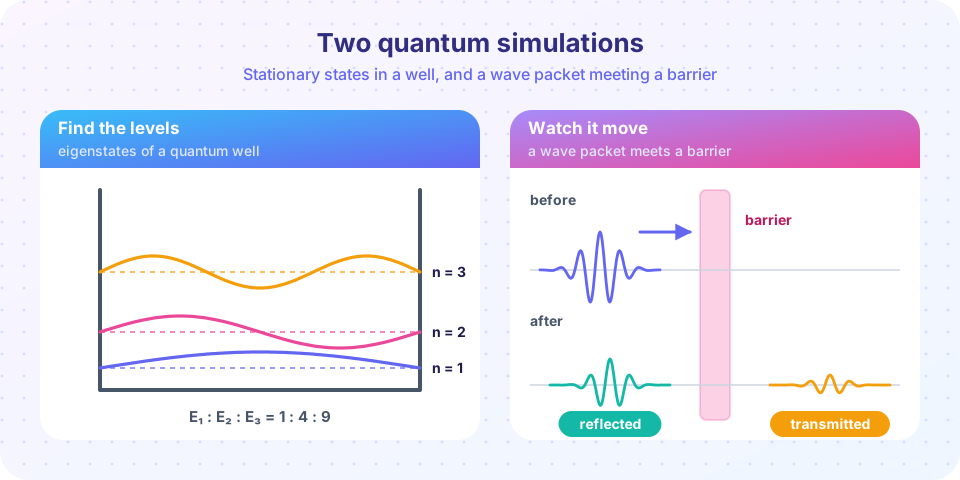
Quantum mechanics replaces trajectories by a wave function ψ(x, t). Its square, |ψ|², is the probability density for finding a particle near x. The equation that governs ψ is the Schrödinger equation, and for a handful of textbook cases it can be solved with pencil and paper. For everything else (a particle in an odd-shaped potential, a collision with a barrier, a molecule) we calculate. This chapter shows three reliable ways to do it, all in one dimension, all in a few lines of NumPy.
What you will learn
- The two forms of the Schrödinger equation and which one to use when.
- Why we work in natural units with
ħ = m = 1. - The three methods of this chapter: matrix diagonalization, split-step propagation and the variational principle.
- What each lesson covers.
Key terms
Wave function ψ: a complex-valued function whose squared magnitude is a probability density.
Hamiltonian H: the energy operator, kinetic plus potential: H = −(ħ²/2m) d²/dx² + V(x).
Eigenstate: a state with a definite energy: Hψ = Eψ.
Wave packet: a localized superposition of many momenta, the quantum picture of a moving particle.
Unitary evolution: time evolution that preserves the total probability, ∫|ψ|² dx = 1.
Two equations, two jobs
The time-independent Schrödinger equation Hψ = Eψ asks: which states have a sharp energy, and what are those energies? On a grid, it becomes a matrix eigenvalue problem and the computer returns the energy levels and shapes directly. This answers "what is the spectrum of this well?".
The time-dependent equation iħ ∂ψ/∂t = Hψ asks: how does a given starting state evolve? We solve it by stepping forward in time. This answers "what happens when the packet reaches the barrier?".
Natural units
Writing ħ, m and the particle charge in every formula is tiresome and error-prone. In natural units we set ħ = m = 1. Then the Hamiltonian is simply H = −½ d²/dx² + V(x), and all quantities are plain numbers. To return to real units at the end, you only need two scales: a length ℓ and an energy ε related by ε = ħ²/(m ℓ²). For an electron and ℓ = 1 Å = 1e-10 m that energy unit is about 7.62 eV.
Method 1: levels
Method 2: motion
Method 3: bounds
Sanity checks
What each lesson covers
- Energy levels from matrices: finite differences, the box, the oscillator and a finite well, with convergence tests.
- Wave packets and tunneling: the split-step Fourier method and a barrier experiment checked against an exact formula.
- The variational method: trial wave functions for an anharmonic oscillator and for hydrogen.
- Chapter 7 review: a one-page picture and ten questions.
Try it
Convert natural units to electron-volts and picometers for an electron. This calculator applies the definitions above.
Press Run (or Ctrl + Enter) to see the result here.
Program input · what you'd type while the program runs
Type the answers before you press Run, one per line. Each time the program reads a line (with input()), it gets the next line from this box.
A first look at a wave function: a Gaussian wave packet is a bump multiplied by a plane wave. We plot its real part and its probability density and check that the density is normalized.
Press Run (or Ctrl + Enter) to see the result here.
Program input · what you'd type while the program runs
Type the answers before you press Run, one per line. Each time the program reads a line (with input()), it gets the next line from this box.
Check your understanding
Quick check · 4 questions
of 4 answered You scored / 4 · perfect!
-
1. What does |ψ(x)|² represent?
The squared magnitude of the wave function is a probability density. -
2. Which equation do you solve to find the energy levels of a well?
Energy eigenstates satisfy Hψ = Eψ. -
3. In natural units with ħ = m = 1, the Hamiltonian is...
The kinetic term −ħ²/(2m) d²/dx² becomes −½ d²/dx². -
4. Unitary time evolution guarantees that...
A unitary operator preserves the norm of ψ.
Summary
- ψ is a complex wave function;
|ψ|²is a probability density and must integrate to 1. - Levels: diagonalize the Hamiltonian matrix. Motion: step
ψin time. Bounds: the variational principle. - Natural units (
ħ = m = 1) turnHinto−½ d²/dx² + V; convert back at the end with a length and an energy scale. - Always test against a case with a known answer.
Track your progress
Create a free account to tick off lessons and pick up where you left off on any device.
of Computational Physics lessons completed