


















Lesson 12 of 47 · Ordinary Differential Equations
Euler's Method
Learn Euler's method for ordinary differential equations: the algorithm, why its global error is first order, how to test it, and when a large step makes it unstable.
Euler's method is the simplest way to solve an ODE numerically, and it is the idea behind every other method in this chapter. Stand at a point, look at the slope, walk a short distance along it, and repeat. It is easy to code in five lines, easy to understand, and not very accurate, which makes it perfect for learning what accuracy and stability mean.
What you will learn
- The Euler update and how to code it for a system of equations.
- Local and global error, and why Euler is first order.
- How to test a solver against a known solution.
- The stability limit for decay problems, and why Euler fails for oscillators.
Key terms
Local truncation error: the error made in one step, assuming the starting value is exact.
Global error: the accumulated error at the final time.
Order: Euler's global error is O(h); halving h halves the error.
Stability: a method is stable for a problem and step size if errors do not grow without bound.
The method
Take dy/dt = f(t, y) with y(t₀) = y₀. Replace the derivative by a forward difference over one step:
(y_{n+1} − y_n) / h ≈ f(t_n, y_n)
Solve for the new value:
y_{n+1} = y_n + h f(t_n, y_n), t_{n+1} = t_n + h
That is all. The same formula works for a vector y, such as (x, v), by applying it to each component.
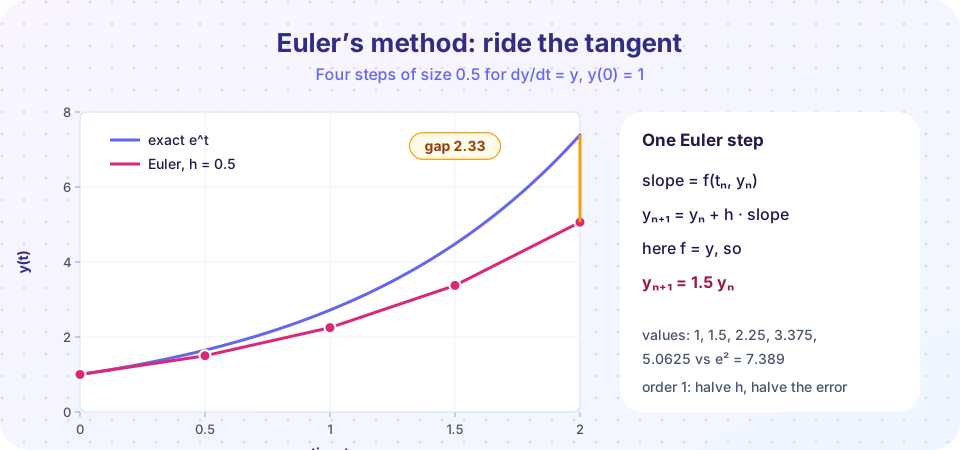
In the picture, the pink line segment from each dot has the slope of the ODE at that dot. For dy/dt = y the slope equals the height, so each step multiplies y by 1 + h = 1.5. After four steps you get 1.5⁴ = 5.0625, while the true value e² = 7.389 is much larger. The curve is convex, so the tangent always undershoots.
Where the error comes from
Expand the exact solution: y(t+h) = y(t) + h y′(t) + h² y″(t)/2 + …. Euler keeps only the first two terms, so each step has local error about h² y″/2, which is O(h²).
To reach a fixed final time T you need T/h steps. If each step contributes an error of order h², the total is about (T/h) × h² = T h. The global error is first order: O(h). Halve the step, double the work, halve the error. That is a poor deal compared with the methods in the next lesson.
A reusable implementation
The function below works for any system. The right-hand side f(t, y) takes a time and a NumPy array and returns an array of slopes.
Press Run (or Ctrl + Enter) to see the result here.
Program input · what you'd type while the program runs
Type the answers before you press Run, one per line. Each time the program reads a line (with input()), it gets the next line from this box.
The last column, error / h, stays almost constant. That is the signature of a first-order method: error proportional to the step. You should check this for every solver you write.
Stability: when a bigger step is worse than useless
Consider decay dy/dt = −λ y. Euler gives y_{n+1} = (1 − λ h) y_n. Each step multiplies the value by the factor 1 − λ h.
- If
0 < λh < 1the factor is between 0 and 1: smooth decay, as it should. - If
1 < λh < 2the factor is between −1 and 0: the numbers flip sign each step but still shrink. The shape is wrong but the error dies out. - If
λh > 2the magnitude exceeds 1: the numerical solution explodes, even though the true solution decays.
Stability demands h < 2/λ, and for good accuracy h must be much smaller. Try it below with λ = 2 (so the stability limit is h = 1). Drag the slider and watch the pink points leave the true curve.
Euler versus oscillators
For the frictionless oscillator x′ = v, v′ = −ω² x, one Euler step multiplies the energy by 1 + ω² h². The energy grows every step, no matter how small h is. After N = T/h steps the energy has been multiplied by about e^{ω² h T}, so a smaller step slows the growth but never stops it. Euler is not just inaccurate for oscillators; it adds energy systematically.
The fix is not a smaller step but a better method. The next lessons introduce Runge-Kutta methods for accuracy and symplectic methods for long-term energy behavior.
Press Run (or Ctrl + Enter) to see the result here.
Program input · what you'd type while the program runs
Type the answers before you press Run, one per line. Each time the program reads a line (with input()), it gets the next line from this box.
Common misconceptions
"Euler works if I make h small enough." It converges as h → 0, but the cost grows quickly. For long oscillator runs the energy still drifts upward.
"Instability means a bug." Instability is a property of the method and the step size. The code can be perfectly correct and still explode when h exceeds the stability limit.
"The local error is h, so the global error is h." The local error is h²; adding about 1/h of them gives a global error of h.
Check your understanding
Quick check · 5 questions
of 5 answered You scored / 5 · perfect!
-
1. What is Euler's update for dy/dt = f(t, y)?
Move along the slope f(t, y) for a time h. -
2. You halve h in Euler's method. The global error changes by about
Euler's method is first order: error proportional to h. -
3. For dy/dt = -3y, what is the largest step for which Euler is stable?
The factor is 1 - 3h and must satisfy |1 - 3h| < 1, so h < 2/3. -
4. What does Euler do to the energy of a frictionless oscillator?
Each step multiplies the energy by 1 + omega^2 h^2. -
5. The local truncation error of Euler's method is of order
The first neglected Taylor term is h^2 y''/2.
Summary
- Euler's update is
y_{n+1} = y_n + h f(t_n, y_n). - Local error is
O(h²), global errorO(h): first order. - Test with a known solution and check that
error / hstays constant. - Decay problems need
h < 2/λfor stability. - For oscillators Euler pumps in energy at every step, which motivates better methods.
Next: Runge-Kutta Methods
Track your progress
Create a free account to tick off lessons and pick up where you left off on any device.
of Computational Physics lessons completed