


















Lesson 32 of 47 · Molecular Dynamics
Chapter 6 review: molecular dynamics
A recap of the molecular dynamics chapter in one picture and one table, plus a ten-question quiz on forces, integrators, boundaries and measurements.
You have built every part of a molecular dynamics simulation: a pair potential, an integrator, periodic boundaries and a set of measurements. This review shows how they fit together and tests the details that decide whether a simulation is trustworthy.
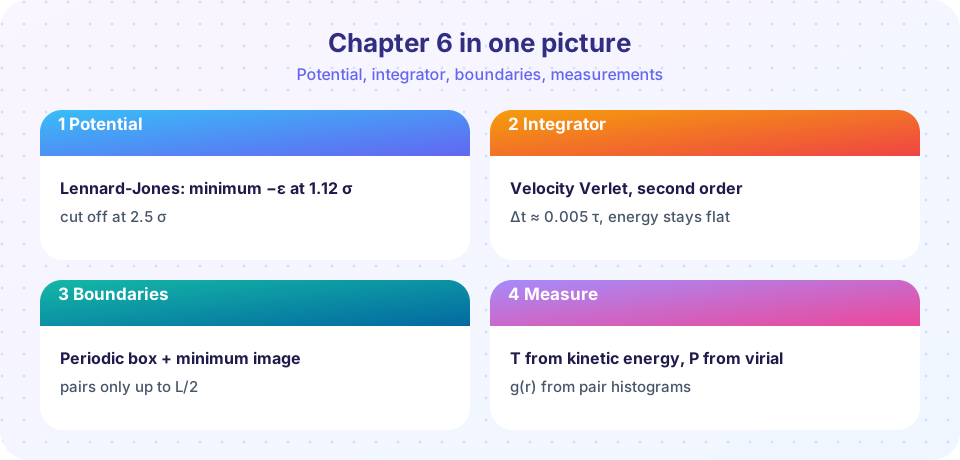
Recap table
| Part | What to remember |
|---|---|
| Potential | U = 4ε[(σ/r)¹² − (σ/r)⁶]; minimum −ε at 2^(1/6)σ; cut at 2.5σ and shift |
| Force | F/r = 24ε(2(σ/r)¹² − (σ/r)⁶)/r²; Newton's third law halves the work |
| Integrator | velocity Verlet: half kick, drift, new forces, half kick; second-order, symplectic |
| Time step | reduced Δt ≈ 0.005; energy fluctuation scales like Δt² |
| Boundaries | wrap with pos % L; distances with d − L·round(d/L); need r_c ≤ L/2 |
| Measurements | T = Σv²/(d(N−1)); P = ρT + Σr·F/(dV); g(r) from pair histograms up to L/2 |
| Workflow | build lattice → random velocities → equilibrate → measure → check energy |
A checklist for any MD result
- Is the energy conserved (small fluctuation, no drift) in an NVE run?
- Was the starting configuration forgotten (equilibration discarded)?
- Is the box at least twice the cut-off?
- Do the averages stop changing when the run is made longer?
- Does the result agree with a known case (for a 3D LJ fluid, the first
g(r)peak near 1.0 to 1.1 σ at liquid density)?
Check your understanding
Quick check · 10 questions
of 10 answered You scored / 10 · perfect!
-
1. The Lennard-Jones potential crosses zero at...
At r = σ the two terms cancel: (1)¹² − (1)⁶ = 0. -
2. Which integrator property best explains stable energy over millions of steps?
Symplectic integrators conserve a shadow energy, so the real energy stays in a narrow band. -
3. A box has L = 6σ. What is the largest valid cut-off?
r_c ≤ L/2 = 3σ. -
4. Which quantity needs both positions and forces?
The virial sums r_ij · F_ij over all pairs. -
5. Doubling the time step in velocity Verlet changes the energy fluctuation by about a factor of...
The fluctuation scales like Δt². -
6. After a velocity-rescaling equilibration, what should you do for production measurements of dynamics?
Rescaling distorts fluctuations; use NVE or a rigorous thermostat for production. -
7. In g(r), the first peak near r ≈ σ represents...
Neighbors touching each other sit near the potential minimum, giving a tall first peak. -
8. The O-H stretch period is about 9 fs. Using 20 steps per period suggests a time step of about...
9 fs / 20 ≈ 0.45 fs; practical simulations use 1-2 fs together with bond constraints. -
9. Newton's third law in the force loop lets you...
F_ij = −F_ji, so each pair needs one evaluation. -
10. Which is NOT a good sign of a healthy simulation?
A steady energy drift shows the integration or time step is not good enough.
Summary
- MD is a loop of forces, integration, wrapping and measurement.
- Lennard-Jones, velocity Verlet and minimum-image periodic boundaries are the standard building blocks.
- Temperature, pressure and
g(r)turn trajectories into physics. - Check energy conservation, equilibration and box size before believing a number.
Track your progress
Create a free account to tick off lessons and pick up where you left off on any device.
of Computational Physics lessons completed