


















Lesson 2 of 49 · Getting Started
What Is Operations Research?
Learn what operations research is, where it came from, which decisions it improves and why a computer can beat intuition when choices multiply.
Imagine a delivery company with 40 parcels to drop off. In which order should the driver visit the houses? You could guess, and your guess might be fine. But the number of possible orders is larger than the number of atoms you could count in a lifetime, and a good order can save hours of fuel and driving every day. Operations research is the discipline that turns questions like this into models a computer can search. It combines mathematics, computer science and a good understanding of how organizations work.
In this lesson you will see what OR is, where it came from, which problems it solves, and why a method matters when the number of choices explodes.
What you will learn
- A clear definition of operations research and how it differs from plain data analysis.
- The main milestones in its history and the people behind them.
- The families of problems OR solves.
- Why the number of possible decisions grows so fast that guessing fails.
Key terms
Operations research (OR): using models and algorithms to improve decisions about how to run a system.
Decision variable: a quantity you are free to choose, such as the number of cakes to bake.
Objective: the measure you want to make as large (profit) or as small (cost) as possible.
Constraint: a rule or limit that every acceptable decision must obey.
Optimal: the best possible decision under the model's rules.
A working definition
OR answers the question "What should we do?" while data analysis mostly answers "What happened?" and "What is likely to happen?". An OR study usually has three ingredients:
- A decision to be made (how many, which, when, where).
- A goal that measures how good a decision is.
- Limits that rule some decisions out (money, time, capacity, laws).
The word "operations" is historical. It refers to the day-to-day running of a system such as a factory, a hospital or an army. The British name is operational research; North America mostly says operations research. Fields close to it are management science (OR for business) and decision science.
A short history
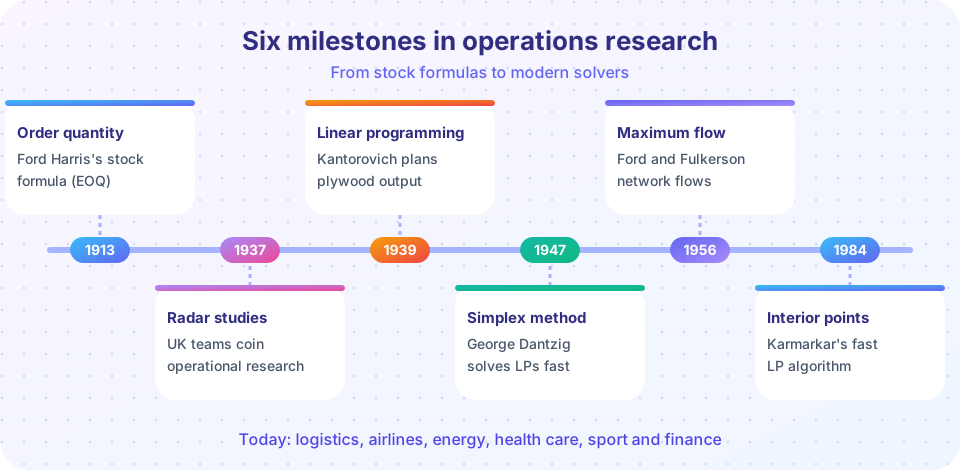
The name came from the military. In the late 1930s, British scientists around the radar stations at Bawdsey studied not the radar itself but how its information should be used in the air-defence system. A. P. Rowe described that kind of study as "operational research". During the Second World War, groups of mixed scientists, such as the one led by the physicist Patrick Blackett, advised on convoy sizes, search patterns and the best use of aircraft.
The mathematics is older and younger at once:
- 1913: Ford W. Harris published a formula for the best size of a stock order, the first of many inventory models you will meet in Chapter 5.
- 1939: the Soviet mathematician Leonid Kantorovich described a way to plan production in a plywood trust that is now recognized as linear programming. He shared the 1975 Nobel Memorial Prize in Economics with Tjalling Koopmans for work on the optimal allocation of resources.
- 1947: George Dantzig designed the simplex method, which solves linear programs efficiently and is the engine of Chapter 3.
- 1956: L. R. Ford Jr. and D. R. Fulkerson published a method for maximum flow in networks (Chapter 4).
- 1984: Narendra Karmarkar introduced an interior-point method for linear programming that opened a second family of fast algorithms.
Since then OR has grown with computing power. A problem that needed a mainframe in 1960 now solves in a blink on a phone.
What kinds of problems does OR solve?
| Family | Typical question | Chapter |
|---|---|---|
| Resource allocation | How should limited machines and money be split among products? | 2 and 3 |
| Routing and networks | What is the shortest, cheapest or highest-capacity route? | 4 |
| Inventory | When and how much should we order? | 5 |
| Scheduling | Which job goes on which machine, and when? | 5 |
| Waiting lines | How many servers keep customers from waiting too long? | 6 |
| Decisions under uncertainty | Which option is best when outcomes are random? | 7 |
| Competition | How do rivals' choices change mine? | 7 |
Airlines use OR to schedule crews and set prices, delivery firms to plan routes, hospitals to roster staff, power companies to decide which plants to run each hour, and sports leagues to create fixtures. In each case the model is a simplified picture of the organization, and the algorithm searches it.
Why guessing fails: combinatorial explosion
Suppose you must assign n jobs to n workers, one job per worker. The first job can go to any of n workers, the second to any of the remaining n - 1, and so on. The number of assignments is n! = n × (n - 1) × ... × 1. For 10 jobs that is 3,628,800, which a computer can check in a moment. For 20 jobs it is about 2.4 × 10¹⁸, and for 30 jobs about 2.7 × 10³². Even a machine that checks a billion plans a second would need far longer than the age of the universe.
Good methods avoid checking every plan. They use structure (for example, "the best plan must lie at a corner of the feasible region") to throw away most plans without looking at them. Learning those structures is the heart of this course.
Press Run (or Ctrl + Enter) to see the result here.
Program input · what you'd type while the program runs
Type the answers before you press Run, one per line. Each time the program reads a line (with input()), it gets the next line from this box.
Models, not magic
An OR model is a deliberate simplification. Sunrise Bakery makes cakes (x batches) and bread (y batches). Each cake batch earns $60 and each bread batch $40. The oven allows 2x + y ≤ 16 hours and the baker x + 2y ≤ 14 hours. The plans worth comparing are the corners of the region these limits define: (0, 0), (8, 0), (6, 4) and (0, 7). Here is how they compare.
Press Run (or Ctrl + Enter) to see the result here.
Program input · what you'd type while the program runs
Type the answers before you press Run, one per line. Each time the program reads a line (with input()), it gets the next line from this box.
The winning plan, 6 cake batches and 4 bread batches, earns $520 a day. You will learn why corners are enough in Chapter 3.
How OR differs from related fields
- Statistics describes data and estimates uncertainty. OR uses such estimates as inputs to decisions.
- Machine learning predicts. OR prescribes. Modern systems often use both: a forecast of demand feeds an optimization model.
- Economics explains how people and markets behave. OR often uses its ideas (marginal cost, prices) as tools.
- Computer science supplies algorithms and complexity theory, which tell us which problems are easy and which are hard.
Common misconceptions
"OR is only about linear programming." Linear programming is the best-known tool, but queues, simulation, inventory, game theory and heuristics are all part of OR.
"An optimal answer is the best thing to do in real life." It is the best answer to the model. If the model ignores something important, such as a staff member's holiday, the plan may fail.
"More data always gives a better decision." A decision needs the right data and a model that uses it. More numbers cannot replace a clear goal.
Check your understanding
Quick check · 5 questions
of 5 answered You scored / 5 · perfect!
-
1. Which question is typical for operations research?
OR prescribes decisions (how many, which, when). Describing past data is statistics. -
2. What did George Dantzig contribute in 1947?
Dantzig developed the simplex method. The order quantity formula is Harris (1913) and max flow is Ford and Fulkerson (1956). -
3. Roughly how many ways can 20 jobs be assigned to 20 workers, one job each?
The count is 20! which is about 2.4 × 10^18, far too many to check one by one. -
4. What is an optimal solution?
Optimal means feasible and best for the stated objective. -
5. Why can OR methods avoid checking every plan?
Structure, such as corner points in linear programming, lets algorithms skip huge numbers of plans.
Summary
- OR uses models and algorithms to improve decisions: what to do, how much, which and when.
- It grew from wartime studies in the late 1930s and from mathematics such as Kantorovich's planning and Dantzig's simplex method.
- Main problem families are allocation, networks, inventory, scheduling, queues, uncertainty and competition.
- The number of possible plans grows explosively, so smart structure beats brute force.
- A model's optimum is only as good as the model.
Next: The OR Modelling Process
Track your progress
Create a free account to tick off lessons and pick up where you left off on any device.
of Operations Research lessons completed