


















Lesson 49 of 49 · Projects and Practice
Further Study: Where to Go After Operations Research
Plan your next steps in operations research: which topics deepen each chapter, a history timeline, tools and solvers, and the tracks on this site that continue the journey.
You now have a working toolkit: inventory models, scheduling rules, queueing formulas, simulation, decision analysis, zero-sum games and heuristics. Operations research is a wide field, and this part of the course sampled its most widely used tools. This final lesson helps you choose what to study next, shows you where the ideas came from and points to the tracks on this site that continue each thread.
What you will learn
- Which topics extend each chapter of the course.
- How the field developed, and who the key people were.
- Which software and solvers professionals use.
- A suggested learning path for different goals.
Key terms
Solver: software that finds optimal or good solutions to a mathematical model, such as HiGHS or Gurobi.
Mathematical programming: the family of optimization models (linear, integer, convex, nonlinear).
Stochastic: involving randomness, as in stochastic processes and stochastic optimization.
Analytics: using data and models to support decisions.
A short history
Operations research grew from practical urgency. During the Second World War, British and American teams used mathematics to decide how to place radar stations, how to size convoys and how to schedule aircraft maintenance. After the war, the ideas moved into industry and government.
What to study next
If you liked optimization models
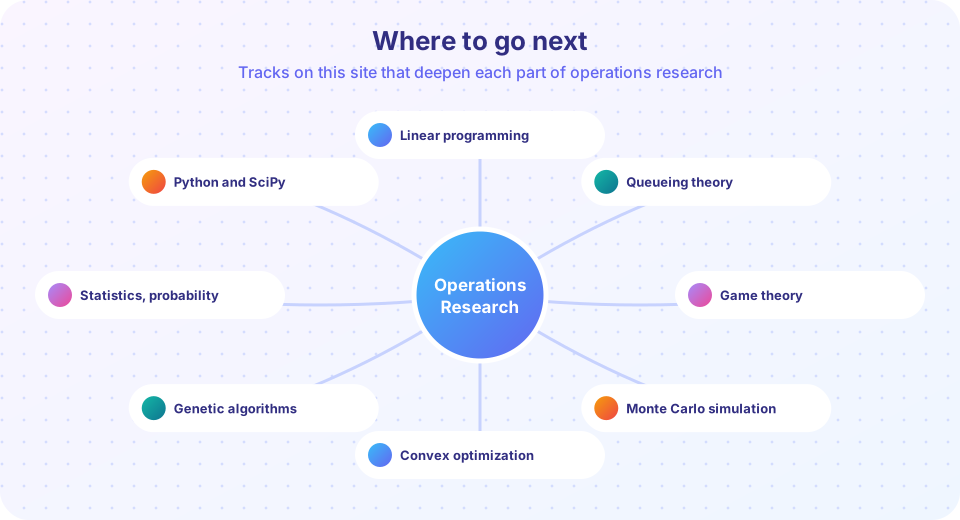
Linear programming goes deep into the simplex method, duality, sensitivity analysis, network flows and integer programming. It is the most useful single next step, because so many practical problems are linear or can be linearized. From there, convex optimization generalizes linear programs to a larger class that is still efficiently solvable and underlies much of modern machine learning.
If you liked queues and randomness
Queueing theory extends M/M/1 and Erlang C to general service times, priorities, networks of queues and finite populations. Monte Carlo simulation studies random-number generation, variance reduction and estimating quantities by sampling. Probability and statistics provides the foundation for both: distributions, estimation, confidence intervals and hypothesis tests, which you used informally in this course.
If you liked decisions and games
Game theory continues with non-zero-sum games, the Nash equilibrium, repeated games, auctions and bargaining. In decision analysis, topics to look for next are utility theory, multi-criteria decision making and Markov decision processes (sequential decisions under uncertainty).
If you liked heuristics
Genetic algorithms covers population-based search in depth. Other directions include tabu search, constraint programming, vehicle routing and local-search frameworks. A solid grounding in algorithms and data structures (DSA) makes all of these easier to implement efficiently.
If you liked the programming
The code in this course used plain Python with a little NumPy and SciPy. The Python, NumPy and SciPy tracks deepen the tools. SciPy's linprog and milp use the HiGHS solver; for bigger models, practitioners use modeling libraries such as PuLP, Pyomo or Google OR-Tools, and commercial solvers such as Gurobi or CPLEX. Those libraries and solvers cannot run in the in-browser editors on this site, but they follow the same modelling ideas you practiced.
Topics not covered here
| Topic | What it is | Why it matters |
|---|---|---|
| Network optimization | Shortest paths, maximum flow, minimum-cost flow | Routing, logistics and project networks |
| Project scheduling | CPM and PERT | Planning large projects |
| Markov chains and MDPs | Random processes and sequential decisions | Maintenance, pricing, queues |
| Dynamic programming | Solving problems stage by stage | Inventory over time, routing, resource allocation |
| Forecasting | Time-series methods | Inputs to inventory and staffing models |
| Revenue management | Pricing under capacity limits | Airlines, hotels |
| Stochastic optimization | Optimization with random data | Energy, finance, supply chains |
A suggested learning path
- Revisit the practice set until every problem comes out right without hints.
- Study linear programming (modelling first, simplex second).
- Add probability and statistics if you have not studied them yet.
- Pick one applied area (supply chains, healthcare, transport, energy, finance) and look for a small real data set to model.
- Build a portfolio project: define a question, model it, solve it, validate and write a one-page recommendation, as in the projects of this chapter.
The program below turns your interests into a reading order from this site's tracks. It is only a suggestion engine, but it shows the dependencies between topics.
Press Run (or Ctrl + Enter) to see the result here.
Program input · what you'd type while the program runs
Type the answers before you press Run, one per line. Each time the program reads a line (with input()), it gets the next line from this box.
Habits that make you better
- Model small first. A model you can solve by hand is a model you understand.
- Check against reality. If the model's answer surprises you, find out why before you trust it.
- Quote ranges and assumptions. Honest uncertainty earns more trust than false precision.
- Write it up. The skill of explaining a model to a non-expert is as valuable as solving it.
Where operations research is used
The methods of this course appear in many industries. Airlines use optimization for crew scheduling and queueing models for check-in counters. Hospitals plan operating-room schedules and bed capacity. Delivery companies solve vehicle routing problems for thousands of stops every morning, with heuristics very like the ones in chapter 8. Retailers decide stock levels with newsvendor-type models. Power companies schedule generators and forecast demand. Banks and insurers use simulation to measure risk. In each case the analyst's job is the same one you practiced in the projects: understand the question, build a model of the right size, solve it, test it against reality and explain the result.
How to keep learning
Read short case studies of real projects, such as those collected by professional societies, to see how the five-step workflow plays out and how much of the work is about people and data. Try an open data set (public transport timetables, hospital waiting times, bike-sharing logs) and ask a decision question about it. Re-implement a method from scratch before using a library; you will understand its behavior far better. And when you meet a new technique, ask the same three questions as in this course: what does it assume, what does it guarantee and how would I check it on a small example?
Common misconceptions
"Operations research is only about big companies." The same ideas help a bakery, a clinic or a student group planning an event.
"I need advanced mathematics before I start." You need algebra, probability and some patience. The advanced tools come as you need them.
"Software will do the thinking." Solvers answer the question you pose. Deciding which question to pose is the human part.
Check your understanding
Quick check · 4 questions
of 4 answered You scored / 4 · perfect!
-
1. Who proved that every finite two-player zero-sum game has a value?
Von Neumann proved the minimax theorem in 1928. -
2. Which next step most directly deepens the simplex method and duality?
The linear programming track covers the simplex method, duality and sensitivity analysis. -
3. Which solver does SciPy's linprog use by default in recent versions?
SciPy ships the open-source HiGHS solver. -
4. What is a good first step for a portfolio project?
A clear question and decision come first; the model follows from them.
Summary
- Operations research began with wartime problems and now spans optimization, queues, simulation, decisions, games and heuristics.
- Natural next steps are linear programming, probability and statistics, queueing theory, game theory and algorithms.
- Practitioners use Python libraries and solvers; the modelling ideas are the same as in this course.
- Build projects, check against reality, quote ranges and write up your recommendations.
Back to the course overview: Operations Research
Track your progress
Create a free account to tick off lessons and pick up where you left off on any device.
of Operations Research lessons completed