


















Lesson 6 of 49 · Modelling Decisions
Chapter 2 Overview: Modelling Decisions
Chapter 2 overview: learn to turn a decision story into variables, an objective and constraints, the central skill of operations research.
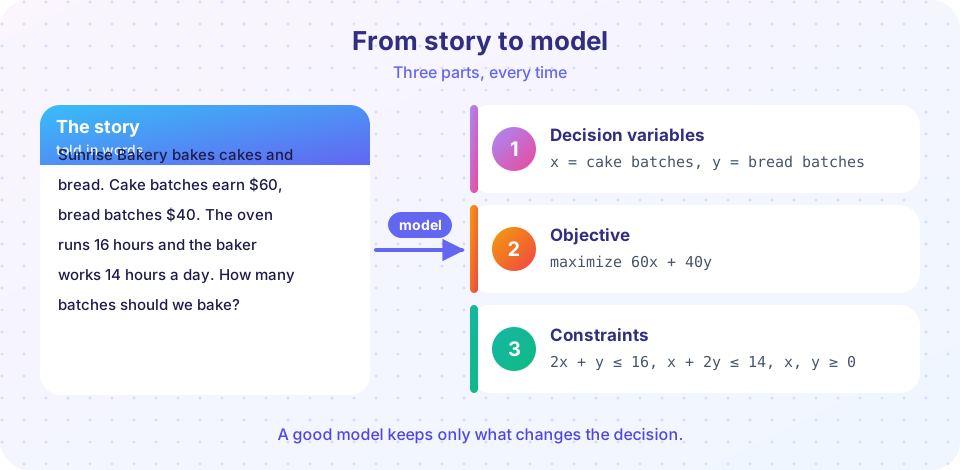
Solvers are fast, but they cannot read your mind. A solver needs a model: a precise description of what you may choose, what you want and what the rules are. Writing that description is the most valuable skill in operations research, and it is a craft that improves with practice. This chapter teaches the craft with a steady supply of examples: a bakery, a furniture workshop, a diet and a project portfolio.
What you will learn
- The big picture of the chapter: what a model is and why we build one.
- The three-part recipe that every model in this course follows.
- What each lesson of the chapter covers.
Key terms
Decision variable: a quantity you choose, written as a symbol such as x.
Objective function: a formula that scores a decision; you maximize or minimize it.
Constraint: an equation or inequality that every allowed decision must satisfy.
Linear model: a model in which the objective and every constraint are sums of variables times constants.
The big picture
A model is not reality; it is a deliberately simple copy that keeps the parts that matter. A map does the same thing: it leaves out trees and benches so that you can find your way. A good OR model is as simple as possible while still ranking decisions the way a wise manager would.
Step 1: choose the unknowns
Name every quantity you control, with units.
Step 2: say what you want
The objective is a formula in the variables.
Step 3: state the limits
Every rule becomes an inequality or equation.
Step 4: check the model
Models improve through several rounds.
What each lesson covers
- Decision variables, objectives and constraints takes the three parts apart, discusses units, kinds of variables and the assumptions behind linear models.
- The product-mix model is the classic first model: a workshop with limited wood, labor and finishing time. You also learn to read shadow prices, which tell you what an extra hour is worth.
- Diet and blending models turns the problem upside down: instead of a maximum under limits, you find the cheapest mix that reaches minimum requirements.
- Binary variables and logic shows how yes/no variables express fixed costs, either-or rules and "if this then that" conditions.
- Chapter 2 review gathers the translation rules on one page and tests you with ten questions.
A first look: sort the sentences
Here is the exercise that the whole chapter trains. Read a paragraph and color each phrase: what is chosen (variable), what is wanted (objective), what limits (constraint). Try it in the next widget with a bakery story.
Press Run (or Ctrl + Enter) to see the result here.
Program input · what you'd type while the program runs
Type the answers before you press Run, one per line. Each time the program reads a line (with input()), it gets the next line from this box.
Three questions before you write any symbol
Whenever you face a new decision problem, pause and answer these questions in words.
- What exactly can I choose? Name the quantities, their units and whether they must be whole numbers. If the answer is "I choose how many of each product", you have your variables.
- How will I know a plan is good? Pick one measure and a direction. "Make as much money as possible" becomes a profit formula; "keep customers happy" must first be turned into something measurable, such as waiting time.
- What stops me from choosing anything? List capacities, budgets, minimums, legal rules and physical facts. Each becomes a constraint, and forgetting one is the most common modelling mistake.
If you can answer all three clearly, the algebra is mostly bookkeeping. If you cannot, the problem is not yet ready for a model, and talking to the people involved will help more than any software.
Common misconceptions
"A model must include every detail." Extra detail makes a model slow and hard to trust. Include only what changes the decision.
"There is only one correct model." Different modellers choose different variables and simplifications. What matters is whether the model answers the question and can be checked.
"Modelling is just algebra." The hard part is deciding what counts as a decision, what counts as a limit and what to leave out.
Check your understanding
Quick check · 4 questions
of 4 answered You scored / 4 · perfect!
-
1. Which part of a model describes what you want to achieve?
The objective function scores a decision; you maximize or minimize it. -
2. In the bakery story, "the oven is free for only 16 hours a day" becomes what in the model?
A capacity limit is a constraint on the decision variables. -
3. Why do we keep models as simple as possible?
A model should include only what matters for the decision. -
4. Which is a decision variable?
A decision variable is something you choose; capacities and profits are given data.
Summary
- A model has decision variables, an objective function and constraints.
- Modelling means translating a story into these three parts and checking the result.
- The chapter moves from the anatomy of a model to maximization, minimization and yes/no logic.
- Keep the model as simple as the decision allows.
Track your progress
Create a free account to tick off lessons and pick up where you left off on any device.
of Operations Research lessons completed