


















Lesson 5 of 49 · Getting Started
Chapter 1 Review: Getting Started
Review the foundations of operations research: definitions, history, the six-stage process and the Python toolkit, with a recap table and a ten-question quiz.
You have now seen what operations research is, how a study is organized and which tools you will use. This review pulls the chapter together in one picture, a recap table and a quiz that mixes all the lessons. Take it a few days after reading the chapter; retrieving facts after a delay is one of the best ways to make them stick.
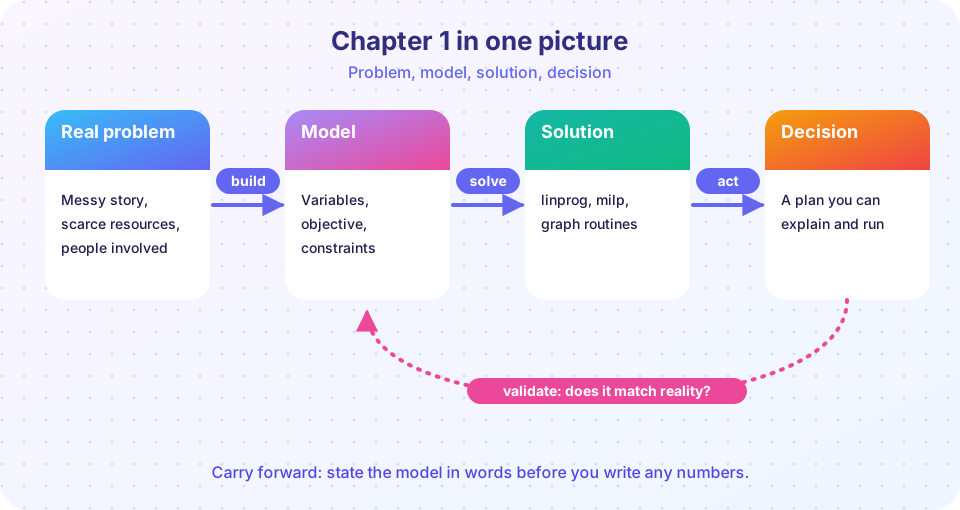
What you will learn
- A compact recap of every lesson in Chapter 1.
- Self-test questions that mix definitions, history, process and tools.
- Which ideas to carry into Chapter 2.
Recap table
| Lesson | Big idea | Remember |
|---|---|---|
| Course map | OR supports decisions with models | Nine chapters, running example Sunrise Bakery |
| What is OR? | Decision, objective, constraints | Plans explode (n! grows fast), so structure matters |
| The modelling process | Six stages in a loop | Validation and sensitivity before trust |
| Python toolkit | linprog, milp, csgraph | linprog minimizes; check the status |
The Sunrise Bakery numbers to remember
The model maximize 60x + 40y with 2x + y ≤ 16 (oven) and x + 2y ≤ 14 (baker) has its best plan at 6 cake batches and 4 bread batches, for $520 a day. Both constraints are binding there: the oven and the baker are completely used. If you can reproduce this answer by hand (solve the two constraint equations together) and with code, you have the core skill of the chapter.
Press Run (or Ctrl + Enter) to see the result here.
Program input · what you'd type while the program runs
Type the answers before you press Run, one per line. Each time the program reads a line (with input()), it gets the next line from this box.
Try your own plans in the second block. Notice that (7, 3) uses 17 oven hours: it looks attractive but breaks a limit.
The chapter in plain words
The course map told you what to expect: nine chapters that move from foundations to projects, a running example (Sunrise Bakery) and a study routine built on running code and drawing the problem. Its main message was that operations research is a way of making decisions, not a branch of computer programming.
The lesson on what OR is gave you a definition and a history. OR answers "what should we do?" with a decision, an objective and limits. It grew out of wartime studies of radar, convoys and search, and then out of mathematics: Harris's order quantity in 1913, Kantorovich's production planning in 1939, Dantzig's simplex method in 1947, Ford and Fulkerson's flows in 1956 and Karmarkar's interior-point method in 1984. You also saw why brute force fails: the number of ways to assign n jobs to n workers is n!, which passes the age of the universe at checking speed for only 25 or so jobs.
The modelling process gave you a loop of six stages: define the problem, collect data, build the model, solve it, validate it and implement it. The lesson stressed that validation (expert review, historical tests, sensitivity analysis) and implementation decide whether a study has any value, and that the loop is traversed more than once.
The toolkit lesson turned the bakery into code. You learned that linprog minimizes, that its status and slack values deserve a look before you trust res.x, that milp adds integers and yes/no variables, and that csgraph supplies the network algorithms of Chapter 4.
Habits to carry forward
- State the decision, the goal and the limits in plain words before any symbols.
- Write units next to every number. Hours, dollars and batches must never be mixed.
- Check a solution by hand. Substitute it into every constraint, as you did with
(6, 4). - Ask what happens if a number is wrong, which is sensitivity analysis in everyday form.
- Remember who will use the answer. A plan that nobody follows has no value.
Common misconceptions
"Once the solver says optimal, the job is done." Validation, sensitivity analysis and implementation are still ahead.
"OR and statistics are the same." Statistics learns from data; OR chooses actions. They work together.
"A bigger model is a better model." Start with the simplest model that captures the trade-off and add detail only when it changes the decision.
Check your understanding
Quick check · 10 questions
of 10 answered You scored / 10 · perfect!
-
1. Which pair describes what OR chooses and what it measures?
A model chooses decision variables to make an objective as good as possible within the constraints. -
2. Who is credited with the simplex method?
Dantzig developed the simplex method in 1947. Harris did stock orders, Karmarkar interior points, Blackett led wartime operational research. -
3. How many ways can 10 jobs be assigned to 10 workers, one job each?
10! = 3,628,800. -
4. Which stage of an OR study comes right after building the model?
The sequence is define, collect data, build the model, solve, validate, implement and monitor. -
5. What does sensitivity analysis tell you?
It tests how robust the recommended decision is to uncertainty in the inputs. -
6. Which statement about linprog is correct?
linprog always minimizes; for maximization use the negative of the objective. -
7. A problem is reported as unbounded. What is the most likely cause?
If the objective can improve forever, some limiting constraint has probably been left out of the model. -
8. Why is validation done on data the model was not built from?
A model that only fits its own data can still fail on new cases. -
9. At the optimal bakery plan (6, 4), what are the slacks of the two constraints?
Oven: 2·6 + 4 = 16 and baker: 6 + 2·4 = 14, so both resources are used completely. -
10. Which tool fits a yes/no decision such as whether to open a warehouse?
A binary variable, an integer bounded between 0 and 1, models a yes/no decision.
Summary
- OR supports decisions with models, algorithms and checking.
- Its history runs from wartime studies to Dantzig's simplex method and modern solvers.
- A study loops through define, data, model, solve, validate and implement.
- Python with scipy gives you
linprog,milpand graph routines. - Sunrise Bakery's best plan is 6 cake and 4 bread batches, $520, with both resources binding.
Track your progress
Create a free account to tick off lessons and pick up where you left off on any device.
of Operations Research lessons completed