


















Lesson 47 of 49 · Projects and Practice
Glossary: Inventory, Queues, Decisions and Heuristics
A plain-language glossary of the key terms from chapters 5 to 8: inventory, scheduling, queueing, simulation, decision analysis, games and heuristics, with flashcards.
Every field has its own vocabulary, and operations research borrows words from mathematics, economics, engineering and computer science. This glossary collects the terms used in chapters 5 to 8, in alphabetical order inside each chapter group. Each entry gives a short definition and, where it helps, the key formula. Use it while you solve the practice problems, and use the flashcards at the end to test yourself.
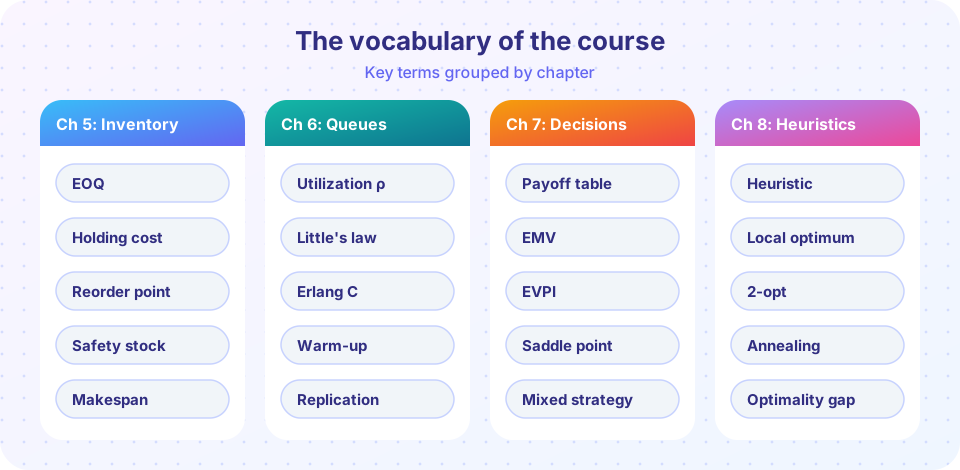
What you will learn
- The precise meaning of the main terms in each chapter.
- How terms from different chapters connect (for example, utilization and safety stock both deal with variability).
- Which formulas go with which words.
Key terms
Model: a simplified description of a decision problem, with variables, an objective and constraints.
Assumption: a simplification built into a model; every formula in this course has them.
Optimal: best according to the chosen objective and the model.
Sensitivity analysis: checking how the answer changes when inputs change.
Chapter 5: Inventory and scheduling
| Term | Meaning |
|---|---|
| Backorder | Demand that waits to be filled later instead of being lost. |
| Completion time | The clock time when a job finishes; with all jobs ready at time 0 it equals the flow time. |
| Critical ratio | Cu / (Cu + Co); the probability of not running out at the best newsvendor order. |
| Cycle service level | The probability of no stock-out during a replenishment cycle. |
| EOQ | Economic order quantity, √(2DS/H); balances ordering and holding costs. |
| EPQ | Economic production quantity, √(2DS / (H(1 − D/P))), for stock that is filled gradually. |
| Fill rate | The fraction of demand served directly from stock. |
| Flow shop | A shop where every job visits the machines in the same order. |
| Holding cost | The cost of keeping one unit in stock for one period, often a percentage of its value per year. |
| Johnson's rule | An optimal sequencing rule for two machines in series. |
| Lateness | completion time − due date; negative if early. |
| Lead time | The delay between placing and receiving an order. |
| Makespan | The time at which the last job finishes. |
| Newsvendor model | A single-period stocking model with random demand, overage and underage costs. |
| Ordering (setup) cost | The fixed cost of placing an order or starting a production run. |
| Overage cost (Co) | The loss on each unit left over, cost − salvage. |
| Reorder point (ROP) | The stock level that triggers a new order; lead-time demand plus safety stock. |
| Safety stock | Extra stock held to protect against variability, z · σ_L. |
| SPT / EDD | Shortest processing time first; earliest due date first. |
| Underage cost (Cu) | The profit lost on each unit of unmet demand, price − cost. |
Chapter 6: Queueing and simulation
| Term | Meaning |
|---|---|
| Arrival rate (λ) | The average number of arrivals per unit time. |
| Discrete-event simulation | A simulation whose state changes only at event times, with a clock and an event list. |
| Erlang | The unit of offered load; one Erlang keeps one server busy all the time. |
| Erlang C | The probability that an arriving customer must wait in an M/M/c queue. |
| Event list | The time-ordered list of future events in a simulation. |
| Kendall notation | A/S/c naming of queues, such as M/M/1 or M/M/c. |
| Little's law | L = λW; the average number in a stable system equals arrival rate times average time. |
| M/M/1, M/M/c | Queues with Poisson arrivals, exponential service and one or c servers. |
| Offered load (a) | λ/μ, the work arriving per unit time, in Erlangs. |
| Poisson process | Random arrivals at a constant average rate; gaps are exponential. |
| Pooling | Serving all customers from one shared line instead of separate lines. |
| Queue discipline | The rule for choosing who is served next (FIFO, priority, and so on). |
| Replication | One complete simulation run with its own random numbers. |
| Service rate (μ) | The number of customers one busy server completes per unit time. |
| Service level | A target such as "80 percent answered within 20 seconds". |
| Steady state | The long-run behavior after start-up effects have died out. |
| Utilization (ρ) | The fraction of time servers are busy, λ/(cμ); must be below 1. |
| Warm-up period | The initial part of a simulation run that is discarded because the system starts empty. |
Chapter 7: Decision analysis and game theory
| Term | Meaning |
|---|---|
| Alternative | One of the actions you can choose. |
| Bayes' rule | The formula for updating a probability after new evidence. |
| Decision tree | A diagram of decisions (squares) and chance events (circles) solved by rolling back. |
| Dominated strategy | A strategy never better than another one; it can be removed. |
| EMV | Expected monetary value, the probability-weighted average payoff. |
| EVPI | EV with perfect information − best EMV; the most any information can be worth. |
| EVSI | Expected value of sample information, for an imperfect study; at most EVPI. |
| Hurwicz criterion | A weighted mix of the best and worst payoffs by an optimism index. |
| Maximin / maximax | Choose the best worst case; choose the best best case. |
| Minimax regret | Choose the option whose largest regret is smallest. |
| Mixed strategy | Randomizing over actions with fixed probabilities. |
| Payoff table | A table of results for each alternative in each state of nature. |
| Saddle point | An entry that is the minimum of its row and the maximum of its column. |
| State of nature | An uncontrollable condition, such as high demand. |
| Value of the game | The payoff the row player can guarantee in a zero-sum game. |
| Zero-sum game | A game where one player's gain is exactly the other's loss. |
Chapter 8: Heuristics and practice
| Term | Meaning |
|---|---|
| Annealing (simulated) | Local search that accepts worse moves with probability exp(−Δ/T). |
| Cooling schedule | The rule for lowering the temperature, often T ← αT. |
| Genetic algorithm | A metaheuristic that evolves a population of solutions by selection, crossover and mutation. |
| Greedy rule | Take the best immediate choice at each step without reconsidering. |
| Heuristic | A method that finds a good solution quickly with no guarantee of optimality. |
| Local optimum | A solution that no small move can improve. |
| Metaheuristic | A general strategy for guiding heuristics, such as annealing, tabu search or genetic algorithms. |
| Multi-start | Running local search from many starting solutions and keeping the best. |
| Neighborhood | The set of solutions reachable by one small move. |
| NP-hard | A class of problems with no known fast exact algorithm. |
| Optimality gap | (value − best) / best, as a percentage. |
| Shadow price | The change in the best objective value per unit increase of a constraint limit. |
| Tabu search | A local search that forbids undoing recent moves for a while. |
| 2-opt | A tour move that removes two edges and reconnects the tour by reversing a segment. |
| Validation | Checking that a model represents reality well enough for the decision. |
Connections worth noticing
- Variability is the common thread. It creates safety stock (chapter 5), lines at servers (chapter 6) and the need for probabilities (chapter 7).
- Square roots appear again and again: EOQ, safety stock and the Erlang staffing rule all scale with square roots, which is why doubling demand does not double the buffers.
- Pooling works in inventory (one central stock instead of several small ones) and in queues (one shared line). Both exploit the fact that independent variations partly cancel.
Flashcards
Click a card to flip it. The deck holds twelve terms from the glossary.
The second tool is a small lookup program: type part of a word and see the formula that goes with it.
Press Run (or Ctrl + Enter) to see the result here.
Program input · what you'd type while the program runs
Type the answers before you press Run, one per line. Each time the program reads a line (with input()), it gets the next line from this box.
Common misconceptions
"Different names mean different things." Often not: flow time and completion time coincide when all jobs start at time 0, and "service level" has several meanings (cycle service level, fill rate, call-center service level). Always check which one is meant.
"A glossary is for memorizing." Use it to check your understanding, then practice with the formulas until the symbols feel natural.
Check your understanding
Quick check · 4 questions
of 4 answered You scored / 4 · perfect!
-
1. Which term measures the share of demand served directly from stock?
The fill rate counts demand served from stock; the cycle service level counts cycles without a stock-out. -
2. What is an Erlang?
Offered load a = λ/μ is measured in Erlangs. -
3. Which term refers to the profit lost on each unit of unmet demand?
Underage cost Cu is typically price minus cost. -
4. Which pair correctly matches a term and its meaning?
The other two definitions are wrong: makespan is the time the last job finishes, and a local optimum is only best among nearby solutions.
Summary
- The vocabulary of the course centers on four ideas: inventory under variability, waiting lines, decisions under uncertainty and heuristics for hard problems.
- Many terms come with a formula; learn the formula and its assumptions together.
- Variability, square-root laws and pooling connect the chapters.
- Use the flashcards and the lookup tool to review.
Next: Cheat sheet
Track your progress
Create a free account to tick off lessons and pick up where you left off on any device.
of Operations Research lessons completed