


















Lesson 24 of 49 · Inventory and Scheduling
Chapter 5 Overview: Inventory and Scheduling
A map of chapter 5: how operations researchers decide how much to order, when to reorder and in what sequence to run jobs, with a roadmap of every lesson.
Every shop, factory, hospital and website holds something in reserve. A bakery keeps flour, a hospital keeps blood bags, a streaming service keeps spare servers. Reserves cost money, but running out costs more. Operations research turns this tension into a calculation: how much should we order, and when? Once the goods are in, a second question appears: in what order should we do the work? This chapter answers both.
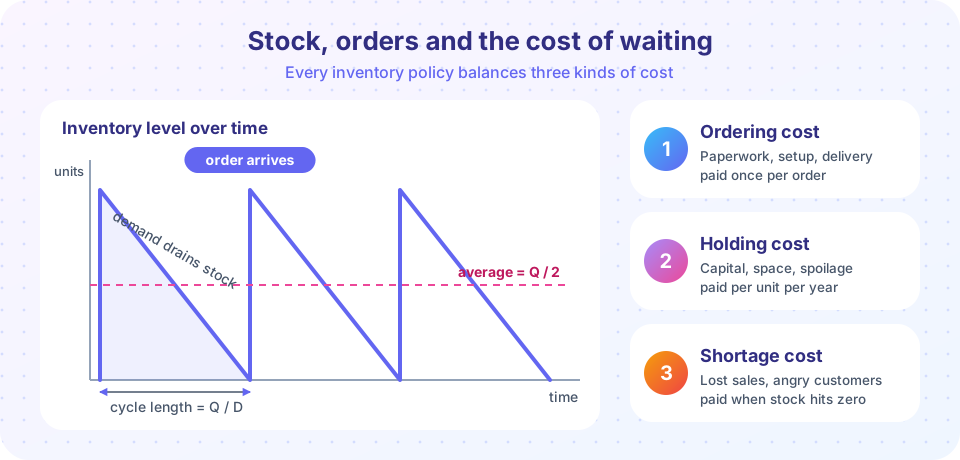
What you will learn
- Why inventory exists and which three costs shape every policy.
- How the chapter's four models fit together: EOQ, EPQ, the newsvendor and scheduling rules.
- Which questions each model answers, and which assumptions each one makes.
- How to read the rest of the chapter and what to try first.
Key terms
Inventory: goods or materials held now to meet demand later.
Lead time: the delay between placing an order and receiving it.
Holding cost: the yearly cost of keeping one unit in stock (capital tied up, storage, insurance, spoilage).
Ordering (setup) cost: the fixed cost of placing one order or starting one production run, however large it is.
Shortage cost: the cost of not having an item when a customer wants it.
Why hold stock at all?
Imagine a shop that sells exactly one pair of shoes per day and that can receive deliveries instantly and for free. It would never need stock: it would order one pair each morning. Real life breaks both assumptions. Deliveries take time (lead time), each delivery has a fixed cost, and demand is never exactly predictable. Inventory is the buffer that absorbs these frictions. Economists describe three motives for holding it: to save fixed costs by ordering in batches, to cover lead times, and to protect against uncertainty.
Each motive leads to a different model:
| Motive | Typical question | Model in this chapter |
|---|---|---|
| Batching to save fixed costs | How big should each order be? | EOQ (economic order quantity) |
| Making your own stock | How big should a production run be? | EPQ (economic production quantity) |
| One-shot uncertain demand | How many do I stock for a single selling season? | Newsvendor model |
| Using scarce capacity well | In what order should jobs run? | Scheduling rules |
The big picture
Three costs pull in different directions
Certain demand
A square-root formula
Uncertain demand
A probability decides
Then schedule the work
A first calculation
You do not need any formula yet to feel the trade-off. The code below prices an order policy for a year. Change the order size and watch the two costs move in opposite directions.
Press Run (or Ctrl + Enter) to see the result here.
Program input · what you'd type while the program runs
Type the answers before you press Run, one per line. Each time the program reads a line (with input()), it gets the next line from this box.
Small orders mean many orders and a large ordering bill; large orders mean a large average stock and a large holding bill. Somewhere in the middle the total is lowest. The next lesson finds that point exactly.
Where the chapter goes
| Lesson | What you will learn |
|---|---|
| The EOQ model | The classic square-root formula, cost curves, reorder points and sensitivity |
| Production runs and quantity discounts | The EPQ model and how to compare price breaks |
| Uncertain demand: newsvendor and safety stock | Critical ratios, service levels and reorder points under randomness |
| Scheduling: dispatch rules and Johnson's rule | SPT, EDD, flow time, lateness, and two-machine flow shops |
| Chapter 5 review | A one-page recap picture and a ten-question quiz |
Common misconceptions
"More stock is always safer." Extra stock protects against shortages but ties up cash, needs space and can spoil. The goal is the cheapest total, not the biggest cushion.
"A formula gives the exact best answer." The formulas assume steady, known demand and constant costs. Real numbers are estimates, which is why the next lesson also studies how forgiving the answer is.
Check your understanding
Quick check · 4 questions
of 4 answered You scored / 4 · perfect!
-
1. Which cost falls when you order in larger batches?
Larger batches mean fewer orders per year, so the yearly ordering bill falls while the holding bill rises. -
2. What does lead time mean?
Lead time is the wait between ordering and delivery, which is why stock must cover demand during that wait. -
3. Which model fits a one-shot decision about how many seasonal items to stock under random demand?
The newsvendor model handles a single ordering decision with uncertain demand and different costs of over- and under-stocking. -
4. Which is NOT one of the three motives for holding inventory in this lesson?
Reserves are justified only by batching, lead times and uncertainty, never by appearances.
Summary
- Inventory is a buffer that absorbs fixed costs, lead times and uncertainty.
- Ordering, holding and shortage costs pull the best policy in different directions.
- EOQ and EPQ handle steady demand; the newsvendor model handles random demand.
- Scheduling rules decide the order in which jobs use a scarce machine.
Next: The EOQ model
Track your progress
Create a free account to tick off lessons and pick up where you left off on any device.
of Operations Research lessons completed