


















Lesson 35 of 49 · Decision Analysis and Game Theory
Chapter 7 Overview: Decision Analysis and Game Theory
A map of chapter 7: choosing under uncertainty with payoff tables and decision trees, valuing information, and finding optimal strategies against a rival.
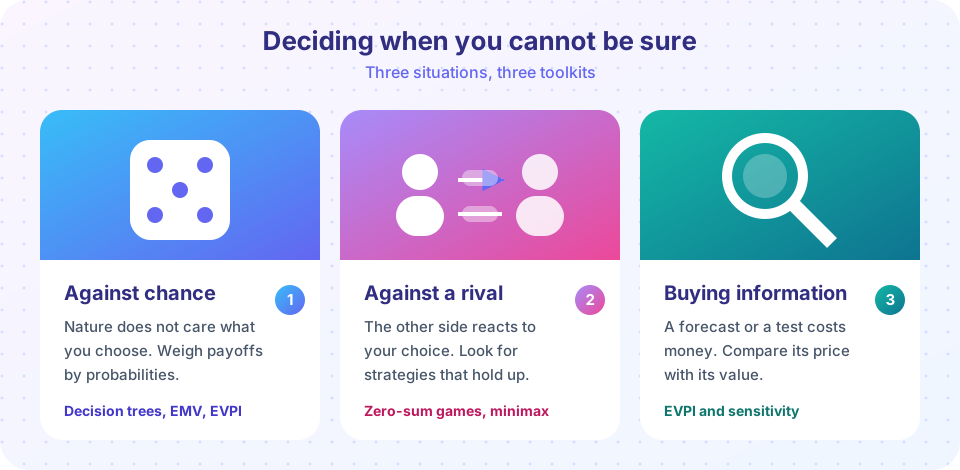
Optimization models in earlier chapters assumed that you know everything that matters. Real decisions are made before the facts arrive: you build a factory before you know the demand, sign a contract before you know the price of fuel, or launch a product while a competitor plans its own. This chapter gives you two groups of tools for those situations. Decision analysis handles uncertainty that is nobody's strategy (weather, demand, test results). Game theory handles uncertainty that comes from another decision-maker who reacts to you.
What you will learn
- The difference between a decision against chance and a decision against a rival.
- The vocabulary of payoff tables, states of nature and strategies.
- How the chapter's lessons fit together.
- Why information has a value that you can calculate.
Key terms
Alternative (action): one of the options you can choose.
State of nature: an uncontrollable future condition, such as high demand.
Payoff: the result (profit, cost, utility) of an alternative in a state of nature.
Strategy: a complete plan of what a player will do in a game.
Expected monetary value (EMV): the probability-weighted average payoff.
Two kinds of uncertainty
When the uncertainty comes from nature, you choose an alternative, then a state of nature occurs by chance, and you receive a payoff. A shop owner who must choose between a small, a medium and a large kiosk faces this: low, medium or high demand is nobody's strategy. The method is to list payoffs, attach probabilities or a risk attitude, and calculate.
When the uncertainty comes from a rival, the other side picks its action knowing you are thinking too. Two companies setting prices, two armies choosing where to attack, and a goalkeeper facing a penalty taker are games. The right question changes from "what is likely?" to "what is a strategy that does well whatever they do?" In some games the best strategy is to randomize, which is what makes the penalty taker unpredictable.
The big picture
Decisions against chance
What is information worth?
Never pay more than the value
Decisions against a rival
Always check
A first calculation
A small business is deciding on the size of a kiosk. The table shows profit in thousands of dollars. Without any theory, you can already compute how an option does on average.
| Option | Low demand (0.3) | Medium demand (0.5) | High demand (0.2) |
|---|---|---|---|
| Small | 40 | 50 | 50 |
| Medium | 20 | 80 | 90 |
| Large | −30 | 60 | 150 |
Press Run (or Ctrl + Enter) to see the result here.
Program input · what you'd type while the program runs
Type the answers before you press Run, one per line. Each time the program reads a line (with input()), it gets the next line from this box.
The Large kiosk has the best best case, the Small kiosk the best worst case, and the Medium kiosk the best average. That conflict is the reason decision theory exists: "best" depends on how you weigh risk, and the next lessons make the choices explicit.
Where the chapter goes
| Lesson | What you will learn |
|---|---|
| Decision trees, criteria and the value of information | Maximin, regret, EMV, tree rollback, EVPI, Bayes updating and sensitivity |
| Zero-sum games | Saddle points, dominance, mixed strategies, the minimax theorem and a linear programming solution |
| Chapter 7 review | A recap picture and a ten-question quiz |
For more on strategic reasoning, see the full game theory track.
Common misconceptions
"The highest expected value is always the right choice." EMV suits repeated decisions with small stakes. For a one-time bet that could ruin you, risk attitude matters.
"Game theory only applies to competitions." It applies to any interaction where outcomes depend on several decision-makers: auctions, negotiations, traffic, pricing.
Check your understanding
Quick check · 4 questions
of 4 answered You scored / 4 · perfect!
-
1. Which of these is a state of nature?
A state of nature is an uncontrollable condition that occurs by chance and is not a decision-maker's strategy. -
2. A payoff table has probabilities 0.5, 0.5 and payoffs 10 and 30 for an option. What is its EMV?
EMV = 0.5 × 10 + 0.5 × 30 = 20. -
3. Which situation is best modeled as a game?
In a game, the other side's choices react to yours. -
4. Why might a manager not pick the highest-EMV option?
EMV ignores attitude to risk, which matters for large one-off decisions.
Summary
- Decision analysis handles uncertainty from nature; game theory handles uncertainty from rivals.
- A payoff table lists options, states and results; criteria and probabilities turn it into a choice.
- Information has a calculable value, and sensitivity analysis shows how robust a choice is.
- Optimal play against a rival can require randomizing.
Track your progress
Create a free account to tick off lessons and pick up where you left off on any device.
of Operations Research lessons completed