


















Lesson 1 of 49 · Getting Started
Course Map: How to Study Operations Research
Start here: what operations research is, who this course is for, what you need to know, how the nine chapters fit together and how to study them.
Every day, someone has to decide something with limited time, money, people or materials. How many cakes should a bakery bake? Which delivery route is shortest? How many nurses should be on the night shift? Operations research (often shortened to OR) is the science of making such decisions well. You describe the problem as a mathematical model, you let a method search for the best answer, and then you check that the answer makes sense in the real world.
This course teaches that craft from the ground up. You will build models, solve them with real code that runs in your browser, and learn how to explain the results to people who never see the math.
What you will learn
- What operations research is and what kind of problems it solves.
- How the nine chapters build on one another.
- What background you need and what you do not need.
- A weekly study routine that works for this subject.
Key terms
Operations research: the use of mathematical models and algorithms to support decisions.
Model: a simplified description of a problem in numbers, variables and rules.
Optimization: finding the best choice (largest profit, smallest cost) among all allowed choices.
Algorithm: a step-by-step procedure that a computer can follow to solve a model.
Who this course is for
The course is written for three kinds of learner:
- Students aged about 16 and up who meet decision mathematics in school or in a first university course (business, engineering, computer science, economics, mathematics).
- Professionals who must plan, schedule or allocate things at work and want a principled way to do it.
- Programmers who want to see how classic algorithms (shortest paths, flows, linear programming) turn into business value.
You do not need to know any optimization. You do need to be comfortable with high-school algebra: solving two equations with two unknowns, reading a graph, and working with inequalities such as 2x + y ≤ 16. A little probability helps in the later chapters. Programming experience is a bonus, but every code block is short and explained.
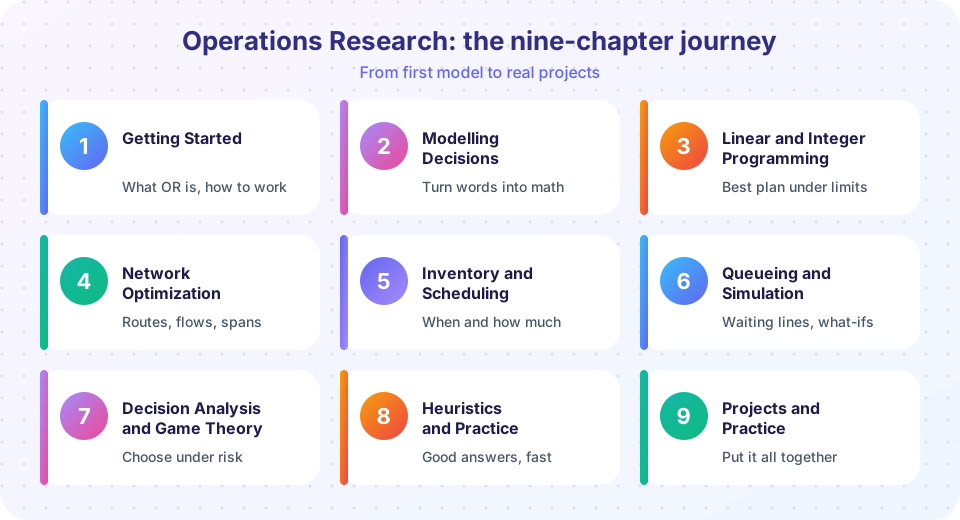
The nine chapters at a glance
Foundations
- Getting Started
- Modelling
- LP and IP
Chapters 1 to 3 teach you to build and solve models.
Structure and flow
- Networks
- Inventory
- Queues
Chapters 4 to 6 cover networks, stock and waiting lines.
Choice and practice
- Decisions
- Heuristics
- Projects
Chapters 7 to 9 deal with uncertainty, hard problems and real projects.
The first four chapters, which this part of the course covers in detail, follow one thread:
- Chapter 1 shows what OR is and how an OR study is organized, and sets up the Python tools you will use.
- Chapter 2 teaches the central skill: turning a messy story into variables, an objective and constraints.
- Chapter 3 solves those models: the graphical method, the simplex method, duality and integer programming.
- Chapter 4 specializes to networks: shortest paths, spanning trees, maximum flow and transportation.
Later chapters add stock control and scheduling, queues and simulation, decisions under risk and game theory, heuristics for problems that are too hard to solve exactly, and finally complete projects.
The running example: Sunrise Bakery
To keep the early chapters concrete we use one small company again and again. Sunrise Bakery makes batches of cakes and batches of bread. Each cake batch earns $60 and each bread batch earns $40. The oven is available for 16 hours a day and the baker's time for 14 hours a day. How many batches of each should the bakery make? It is a toy problem, but it contains the same pieces as a problem with 10,000 products, and you will watch the same ideas scale up. All company names and numbers in this course are invented examples.
Move the sliders until you cannot improve the profit without breaking a limit. That search is exactly what OR automates.
How to study
- Read each lesson once, then run every code block. Change a number and predict the result before you press Run.
- Draw the problem. A picture of a network or a feasible region often shows the answer before any calculation.
- Say the model aloud. If you cannot state the decision, the goal and the limits in three sentences, the model is not ready.
- Do the quiz without notes, then reread the explanations of the questions you missed.
- Review a chapter after a few days. The review lesson at the end of each chapter is built for that.
Common misconceptions
"Operations research is just for big companies." Any decision with limited resources and several options is an OR problem, from a household budget to a hospital timetable.
"The computer finds the answer, so the math is optional." The solver only answers the question you modelled. Most mistakes in practice come from a wrong or missing constraint, which only a person who understands the problem can notice.
"The best answer is always the one the model gives." A model is a simplification. The result is advice that must be checked against reality.
Try it
Press Run (or Ctrl + Enter) to see the result here.
Program input · what you'd type while the program runs
Type the answers before you press Run, one per line. Each time the program reads a line (with input()), it gets the next line from this box.
Check your understanding
Quick check · 4 questions
of 4 answered You scored / 4 · perfect!
-
1. What is the main goal of operations research?
OR supports decisions: it models a problem, finds a best or good answer, and checks it against reality. -
2. Which math background does this course expect?
Solving small systems of equations and reading inequalities is enough to start; the course builds the rest. -
3. In the Sunrise Bakery example, what limits the number of batches?
The oven (16 hours) and the baker (14 hours) are the scarce resources that make some plans infeasible. -
4. Why is a model's answer still checked against reality?
A model leaves details out. A missing constraint can make an answer that looks optimal impossible to carry out.
Summary
- Operations research turns decisions into models, solves them with algorithms and checks the results.
- The course has nine chapters: foundations (1 to 3), networks, stock and queues (4 to 6), and uncertainty, heuristics and projects (7 to 9).
- Sunrise Bakery is the running example; numbers in the course are invented for teaching.
- Study actively: run the code, draw the problem and state the model in words.
Track your progress
Create a free account to tick off lessons and pick up where you left off on any device.
of Operations Research lessons completed