


















Lesson 39 of 49 · Heuristics and Practice
Chapter 8 Overview: Heuristics and Practice
A map of chapter 8: why some optimization problems defeat exact methods, how heuristics find good answers fast, and how operations research projects work in practice.
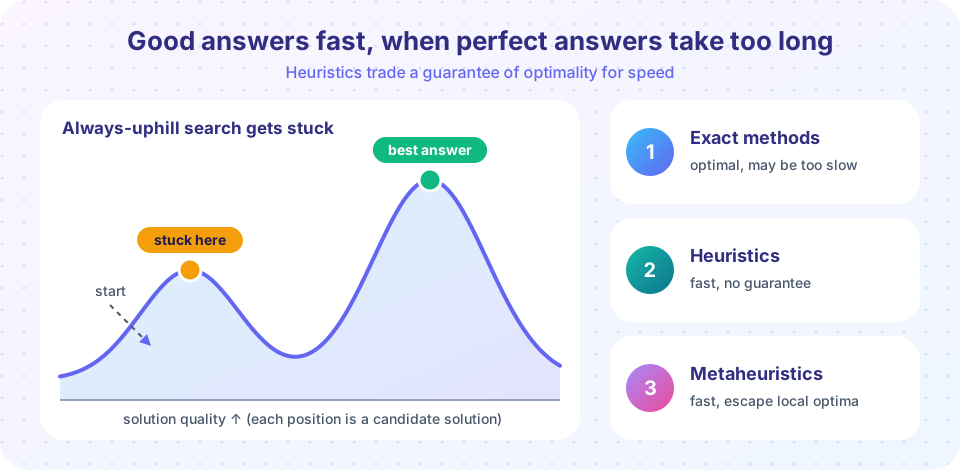
Linear programs can have millions of variables and still be solved in minutes. Yet a delivery planner choosing the order of stops for a single truck with a few dozen customers can run into a problem that no known method solves exactly in reasonable time. The difference is not the size of the data; it is the structure of the problem. This chapter is about what to do when exact methods are too slow: use a heuristic, a method that finds a good solution quickly without promising that it is the best.
It also closes the loop with practice. Methods matter only if they end up changing decisions, so the last lesson of the chapter follows the whole workflow of a real project.
What you will learn
- Why some problems explode in difficulty and what "NP-hard" means in practice.
- The difference between exact methods, heuristics and metaheuristics.
- How to measure a heuristic's quality with an optimality gap.
- How the chapter's lessons fit together.
Key terms
Heuristic: a practical rule or procedure that finds a good solution quickly but gives no guarantee of optimality.
Local optimum: a solution that no small change can improve, though a better one may exist elsewhere.
Metaheuristic: a general strategy (simulated annealing, genetic algorithms, tabu search) for guiding heuristics to avoid getting stuck.
NP-hard: a problem class for which no fast exact algorithm is known; exact solution times grow explosively with size.
Optimality gap: (heuristic value − best value) / best value, the percentage by which a heuristic misses the best answer.
When exact methods run out of steam
Take the traveling salesman problem (TSP): visit every city once and return home, minimizing the distance. For n cities, the number of distinct round trips is (n − 1)! / 2:
| Cities | Number of tours |
|---|---|
| 5 | 12 |
| 10 | 181,440 |
| 12 | 19,958,400 |
| 20 | about 6 × 10¹⁶ |
| 30 | about 4 × 10³⁰ |
A computer checking a billion tours per second would need over a year to finish 20 cities and far longer than the age of the universe for 30. Clever exact algorithms (branch and bound, dynamic programming, cutting planes) push the limit a long way (modern solvers handle thousands of cities), but they still take hours or days, and the general problem is NP-hard. Many other practical problems share this behavior: vehicle routing, scheduling many machines, bin packing, timetabling, facility layouts.
Three families of methods
Exact methods
Heuristics
Local search
Metaheuristics
An important rule of thumb: when a good heuristic exists, a solution a few percent from optimal is usually worth far more than a perfect answer delivered too late. A route that is 3 percent longer than optimal but ready in a second is better than the best route computed after the trucks have left.
Counting tours and finding the exact answer
The first program shows how fast the count grows. The second finds the true optimum for 12 cities with a clever dynamic program (the Held-Karp algorithm, which needs about n² · 2ⁿ steps instead of n!) and compares it with a quick heuristic.
Press Run (or Ctrl + Enter) to see the result here.
Program input · what you'd type while the program runs
Type the answers before you press Run, one per line. Each time the program reads a line (with input()), it gets the next line from this box.
Press Run (or Ctrl + Enter) to see the result here.
Program input · what you'd type while the program runs
Type the answers before you press Run, one per line. Each time the program reads a line (with input()), it gets the next line from this box.
Exact dynamic programming is fine for 12 cities but hopeless for 40, since 2⁴⁰ states is about a trillion. Heuristics keep working. The next lessons build them.
Where the chapter goes
| Lesson | What you will learn |
|---|---|
| Construction heuristics and local search | Greedy rules, nearest neighbor, knapsack by ratio, 2-opt moves and local optima |
| Simulated annealing | Accepting worse moves, cooling schedules, and a run on the TSP; tabu and genetic ideas |
| From messy problem to decision | The OR workflow, modelling a small business problem, sensitivity analysis and validation |
| Chapter 8 review | A recap picture and a ten-question quiz |
For evolutionary methods in depth, see the genetic algorithms track.
Common misconceptions
"A heuristic is a bad solution." A well-chosen heuristic is often within a few percent of optimal; the real cost is that you do not know how close.
"Exact methods are always better." If they cannot finish in time, they deliver nothing. Many practical systems run a heuristic for speed and an exact method as an offline check.
"Big problems need big computers." Often they need a better formulation or a smarter algorithm.
Check your understanding
Quick check · 4 questions
of 4 answered You scored / 4 · perfect!
-
1. How many distinct round trips visit 6 cities once each? Use (n − 1)!/2.
(6 − 1)!/2 = 120/2 = 60. -
2. What is a local optimum?
Local search stops at such a solution even when a better one exists elsewhere. -
3. A heuristic gives a tour of length 105 while the optimum is 100. What is the optimality gap?
(105 − 100)/100 = 5%. -
4. Which is NOT a metaheuristic?
Simulated annealing and genetic algorithms are metaheuristics; dividing by zero is simply an error.
Summary
- Some problems (TSP, vehicle routing, large scheduling) are NP-hard: exact solution times explode.
- Heuristics deliver good answers fast without a guarantee; metaheuristics help escape local optima.
- The optimality gap measures how far a heuristic is from the best known answer.
- A fast good answer usually beats a late perfect one.
Track your progress
Create a free account to tick off lessons and pick up where you left off on any device.
of Operations Research lessons completed