


















Lesson 33 of 46 · Stochastic Models and Simulation
Random walks and Markov chains
Model step-by-step randomness: random walks spread like the square root of time, gambler's ruin has a neat formula, and Markov chains settle into a long-run distribution.
Many random processes are built from simple steps. A drunk person staggers left or right. A gambler wins or loses one coin at a time. Tomorrow's weather depends on today's. Each step is random, yet the long-run behaviour follows clean laws. In this lesson you will meet two classical models: the random walk and the Markov chain, and use simulation to check the formulas.
What you will learn
- Why a random walk's spread grows like
√n, not liken. - How to compute and simulate gambler's ruin probabilities.
- How to write a Markov chain as a transition matrix and find its long-run distribution.
- How to check a formula by simulating the process.
Key terms
Random walk: a path built from independent random steps, such as ±1 with equal probability.
Gambler's ruin: the problem of whether a gambler with a finite fortune reaches a target before going broke.
Markov property: the next state depends only on the present state, not on the past.
Stationary distribution: a probability vector π with π·P = π; the chain's long-run fractions of time in each state.
Random walks
Start at 0. Each second, move +1 or −1 with equal probability. After n steps the position is the sum of n independent steps. Each step has mean 0 and variance 1, and variances of independent quantities add, so the position has mean 0 and variance n. Its standard deviation is √n.
So after 100 steps a typical walker is about 10 units from the start, not 100. After 10,000 steps, about 100. Randomness spreads out slowly, like the square root of time. This √n law is behind diffusion (a drop of dye spreading in water), measurement noise averaging out, and the 1/√N rule from the Monte Carlo lesson.
Gambler's ruin
You start with k coins and play a game that wins one coin with probability p and loses one with probability q = 1 − p. You stop when you reach N coins (success) or 0 (ruin). The probability of reaching N is
- if
p = 0.5:k/N - if
p ≠ 0.5:(1 − (q/p)^k) / (1 − (q/p)^N)
With k = 3, N = 10 and a fair game, you succeed with probability 0.3. Even a tiny disadvantage hurts a lot over long games: with p = 0.48 the success probability falls noticeably below 0.3 (you will compute it below). The casino does not need big edges, only many rounds.
Press Run (or Ctrl + Enter) to see the result here.
Program input · what you'd type while the program runs
Type the answers before you press Run, one per line. Each time the program reads a line (with input()), it gets the next line from this box.
Markov chains
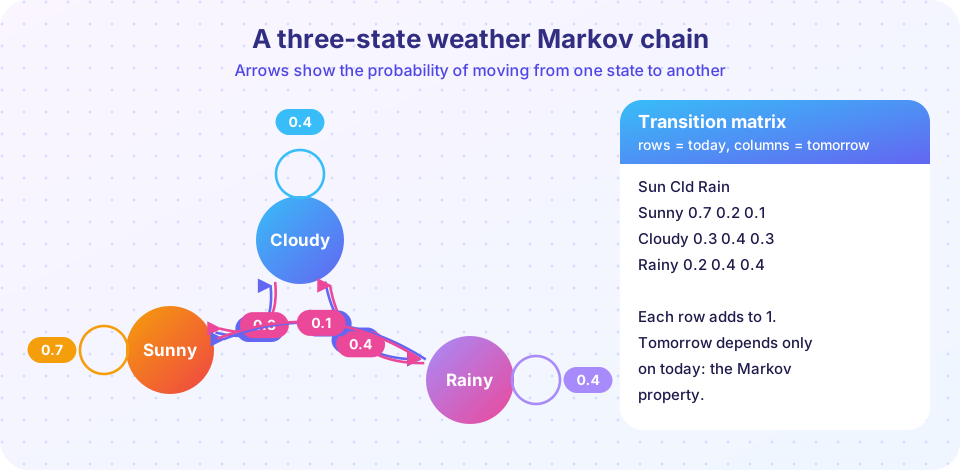
Suppose the weather each day is Sunny, Cloudy or Rainy, and the chance of tomorrow's weather depends only on today's. The transition matrix P collects those chances; row i is "today is state i", column j is "tomorrow is state j":
| Today \ Tomorrow | Sunny | Cloudy | Rainy |
|---|---|---|---|
| Sunny | 0.7 | 0.2 | 0.1 |
| Cloudy | 0.3 | 0.4 | 0.3 |
| Rainy | 0.2 | 0.4 | 0.4 |
Every row sums to 1. If π is today's probability vector (as a row), tomorrow's is π·P, and the day after is π·P². Remarkably, for chains like this one, the rows of Pⁿ all converge to the same vector, no matter where you start. That limit is the stationary distribution, the solution of π·P = π with Σπ = 1. It tells you the long-run fraction of sunny, cloudy and rainy days.
Another useful fact: the number of consecutive days a chain stays in a state with self-transition probability a is geometric, with mean 1/(1 − a). A sunny spell lasts 1/(1 − 0.7) = 3.33 days on average.
Press Run (or Ctrl + Enter) to see the result here.
Program input · what you'd type while the program runs
Type the answers before you press Run, one per line. Each time the program reads a line (with input()), it gets the next line from this box.
Common misconceptions
"After a run of losses, a win is due." Each step of a random walk is independent. The walk has no memory, and nothing is "due".
"A fair game means you will end up even." In a fair game the average gain is zero, but the spread of results grows like √n, and gambler's ruin shows you can still go broke.
"The Markov property means the past is irrelevant." It means the past matters only through the present state. If your model needs yesterday's weather to predict tomorrow, define the state as the last two days.
Simulating a game with a hidden advantage
The last demo is a small exploration: change p and watch the proportion of successful gamblers. Because the plot uses the exact formula, it also shows how a 2 percent edge compounds with the target size.
Press Run (or Ctrl + Enter) to see the result here.
Program input · what you'd type while the program runs
Type the answers before you press Run, one per line. Each time the program reads a line (with input()), it gets the next line from this box.
Check your understanding
Quick check · 5 questions
of 5 answered You scored / 5 · perfect!
-
1. A symmetric random walk takes 400 steps. About how far from the start is a typical walker?
The standard deviation of the position is sqrt(400) = 20. -
2. In a fair game you start with 3 coins and stop at 10 or 0. What is the chance of reaching 10?
For p = 0.5 the success probability is k/N = 3/10. -
3. What does the Markov property say?
Given the present, the past does not add information about the next step. -
4. The rows of a transition matrix must:
Each row is a probability distribution over tomorrow's state. -
5. A state has self-transition probability 0.8. How long does a stay in it last on average?
The stay is geometric with mean 1/(1 - 0.8) = 5.
Summary
- A random walk's spread grows like
√n. - Gambler's ruin:
k/Nfor a fair game, a geometric formula otherwise; small edges compound. - A Markov chain is a transition matrix; rows of
Pⁿconverge to the stationary distributionπ = πP. - Simulation and formulas should agree; use one to check the other.
Next: Queue simulation
Track your progress
Create a free account to tick off lessons and pick up where you left off on any device.
of Mathematical Modelling lessons completed