


















Lesson 11 of 46 · Dimensional Analysis and Scaling
Dimensions and Scaling: Overview
Chapter 3 overview: why size changes everything, the square-cube law, and how units and dimensional analysis let you find formulas before you solve anything.
Why can an ant carry many times its own weight, while an elephant cannot even jump? Why do small animals eat almost constantly while whales do not? Why does a model airplane in a wind tunnel tell engineers about a real jet? The answers all rest on a simple fact: when you change the size of something, different quantities change at different rates.
This chapter gives you three tools that work before you solve a single equation: checking dimensions, building dimensionless groups, and reading scaling laws. They make models smaller, safer and often much more general.
The big picture
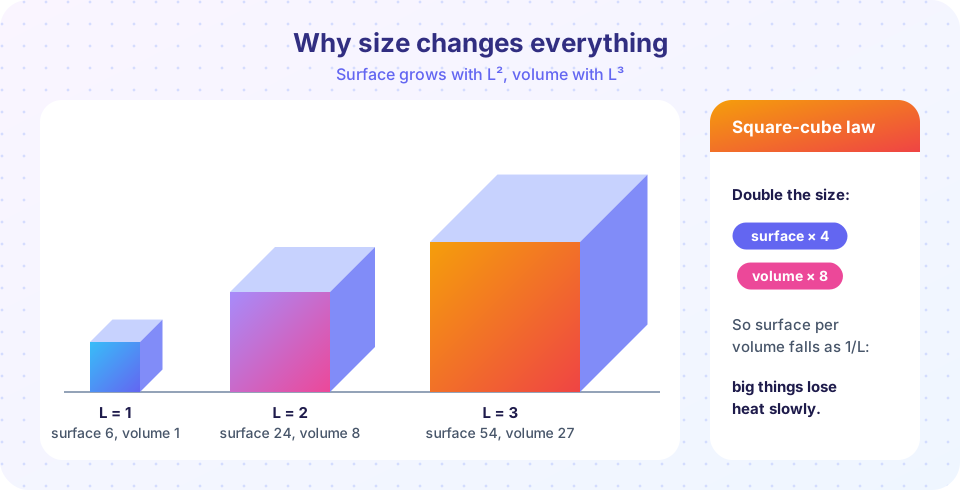
Take any object and make it twice as long in every direction. Its surface area grows by a factor of 2² = 4 and its volume (and mass, if the material is the same) by 2³ = 8. So the ratio of surface to volume halves. In general, for a scale factor s:
- lengths grow as
s - areas grow as
s² - volumes and masses grow as
s³
This is the square-cube law. Galileo described it in 1638 in his book Two New Sciences when he argued that giants built exactly like humans would collapse under their own weight. The reason is that bone strength depends on the cross-section of bone (it grows as s²) but the weight to be carried grows as s³. The load per unit area, the stress, therefore grows in proportion to s.
Size changes ratios
Why animals differ
Big bodies lose heat slowly.
Three tools
What this chapter covers
| Lesson | You will learn |
|---|---|
| Units and Dimensions | SI base dimensions, dimensional homogeneity, and using units as an error detector |
| Buckingham Pi and Dimensionless Groups | Deriving the pendulum law from units alone; why dimensionless numbers matter |
| Scaling Laws and Allometry | Power laws, log-log plots and metabolic scaling in animals |
| Chapter 3 Review | A one-page picture and a longer quiz |
Try it
First, tabulate the square-cube law yourself. The ratio of surface to volume is the key quantity for heat loss, chemistry at surfaces and anything that must cross a boundary.
Press Run (or Ctrl + Enter) to see the result here.
Program input · what you'd type while the program runs
Type the answers before you press Run, one per line. Each time the program reads a line (with input()), it gets the next line from this box.
Now try an interactive version about Galileo's argument. Scale a "giant" up from human size and watch the stress on its bones. We assume bone stress is proportional to weight divided by bone cross-section, with everything scaled equally. (This is a classroom model, not a measurement of any real animal.)
Check your understanding
Quick check · 4 questions
of 4 answered You scored / 4 · perfect!
-
1. A cube's side doubles. By what factor does its volume grow?
Volume scales as the cube of the length: 2 cubed is 8. -
2. What happens to the surface-area-to-volume ratio when a shape is scaled up?
Surface grows as s squared but volume as s cubed, so their ratio falls as 1/s. -
3. Why would a giant built exactly like a human struggle, according to Galileo?
Weight grows like s cubed while bone strength grows like s squared. -
4. Which tool in this chapter lets you find a formula from units alone?
Buckingham Pi analysis finds dimensionless combinations of variables, often giving the form of a law.
Summary
- Scaling a shape by
smultiplies lengths bys, areas bys²and volumes bys³. - Surface-to-volume ratio falls as
1/s, which affects heat loss, structure and chemistry. - This chapter's three tools are dimensions, dimensionless groups and power laws.
- They help you check, simplify and generalize models before solving.
Next: Units and Dimensions
Track your progress
Create a free account to tick off lessons and pick up where you left off on any device.
of Mathematical Modelling lessons completed