


















Lesson 5 of 46 · Getting Started
Chapter 1 Review: Getting Started
Review chapter 1 of Mathematical Modelling: what a model is, how to classify models, and the Python tools. A recap table, a one-page picture and a ten-question quiz.
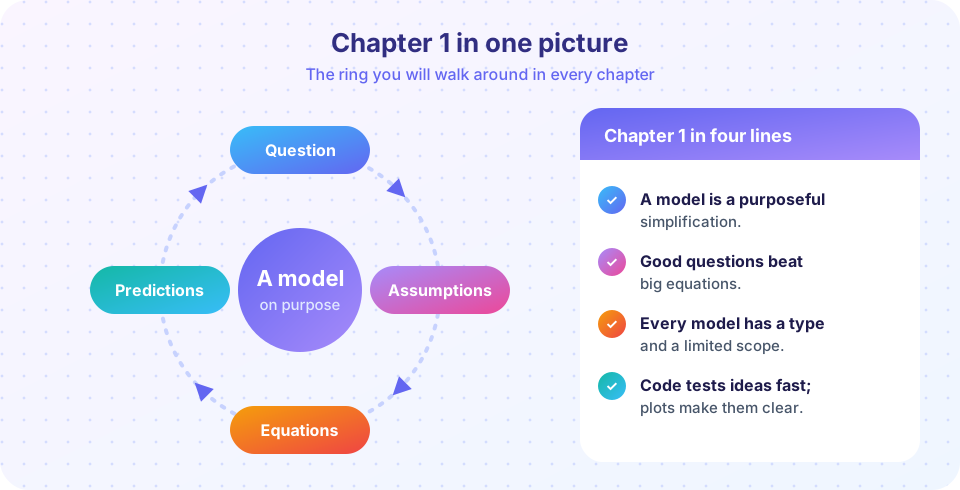
You have met the central idea of the course: a model is a purposeful simplification, and the real skill is deciding what to keep. You have also seen four families of models and the Python tools that bring them to life. This review pulls it together before the real workflow begins in Chapter 2.
The chapter in a table
| Lesson | Big idea | Example |
|---|---|---|
| Course Map | Modelling is the whole path from question to trusted answer | Savings growth, doubling time |
| What Is a Mathematical Model? | A model is a simplification built on stated assumptions | Leaking tank dh/dt = −k√h |
| Types of Models | Chance or not, steps or flow, theory or data | Quadratic fit versus cooling law |
| The Python Modelling Toolkit | NumPy, SciPy, SymPy and Matplotlib turn equations into evidence | Euler versus solve_ivp |
Key formulas and facts to remember
- Tank model:
dh/dt = −k√h, withk = (a/A)√(2g); solutionh(t) = (√h₀ − kt/2)²; empties att = 2√h₀/k. - Discrete rule:
x(n+1) = f(x(n)). Continuous rule:dx/dt = f(x). - Euler's method:
y_new = y + f(t, y)·dt; the error is roughly proportional todt. - Empirical models fit data; mechanistic models explain it. Only the second type extrapolates reliably.
Try it
Build your own model card. A model card is a short, structured note that records the question, assumptions and result in one place. You will use this habit throughout the course. Fill in the dictionary and run it.
Press Run (or Ctrl + Enter) to see the result here.
Program input · what you'd type while the program runs
Type the answers before you press Run, one per line. Each time the program reads a line (with input()), it gets the next line from this box.
Now see where a simple model's prediction depends on a parameter. Which of the two parameters changes the emptying time more when each is doubled: the tank's area A or the hole's area a? Predict, then run.
Press Run (or Ctrl + Enter) to see the result here.
Program input · what you'd type while the program runs
Type the answers before you press Run, one per line. Each time the program reads a line (with input()), it gets the next line from this box.
The last line shows something subtle. Doubling the depth does not double the time, because deeper water also drains faster. Questions like "how does the answer scale with this input?" return in Chapter 3.
Check your understanding
Quick check · 10 questions
of 10 answered You scored / 10 · perfect!
-
1. Which sentence best describes a mathematical model?
Models simplify on purpose, keeping what the question needs. -
2. In the tank model, which quantity is a parameter?
k is fixed during a run. h and t change. -
3. A stochastic model of daily rainfall is run ten times. What do you expect?
Randomness means repeated runs differ, and you study their distribution. -
4. Which pair correctly matches model and type?
A rule from step n to step n+1 is a discrete-time model. A derivative signals continuous time. -
5. Why can a quadratic curve fitted to 20 minutes of cooling data fail at 60 minutes?
Empirical curves know nothing about the process, so extrapolation is unreliable. -
6. Euler's method with step dt = 0.1 gives an error of about 0.004. About what error do you expect with dt = 0.05?
Euler's method is first order, so halving the step roughly halves the error. -
7. You solved a model two ways (algebra and simulation) and they agree. What have you shown?
Agreement checks the solution. Validation against reality is a separate step. -
8. Which Python library is best for checking an algebraic solution exactly?
SymPy works with exact formulas, so it can verify that a proposed solution satisfies the equation. -
9. Kepler's third law (T squared proportional to a cubed) was found from data. Newton's gravitation later explained it. Which is mechanistic?
Newton's theory explains why the relationship holds, so it is mechanistic. Kepler's law was fitted to observations. -
10. In the tank model, doubling the starting depth to 2 m changes the emptying time by a factor of:
t_empty = 2 sqrt(h0) / k, so the time scales with the square root of the depth.
Summary
- A model is a purposeful simplification with stated assumptions, a question and a way to test it.
- Classify by chance, time and theory: this chooses your tools.
- NumPy, SciPy, SymPy and Matplotlib cover almost everything you need.
- Two solution methods that agree check the mathematics, not the model.
- A model card keeps question, assumptions and results together.
Track your progress
Create a free account to tick off lessons and pick up where you left off on any device.
of Mathematical Modelling lessons completed