


















Lesson 7 of 46 · The Modelling Cycle
Defining the Problem and Choosing Assumptions
Turn a vague wish into a precise modelling question, sort variables from parameters, write assumptions down, and test which ones matter with sensitivity.
"Is my coffee too hot?" is a fine thing to wonder and a terrible modelling question. It has no number in it, no time, no target. You cannot compute an answer to it, and two people could build entirely different models and both think they answered it.
The first two steps of the cycle, define and assume, decide the quality of everything that follows. Time spent here is the cheapest time in the whole project.
What you will learn
- How to sharpen a vague idea into a question a model can answer
- How to sort quantities into variables, parameters, constants and inputs
- How to write assumptions as a visible, checkable list
- How a quick sensitivity test shows which assumptions matter most
Key terms
Modelling question: a precise question with a quantity, units, a context and a purpose.
Input and output: what you give the model and what it must produce.
Constant: a quantity that does not change in the situation (assumed here: room temperature).
Sensitivity: how much the answer changes when an input or assumption changes.
Scope: the range of situations where the model is meant to be used.
From wish to question
Start with the purpose. Who needs the answer and what will they do with it? A café owner wants to know when to serve coffee so customers do not burn their mouths. A physicist might want the cooling rate. The same cup, different questions.
A strong modelling question contains:
- A target quantity (a time, a temperature, a count, a cost).
- Units (minutes, °C, dollars).
- A starting situation (coffee poured at 90 °C into a ceramic mug in a 21 °C room).
- A decision or purpose (when is it safe to drink?).
So the wish becomes: "After pouring at 90 °C in a room at 21 °C, how many minutes until the coffee reaches 60 °C?" Now a model can answer it, and so can a stopwatch, which will matter when we check the result.
Sorting the quantities
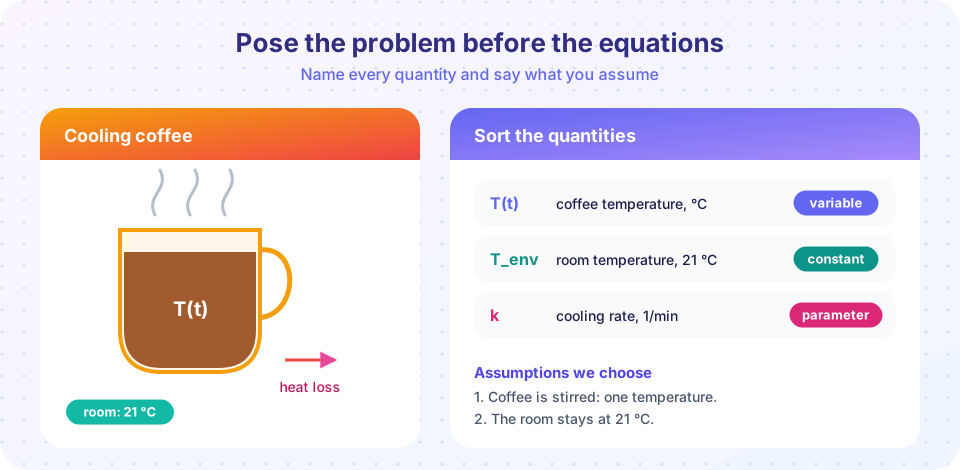
Make a table before you write a single equation. For the coffee:
| Symbol | Meaning | Unit | Role |
|---|---|---|---|
t |
time since pouring | min | independent variable |
T(t) |
coffee temperature | °C | dependent variable (the output) |
T₀ |
starting temperature | °C | initial condition (90) |
T_env |
room temperature | °C | constant (21), assumed |
k |
cooling rate | 1/min | parameter, to be estimated |
- A variable changes during the process; the dependent one is the thing you want, the independent one is what it depends on (usually time).
- A parameter is fixed within one run but may be changed or estimated between runs.
- A constant is treated as unchanging in this problem. (Room temperature is not a law of nature. It is an assumption we choose to hold fixed.)
Notice that every row has a unit. Units are your first error detector, and Chapter 3 is devoted to them.
Writing assumptions
An assumption is any statement you accept without proving it. Models without written assumptions still have them, only hidden, and hidden assumptions are the ones that bite. A good assumption list has three kinds of entries:
- Simplifications: "the coffee is stirred, so it has one temperature everywhere."
- Structure: "heat loss rate is proportional to the temperature difference" (this is Newton's law of cooling, published by Isaac Newton in 1701).
- Numbers: "the room stays at 21 °C."
For each, ask: if this were false, what would happen to the answer? Writing that second column is what turns a list of beliefs into a plan for testing.
| Assumption | If false, then... |
|---|---|
| Coffee is well mixed | The surface cools faster than the core, so my drink temperature depends on where I sip |
| Room stays at 21 °C | A cold draft makes cooling faster |
| Loss proportional to difference | Evaporation (important when very hot) makes early cooling faster than predicted |
| Mug does not absorb heat | The first minute drops faster as the ceramic warms up |
Which assumptions matter? A first sensitivity test
You cannot test everything, so test the cheap thing first: change each input a little and see how much the answer moves. The model we will build in the next lesson gives the time to cool from T₀ to a target T* as
t = −ln((T* − T_env) / (T₀ − T_env)) / k
Do not worry about where it comes from yet. Treat it as a black box and poke it.
Press Run (or Ctrl + Enter) to see the result here.
Program input · what you'd type while the program runs
Type the answers before you press Run, one per line. Each time the program reads a line (with input()), it gets the next line from this box.
The next step is the standard professional trick: change each input by the same relative amount (say ±20%) and compare the swings in a single chart. The longest bar shows the assumption you should worry about first.
Press Run (or Ctrl + Enter) to see the result here.
Program input · what you'd type while the program runs
Type the answers before you press Run, one per line. Each time the program reads a line (with input()), it gets the next line from this box.
Read the bars carefully, because they hold two lessons. First, the target and starting temperatures swing the answer most, but those are part of the question and you know them exactly. That shows how much precision in the question matters. Second, among the inputs you must actually estimate, the cooling rate k moves the answer far more than the room temperature does. So a quick stopwatch experiment to measure k is worth more than a better thermometer for the room, and a rough guess of 21 °C is perfectly fine.
Common misconceptions
"More assumptions make a model weaker." Hidden assumptions are the weakness. A long, written list is a sign of honest modelling.
"Any question will do, the model will sort it out." The model answers exactly the question you pose. A fuzzy question gives an answer to something you did not mean.
"Assumptions are facts." They are choices. Say "I assume" and give a reason, not "it is".
Check your understanding
Quick check · 5 questions
of 5 answered You scored / 5 · perfect!
-
1. Which is the best modelling question?
It names a quantity, units, a starting situation and a target. The others cannot be computed. -
2. In the coffee model, which quantity is the dependent variable?
T(t) is the output that depends on time. Time is the independent variable. -
3. Why should each assumption have an 'if false, then...' note?
The note connects each assumption to a possible failure, which guides what you check later. -
4. A sensitivity test changes each input by 20%. What does a long bar for k mean?
A long bar means high sensitivity, so the uncertainty in that input matters most. -
5. 'The room stays at 21 degrees' is best described as:
Room temperature does vary in reality. We choose to treat it as constant for this problem.
Summary
- Sharpen a vague idea into a question with a target quantity, units, a starting situation and a purpose.
- Sort every quantity into variable, parameter, constant or initial condition, and attach a unit.
- Write assumptions explicitly, each with an "if false" note.
- One-at-a-time sensitivity shows which assumptions and inputs matter most.
Next: Building the Model
Track your progress
Create a free account to tick off lessons and pick up where you left off on any device.
of Mathematical Modelling lessons completed