


















Lesson 46 of 46 · Projects and Practice
Further study: where to go next
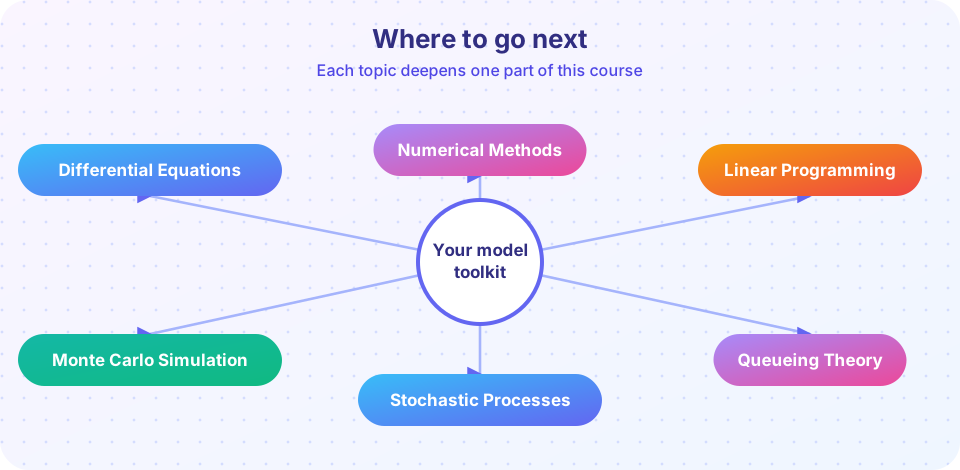
Plan your next steps after this course: deeper tracks on differential equations, numerical methods, linear programming, Monte Carlo, stochastic processes and queueing.
You now know how to turn a question into a model, solve it with equations or simulation, check it and explain it. This last lesson shows where each thread of the course continues, which skills to practise, and how to choose a first project of your own.
What you will learn
- Which track extends each chapter of this course.
- Which habits matter more than any single technique.
- How to choose and scope a first modelling project of your own.
Key terms
Toolkit: the set of methods you can apply without looking them up.
Scope: the boundary of what a project will and will not try to answer.
Reproducible: another person can rerun your work and get the same results.
Where each thread continues
- Chapter 5, continuous models. Go deeper into equations and their solutions in Differential Equations, and into how computers solve them (step size, stability, stiff problems) in Numerical Methods.
- Chapter 6, optimization. Linear Programming covers the simplex method, duality and network models. Convex Optimization explains why some problems are easy to solve for global optima, and Game Theory handles optimization when several decision-makers interact.
- Chapter 7, stochastic models. Monte Carlo Simulation covers variance reduction and sampling methods, Stochastic Processes develops Markov chains and Poisson processes with full proofs, and Queueing Theory extends M/M/1 to many servers and networks.
- Chapter 8, validation and communication. Statistics and Probability provides the theory behind confidence intervals, fitting and hypothesis tests, and Linear Algebra underlies least squares and almost every large model.
Habits that outlast any technique
- Start small. Build the simplest model that could answer the question, then add one thing at a time.
- Check in two ways. Compare a formula with a simulation, or two step sizes, or a limiting case.
- Write assumptions down. Your future self will not remember them.
- Make it reproducible. Fix random seeds, record versions and keep data and code together.
- Show ranges. Whenever a number depends on uncertain inputs, give an interval.
Choosing a first project
A good first project has a question you care about, data you can get (or a way to make honest synthetic data), and a model small enough to finish in a few weeks. Some starting points:
| Interest | Question | Tools from this course |
|---|---|---|
| Health | How would a vaccination programme change an outbreak's peak? | SIR, sensitivity, fan chart |
| Environment | What fishing effort keeps a lake's stock healthy? | logistic harvesting, equilibria |
| Business | Which products should a small shop make this week? | linear programming, shadow prices |
| Cities | How many ticket machines does a station need? | queues, simulation |
| Games | How long does a board game last on average? | Markov chains, Monte Carlo |
| Science | How fast does my coffee (or oven, or room) cool? | ODE, curve fitting, error bars |
Write the one-page report first (question, assumptions, planned model, planned checks), then build. If you cannot write the question in one sentence, narrow the scope.
Try it
This small program recommends a next track from a few answers. It is a toy, but it shows how a decision tool can be written as a handful of rules, and you can extend it with your own tracks.
Press Run (or Ctrl + Enter) to see the result here.
Program input · what you'd type while the program runs
Type the answers before you press Run, one per line. Each time the program reads a line (with input()), it gets the next line from this box.
A second experiment ties the course together in one picture: the same decay curve described by an ODE, a random simulation and a fitted model. Notice that each tool answers a slightly different question.
Press Run (or Ctrl + Enter) to see the result here.
Program input · what you'd type while the program runs
Type the answers before you press Run, one per line. Each time the program reads a line (with input()), it gets the next line from this box.
Common misconceptions
"I must master all the mathematics before building models." Build small models early and learn the mathematics as the models demand it. Each project will show you what to study next.
"The most advanced technique is the best." A well-posed question, honest data and a simple model beat an advanced method applied to the wrong question.
"Modelling is finished when the code runs." Running code is the middle of the cycle. Checking, sensitivity analysis and communication are what make a model useful.
Check your understanding
Quick check · 4 questions
of 4 answered You scored / 4 · perfect!
-
1. Which track would you study to learn how computers solve ODEs and control their errors?
Numerical Methods covers step size, stability and error of solvers. -
2. Which extension is the natural next step for the M/M/1 queue?
Queueing Theory generalizes the single server to multi-server systems and networks. -
3. Why write the one-page report before building the model?
A clear question and scope prevent aimless modelling. -
4. Which habit makes your work reproducible?
Others can rerun your work and obtain the same results.
Summary
- Each chapter of this course connects to a deeper track: equations, numerics, optimization, simulation, stochastic processes, queues, statistics.
- Start with a small question, check in two ways, write assumptions and show ranges.
- Write the one-page report first, then build the model.
- Modelling is a cycle: question, assume, build, solve, check, report, repeat.
Track your progress
Create a free account to tick off lessons and pick up where you left off on any device.
of Mathematical Modelling lessons completed