


















Lesson 17 of 46 · Discrete Dynamical Models
Difference Equations and Their Solutions
Solve linear difference equations x(n+1) = r x(n) + b in closed form, find equilibria and stability, price a loan, and meet Fibonacci and the golden ratio.
When time moves in steps, the language of change is the difference equation: a rule linking each value to the ones before it. In this lesson you will master the most important case, the linear rule, because it is both common and completely solvable. Knowing it well also prepares you for the nonlinear ones in the next lesson.
What you will learn
- How to solve
xₙ₊₁ = r xₙ + bwith a closed formula - How to find the equilibrium and decide whether it is stable
- How to build and use a loan model
- How second-order rules such as Fibonacci lead to the golden ratio
Key terms
Difference equation (recurrence): a rule that expresses xₙ₊₁ using earlier values.
Closed form: a formula for xₙ that needs no earlier values.
Equilibrium (fixed point) x*: a value with f(x*) = x*.
Stable equilibrium: nearby starting values move toward it as n grows.
Amortization: paying off a loan with regular instalments.
The pure growth rule
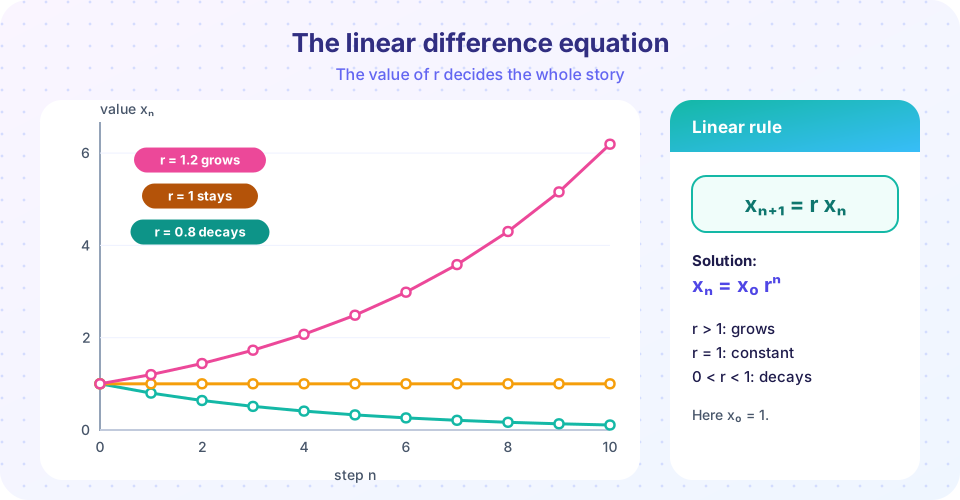
The simplest rule is xₙ₊₁ = r xₙ. Apply it repeatedly: x₁ = r x₀, x₂ = r² x₀, and so xₙ = x₀ rⁿ. This is geometric growth or decay, depending on r:
r > 1: grows without boundr = 1: stays constant0 < r < 1: decays toward 0−1 < r < 0: decays toward 0 while flipping sign each stepr < −1: grows while flipping sign
Adding a constant: x(n+1) = r x(n) + b
Real systems add or remove a fixed amount each step: a monthly deposit, a loan payment (negative b), immigration, harvesting. The rule becomes xₙ₊₁ = r xₙ + b.
Step 1: find the equilibrium. Set x* = r x* + b, so x* = b / (1 − r) (when r ≠ 1).
Step 2: measure distance from equilibrium. Let dₙ = xₙ − x*. Then
dₙ₊₁ = xₙ₊₁ − x* = (r xₙ + b) − (r x* + b) = r (xₙ − x*) = r dₙ
The distance obeys the pure rule, so dₙ = r^n d₀. Therefore
xₙ = x* + rⁿ (x₀ − x*)
Stability. If |r| < 1, rⁿ → 0 and the sequence converges to x* (stable). If |r| > 1 it runs away (unstable).
Example: xₙ₊₁ = 0.8 xₙ + 4. Here x* = 4/(1 − 0.8) = 20. From x₀ = 100: xₙ = 20 + 80 · 0.8ⁿ. From x₀ = 0: xₙ = 20 − 20 · 0.8ⁿ. Both approach 20.
Press Run (or Ctrl + Enter) to see the result here.
Program input · what you'd type while the program runs
Type the answers before you press Run, one per line. Each time the program reads a line (with input()), it gets the next line from this box.
Starting at the equilibrium (x₀ = 20) the sequence never moves, which is exactly what "fixed point" means.
Case study: a loan
You borrow B₀ at monthly interest rate i and repay P each month. Interest is added to the balance, then you pay:
Bₙ₊₁ = (1 + i) Bₙ − P
This is our rule with r = 1 + i and b = −P. The "equilibrium" is x* = P/i: the balance at which interest exactly cancels the payment. Because r > 1, it is unstable. If B₀ < P/i, the balance falls to zero (the loan is repaid); if B₀ > P/i, the balance grows forever. Solving for zero balance after N payments gives the standard instalment formula:
P = B₀ i / (1 − (1 + i)^(−N))
With B₀ = 10,000, i = 0.5% per month (6% a year, compounded monthly) and N = 60 months, the payment is about 193.33. Check it with a simulation, and look at how each payment splits into interest and principal. (This is an arithmetic model, not financial advice. Real loans have fees and differences in how interest is quoted.)
Press Run (or Ctrl + Enter) to see the result here.
Program input · what you'd type while the program runs
Type the answers before you press Run, one per line. Each time the program reads a line (with input()), it gets the next line from this box.
Second-order rules: Fibonacci
Some rules use the two previous values. The Fibonacci sequence Fₙ₊₁ = Fₙ + Fₙ₋₁ (from Leonardo of Pisa's rabbit puzzle, 1202) is the famous one. Try a solution of the form Fₙ = λⁿ. Substituting gives λ² = λ + 1, the characteristic equation, with roots
λ = (1 ± √5) / 2, i.e. φ ≈ 1.618 (the golden ratio) and ψ ≈ −0.618.
The general solution is Fₙ = A φⁿ + B ψⁿ, and fitting F₀ = 0, F₁ = 1 gives Binet's formula Fₙ = (φⁿ − ψⁿ)/√5. Since |ψ| < 1, the second term fades and Fₙ grows like φⁿ: the ratio of consecutive terms tends to the golden ratio.
Iteration also solves equations. Newton's method for √2 uses the rule xₙ₊₁ = (xₙ + 2/xₙ)/2, whose fixed point is √2. The sequence converges extremely fast, roughly doubling the number of correct digits each step.
Press Run (or Ctrl + Enter) to see the result here.
Program input · what you'd type while the program runs
Type the answers before you press Run, one per line. Each time the program reads a line (with input()), it gets the next line from this box.
Common misconceptions
"A closed form is always better." It is great for insight, but when no closed form exists (the logistic map, next lesson) simulation is the honest tool.
"If r is close to 1, nothing much happens." Small differences compound. With r = 1.01 over 100 steps the value grows by a factor of about 2.7; with r = 0.99 it shrinks to about 0.37.
"The loan equilibrium P/i is where the loan ends." It is the unstable balance where interest equals the payment. Below it, you pay off; above it, you fall further behind.
Check your understanding
Quick check · 5 questions
of 5 answered You scored / 5 · perfect!
-
1. The closed form of x(n+1) = r x(n) with x(0) = x0 is:
Each step multiplies by r, so after n steps the factor is r^n. -
2. For x(n+1) = 0.5 x(n) + 3, what is the equilibrium?
x* = b / (1 - r) = 3 / 0.5 = 6. -
3. An equilibrium of x(n+1) = r x(n) + b with r = -0.5 is:
|r| = 0.5 < 1, so the distance from equilibrium shrinks, flipping sign each step. -
4. In the loan model B(n+1) = (1 + i) B(n) - P, the 'equilibrium' P/i is:
Here r = 1 + i > 1, so deviations grow. That is why a loan is either paid off or snowballs. -
5. Which number does F(n+1)/F(n) approach for Fibonacci numbers?
The dominant root of lambda^2 = lambda + 1 is (1 + sqrt 5)/2, about 1.618.
Summary
xₙ₊₁ = r xₙgivesxₙ = x₀ rⁿ; the size ofrdecides growth, constancy or decay.xₙ₊₁ = r xₙ + bhas equilibriumx* = b/(1 − r)and solutionxₙ = x* + rⁿ (x₀ − x*); it is stable when|r| < 1.- A loan is the same rule with
r = 1 + iandb = −P; its instalment formula comes from requiring zero balance afterNpayments. - Second-order rules use a characteristic equation; Fibonacci gives the golden ratio.
Track your progress
Create a free account to tick off lessons and pick up where you left off on any device.
of Mathematical Modelling lessons completed