


















Lesson 6 of 46 · The Modelling Cycle
The Modelling Cycle: Overview
Chapter 2 overview: the six-step modelling cycle from defining the question to reporting results, why it loops, and a first Fermi estimate you can run.
Experienced modellers do not start by writing equations. They start by asking, writing, doubting and sketching, and only then calculate. That order is not a matter of taste: it is what separates a model that answers a question from a pile of correct but useless algebra.
This chapter teaches the workflow professionals use, and you will apply it to one running example, a cooling cup of coffee, so you can see every step on the same problem.
The big picture
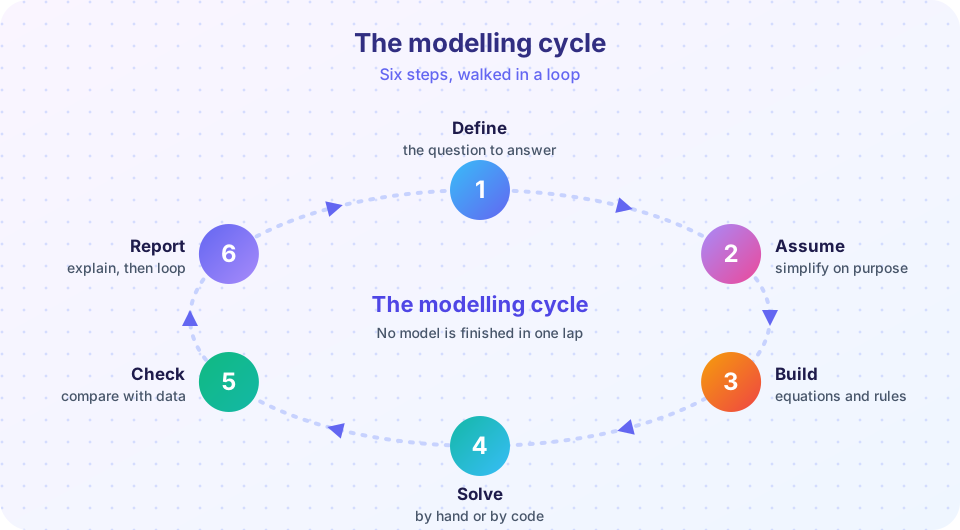
The modelling cycle has six steps. Different textbooks and syllabi name them slightly differently (formulate, solve, interpret, validate and so on), but the shape is always a loop:
- Define the question in a way that can be answered with numbers.
- Assume: decide what matters, what to ignore, and write it down.
- Build the mathematics: variables, equations, rules.
- Solve it, by hand or by computer.
- Check the result against units, limits, common sense and data.
- Report the answer, its limits and what to do next, then loop back.
The spirit is close to the four steps George Pólya taught for problem solving in 1945: understand the problem, make a plan, carry it out, look back. Modelling adds one crucial extra layer: the problem itself is messy, and you have to decide what it is.
Define
Assume
Build and solve
Check and report
Then loop back with a better question.
Why a cycle and not a line?
Suppose your coffee model predicts the drink reaches 60 °C after 9.5 minutes, but a stopwatch says 7. Something is off: perhaps heat also leaves through evaporation at the surface, which your first assumptions ignored. You return to step 2, add that effect, and rebuild. Each lap improves the model. The skill is knowing when it is good enough for the purpose, not when it is perfect.
A useful rule of thumb: do one very rough lap first. A crude model built in an hour often tells you which details matter, so the second lap spends effort where it counts.
What each lesson covers
| Lesson | You will learn |
|---|---|
| Defining the Problem and Choosing Assumptions | Turning a vague wish into a question, sorting variables, parameters and constants, writing assumptions |
| Building the Model | Balance laws, stocks and flows, constitutive rules, and how Newton's cooling law arises |
| Solving, Interpreting and Iterating | Solving by formula and by code, reading the answer, sensitivity and the next lap |
| Chapter 2 Review | A cheat sheet and a longer quiz |
Try it
The fastest first lap is a Fermi estimate, named after the physicist Enrico Fermi, who was famous for quick order-of-magnitude answers. You split a big unknown into smaller guesses, give each a plausible range, and combine them. The answer is not exact but it tells you whether the true value is closer to ten, a thousand or a million.
Question: roughly how many liters of water does a city of one million people use for drinking and cooking in a day?
Press Run (or Ctrl + Enter) to see the result here.
Program input · what you'd type while the program runs
Type the answers before you press Run, one per line. Each time the program reads a line (with input()), it gets the next line from this box.
Now step through the cycle yourself. The stepper below walks one example through all six steps. Click "Next" and notice how the answer improves each time.
Check your understanding
Quick check · 4 questions
of 4 answered You scored / 4 · perfect!
-
1. Which is the correct order of the six steps?
You pose the question, choose assumptions, build the mathematics, solve it, check it and report, then often loop. -
2. Why is the modelling process drawn as a cycle?
A failed check usually points back to an assumption or a variable, and the improved model gets a new lap. -
3. What is a Fermi estimate?
Fermi estimates give order-of-magnitude answers quickly, which helps you decide where to spend effort. -
4. A good first lap of modelling should usually be:
A crude model shows which parts of the problem the answer is sensitive to.
Summary
- The modelling cycle has six steps: define, assume, build, solve, check, report.
- It loops because checking reveals what to improve.
- Do a rough lap first, then spend effort where it matters.
- Fermi estimates are a fast way to start.
- This chapter follows one example, a cooling cup of coffee, through every step.
Track your progress
Create a free account to tick off lessons and pick up where you left off on any device.
of Mathematical Modelling lessons completed