


















Lesson 44 of 46 · Projects and Practice
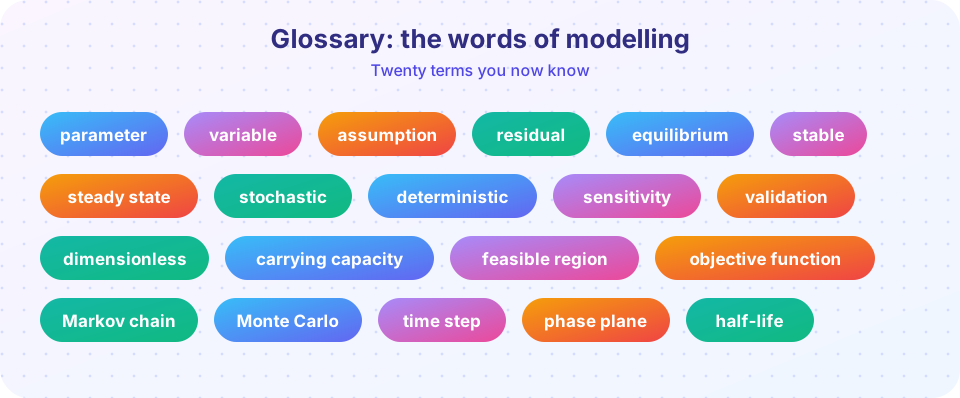
Glossary: the words of modelling
A glossary of the key terms from the ODE, optimization, stochastic and validation chapters, with one-line definitions and an interactive flashcard trainer.
Precise words make precise thinking. This glossary collects the main terms of the second half of the course in one place, grouped by chapter, with a one-line meaning each. Use it as a reference when reading, and then test yourself with the flashcard trainer below.
What you will learn
- The vocabulary of ODE models, optimization, simulation and validation.
- How terms from different chapters connect (for example, equilibrium and steady state).
- How to explain each idea in one sentence.
Key terms
Parameter: a constant in a model, such as k or β, whose value is chosen or fitted.
Variable: a quantity that changes, such as population or time.
Assumption: something the model takes as true without proof.
Model: a simplified description of a system, built for a purpose.
Chapter 5: continuous models
| Term | Meaning |
|---|---|
| Ordinary differential equation (ODE) | An equation relating a function of one variable to its derivatives. |
| Initial value problem | An ODE plus the starting value that selects one solution. |
| Rate constant | The number multiplying the state in a rate law, such as k in dy/dt = k·y. |
| Half-life | Time for a decaying quantity to halve: ln(2)/k. |
| Carrying capacity | The population K the environment can sustain. |
| Equilibrium | A state where the rate of change is zero. |
| Stable / unstable | Whether nearby solutions move toward or away from an equilibrium. |
| Phase plane | A plot of one state variable against another. |
Basic reproduction number R₀ |
Average infections per case in a fully susceptible population: β/γ. |
| Euler's method | Step method y + h·f(t, y); first order. |
| Runge-Kutta (RK4) | Fourth-order step method that averages four slopes. |
| Maximum sustainable yield | The largest harvest a population can support indefinitely, rK/4. |
Chapter 6: optimization
| Term | Meaning |
|---|---|
| Decision variable | A quantity you are free to choose. |
| Objective function | The quantity to maximize or minimize. |
| Constraint | A condition the choices must satisfy. |
| Feasible region | The set of all choices satisfying every constraint. |
| Critical point | Where the derivative is zero; a candidate optimum. |
| Linear program | Linear objective with linear constraints. |
| Corner point | A vertex of the feasible region where the optimum of an LP occurs. |
| Binding constraint | A constraint satisfied with equality at the optimum. |
| Slack | Unused amount of a resource at the optimum. |
| Shadow price | Value of one more unit of a binding resource. |
| Gradient descent | Iteration θ ← θ − η·∇f(θ) that moves downhill. |
| Learning rate | The step multiplier η in gradient descent. |
| Local minimum | A point lower than its neighbours but perhaps not the lowest overall. |
Chapter 7: stochastic models
| Term | Meaning |
|---|---|
| Stochastic | Involving randomness. |
| Deterministic | Giving the same result every run for the same inputs. |
| Monte Carlo method | Estimating by averaging many random simulations. |
| Seed | The starting state of a random-number generator. |
| Standard error | Typical error of an estimate, σ/√N. |
| Percentile | Value below which a given fraction of outcomes fall. |
| Random walk | A path built from independent random steps. |
| Markov property | The next state depends only on the present state. |
| Transition matrix | Matrix whose rows give next-state probabilities. |
| Stationary distribution | Probability vector π with π·P = π. |
| Utilization (load) | Fraction of time a server is busy, ρ = λ/μ. |
| Little's law | L = λ·W in steady state. |
Chapter 8: validation and communication
| Term | Meaning |
|---|---|
| Calibration | Choosing parameter values so the model matches data. |
| Residual | Observed value minus model value. |
| Least squares | Fitting by minimizing the sum of squared residuals. |
| R² | Fraction of variation explained by the model. |
| Overfitting | Fitting noise so the model fails on new data. |
| Validation | Testing a model against data not used in fitting. |
| Cross-validation | Repeated train/test splits over folds of the data. |
| Sensitivity analysis | Studying how outputs change when inputs change. |
| Elasticity | Percent change in output per percent change in an input. |
| Identifiability | Whether data determine each parameter separately. |
| Fan chart | A forecast chart whose bands show growing uncertainty. |
| Structural uncertainty | Doubt about whether the model's form is right. |
Try it: flashcard trainer
Press Next card, try to recall the meaning, then press Show meaning. The cards are shuffled each time you reload.
A second interactive check, in code: a tiny lookup that finds the glossary entries whose term contains a keyword. Edit the keyword and press Run.
Press Run (or Ctrl + Enter) to see the console output here.
No output.
Check your understanding
Quick check · 5 questions
of 5 answered You scored / 5 · perfect!
-
1. Which term means a constraint that is used up at the optimum?
A binding constraint holds with equality at the optimum. -
2. Which term describes fitting noise so closely that predictions on new data are poor?
Overfitting means the model has learned the noise as well as the signal. -
3. What is the Markov property?
Given the present, the past carries no extra information. -
4. What is a stationary distribution?
It is unchanged by one more step of the chain. -
5. What does identifiability ask?
Parameters that trade off against each other cannot be told apart from the data.
Summary
- Know the names of the three ingredients of optimization and the three tools of Chapter 5.
- Stochastic models speak in distributions, standard errors and percentiles.
- Validation vocabulary: calibration, residual, overfitting, cross-validation, sensitivity.
- If you can say each term in one sentence, you understand the idea.
Track your progress
Create a free account to tick off lessons and pick up where you left off on any device.
of Mathematical Modelling lessons completed