


















Lesson 15 of 46 · Dimensional Analysis and Scaling
Chapter 3 Review: Dimensions and Scaling
Review chapter 3: the square-cube law, dimensional homogeneity, Buckingham Pi groups and power laws, with a one-page picture, a cooling-size experiment and a quiz.
This chapter handed you three tools that work before you solve anything: the square-cube law tells you how quantities change with size, dimensional homogeneity checks your equations, and Pi groups and power laws compress many variables into a few meaningful ones. Together they make models safer and more general.
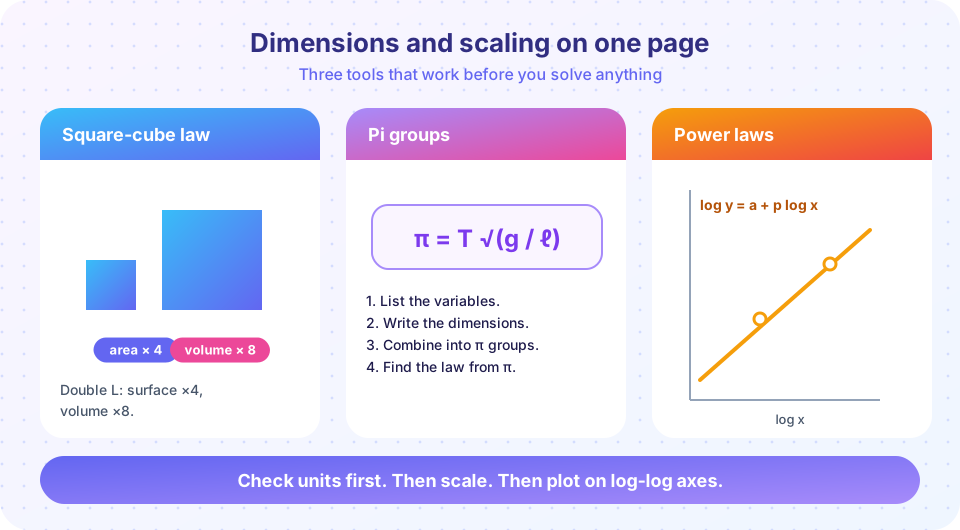
The chapter in a table
| Lesson | Big idea | Formula or fact |
|---|---|---|
| Overview | Size changes ratios | Area ∝ s², volume ∝ s³, surface/volume ∝ 1/s |
| Units and Dimensions | Every term must match | Force M L T⁻²; arguments of exp are dimensionless |
| Buckingham Pi and Dimensionless Groups | n variables, k dimensions, n − k groups |
T√(g/ℓ) is constant; Re = ρvd/μ |
| Scaling Laws and Allometry | Power laws are lines on log-log plots | Kleiber: B ∝ M^(3/4) (approximate) |
Try it
Here is a model in which scaling meets the modelling cycle. A warm water-like sphere cools in air. Heat is lost through the surface (∝ r²) while heat is stored in the volume (∝ r³), so Newton's cooling rate is k = hA/(mc) = 3h/(ρ c r): bigger spheres have smaller k. Predict: if you double the radius, does the half-life double or quadruple?
Press Run (or Ctrl + Enter) to see the result here.
Program input · what you'd type while the program runs
Type the answers before you press Run, one per line. Each time the program reads a line (with input()), it gets the next line from this box.
Time scales linearly with size here because k ∝ (surface)/(volume) ∝ 1/r. Now use the power-law toolkit on the results: the half-life is t½ ∝ r¹. Check that with a log-log fit.
Press Run (or Ctrl + Enter) to see the result here.
Program input · what you'd type while the program runs
Type the answers before you press Run, one per line. Each time the program reads a line (with input()), it gets the next line from this box.
Check your understanding
Quick check · 10 questions
of 10 answered You scored / 10 · perfect!
-
1. A shape is scaled up by a factor of 3 in every direction. Its volume grows by a factor of:
Volume scales as the cube of the length factor: 3 x 3 x 3 = 27. -
2. Which equation is dimensionally inconsistent? (x length, v velocity, t time, a acceleration)
a t has the dimension of velocity (L T^-1), not length. -
3. In the Buckingham Pi theorem, how many groups come from 5 variables with 3 independent dimensions?
n - k = 5 - 3 = 2. -
4. The pendulum period satisfies T = C sqrt(l/g). If the length is quadrupled, the period:
The period scales with the square root of the length, and the square root of 4 is 2. -
5. Which is a dimensionless quantity?
Re = rho v d / mu has all its dimensions cancelling. -
6. On a log-log plot a power law y = a x^p has a slope of:
The slope in log-log coordinates is the exponent p. The intercept relates to a. -
7. Metabolic rate scales as M^(3/4). If M doubles, the rate grows by about:
2^(0.75) is about 1.68. -
8. Why do large animals lose body heat more slowly per kilogram than small ones?
Surface-to-volume ratio falls as 1/s with size, so each kilogram has less surface to lose heat through. -
9. A 1:20 scale model is tested in the same fluid. To match the Reynolds number, the model speed must be:
Re = v d / nu. If d is 20 times smaller, v must be 20 times larger. -
10. Which is the best next step after fitting a straight line to a log-log plot and getting a slope?
Fitted exponents need uncertainty estimates and a check against other possible shapes.
Summary
- Scaling by
sgives areas× s², volumes× s³and surface/volume× 1/s; Newton cooling rate falls as1/r. - Check dimensions of every equation; arguments of
exp,sinandlnmust be dimensionless. - The Buckingham Pi theorem turns
nvariables inton − kdimensionless groups; Pi groups unify data and justify scale models. - Power laws are straight lines on log-log axes; fit exponents and quote uncertainties.
Track your progress
Create a free account to tick off lessons and pick up where you left off on any device.
of Mathematical Modelling lessons completed