


















Lesson 13 of 46 · Dimensional Analysis and Scaling
Buckingham Pi and Dimensionless Groups
Use the Buckingham Pi theorem to derive the pendulum law from units alone, meet the Reynolds number, and see why scale models work. With SymPy and simulations.
Imagine you want to know how the swing time of a pendulum depends on its length, its mass and gravity, but you have never studied physics. You could build pendulums and time them for weeks. Or you could notice that only one combination of those four quantities has no dimensions at all, and conclude almost the whole answer in five minutes with pencil and paper.
That is the power of dimensional analysis. By insisting that the answer make sense in any system of units, you can often shrink a problem with many variables to one with just a few dimensionless combinations.
What you will learn
- What the Buckingham Pi theorem says and how to apply it step by step
- How to derive the pendulum law up to a constant using only dimensions
- What the Reynolds number is and why it governs flow
- Why scale models can predict full-size behavior
Key terms
Dimensionless group (Pi group, π): a product of variables, raised to powers, whose dimensions cancel completely.
Dimension matrix: a table whose rows are base dimensions and columns are variables, listing each exponent.
Buckingham Pi theorem: a problem with n variables and k independent base dimensions can be rewritten using n − k dimensionless groups.
Reynolds number Re = ρ v d / μ: a dimensionless group that compares inertia with viscous forces in a flow.
Dynamic similarity: two flows with equal dimensionless groups behave the same way, whatever their sizes.
The idea
Any physical law can be written as a relation among variables. If you switch from meters to feet, the law must still hold, so it can only depend on combinations of the variables that do not change when you change units: the dimensionless ones. In 1914 Edgar Buckingham stated this precisely:
If a relationship involves
nvariables built fromkindependent dimensions, it can be written as a relationship amongn − kindependent dimensionless groups.
The recipe:
- List every variable that matters, including the one you want.
- Write the dimension matrix (exponents of
M,L,T, ...). - Count:
k= rank of the matrix, groups =n − k. - Find the combinations whose exponents cancel (the null space of the matrix).
- Rewrite the problem in terms of the groups, then use theory or experiment to find the missing relationship.
Example: the pendulum
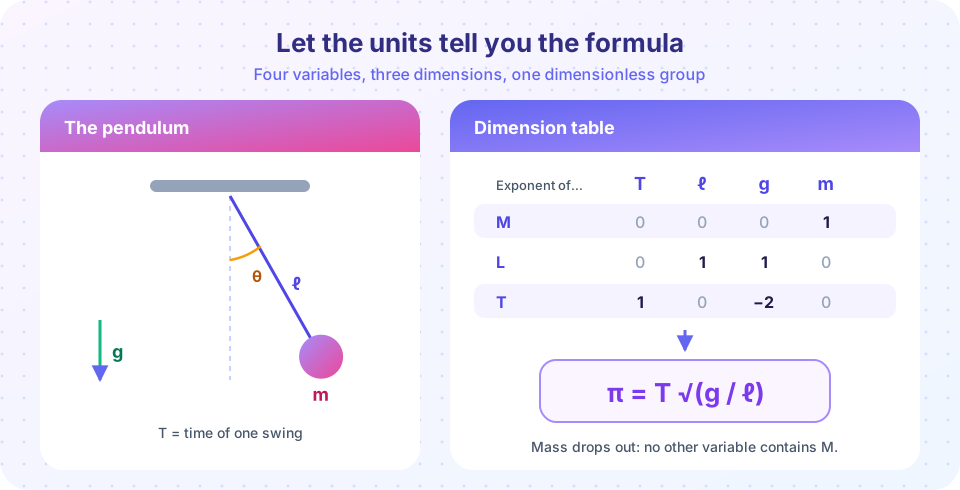
Variables: period T (time), length ℓ, gravity g and bob mass m. So n = 4. The dimensions in the base set M, L, T:
T |
ℓ |
g |
m |
|
|---|---|---|---|---|
M |
0 | 0 | 0 | 1 |
L |
0 | 1 | 1 | 0 |
T |
1 | 0 | −2 | 0 |
Rank 3, so n − k = 1 group. Look for exponents a, b, c, d with T^a ℓ^b g^c m^d dimensionless:
M:d = 0. Mass cannot appear, because nothing else contains mass to cancel it.L:b + c = 0.T:a − 2c = 0.
Pick c = −½: then b = ½ and a = −1. So the group is T⁻¹ ℓ^(½) g^(−½), and inverting it, π = T √(g/ℓ).
Since there is only one group, it must be a constant: T √(g/ℓ) = C, so
T = C √(ℓ/g)
Without any physics we found that the period grows with the square root of the length, falls with the square root of gravity and does not depend on mass (a fact Galileo tested around 1600). The constant C must come from theory or one careful experiment; for small swings it is 2π ≈ 6.283.
But what about the swing angle?
If we also include the starting angle θ₀, which is dimensionless, we have n = 5 variables, still k = 3, so two groups: π₁ = T√(g/ℓ) and π₂ = θ₀. Now π₁ = F(θ₀): the constant becomes a function of the angle. The simulation below finds it numerically.
Press Run (or Ctrl + Enter) to see the result here.
Program input · what you'd type while the program runs
Type the answers before you press Run, one per line. Each time the program reads a line (with input()), it gets the next line from this box.
SymPy clears fractions, so for the pendulum it prints T² g / ℓ, the square of our group T√(g/ℓ), which is just as valid. For the sphere it returns 1/C_D and 1/(C_D Re²), which are products of powers of our hand-made pair, so they carry the same information. The last two lines confirm that C_D and Re themselves have no dimensions.
Checking the pendulum with a simulation
Newton's laws give the equation θ'' = −(g/ℓ) sin θ for a frictionless pendulum. We can time many swings with different lengths, masses (which do not appear!) and starting angles, and then compute the group T√(g/ℓ). If dimensional analysis is right, that number should depend on the angle θ₀ only.
Press Run (or Ctrl + Enter) to see the result here.
Program input · what you'd type while the program runs
Type the answers before you press Run, one per line. Each time the program reads a line (with input()), it gets the next line from this box.
The four lengths, spanning a factor of 100, give the same group to four digits, as the theorem promises. For small angles π ≈ 2π; for larger angles the swing takes longer, so F(θ₀) grows. The simulation and the exact elliptic-integral formula agree.
Example: flow and the Reynolds number
For a sphere of diameter d moving at speed v through a fluid of density ρ and dynamic viscosity μ, the drag force F depends on n = 5 variables. With k = 3 dimensions there are two groups, and the SymPy output above confirms the natural pair:
C_D = F / (ρ v² d²), a drag coefficient (the force measured againstρ v² d²)Re = ρ v d / μ, the Reynolds number (named for Osborne Reynolds, who studied pipe flow in 1883)
Buckingham's theorem therefore says C_D = F(Re): all the sphere-drag data in the world, for any size, speed or fluid, falls on one curve. That is an enormous simplification from a five-variable problem.
Why scale models work
If a small model and a full-size object have the same Reynolds number (and other relevant groups), the flow patterns are similar and the force coefficients agree. You can then measure the model and scale up. There is a catch: matching Re can demand awkward conditions.
Press Run (or Ctrl + Enter) to see the result here.
Program input · what you'd type while the program runs
Type the answers before you press Run, one per line. Each time the program reads a line (with input()), it gets the next line from this box.
This is a real design dilemma: to test small models, engineers use pressurized or cryogenic wind tunnels, water channels, or accept partial similarity. Dimensionless groups tell you exactly what compromise you are making.
Common misconceptions
"The theorem gives the exact formula." It gives the structure of the answer, such as T = C √(ℓ/g). Constants and functions of groups still need theory or experiment.
"You can choose any variables." The result is only as good as your variable list. Forget a relevant variable (for example, air resistance on the pendulum) and the analysis silently misses it. Include one that does not matter (mass) and the mathematics will tell you it drops out.
"Dimensionless groups are unique." Any product or power of groups is also a group (π², 1/π), and you can combine them. The standard named ones are simply the most useful.
Check your understanding
Quick check · 5 questions
of 5 answered You scored / 5 · perfect!
-
1. A problem has 6 variables involving mass, length and time. How many dimensionless groups does the Pi theorem give?
n - k = 6 - 3 = 3 groups (assuming the three dimensions are independent). -
2. Why does the mass drop out of the pendulum analysis?
To cancel M in a product, another variable would need an M. None does, so m has exponent zero. -
3. Which is the Reynolds number?
Re = rho v d / mu compares inertial and viscous effects in a flow. -
4. A 1:10 scale model is tested in the same fluid. To match the Reynolds number, the model's speed must be:
Re = v d / nu. With d ten times smaller and nu unchanged, v must be ten times larger. -
5. The simulation showed T*sqrt(g/l) = 2 pi for small swings with lengths from 0.25 m to 25 m. What does this confirm?
Different lengths give very different periods, but the dimensionless group is constant.
Summary
- The Buckingham Pi theorem:
nvariables andkbase dimensions given − kdimensionless groups. - For a pendulum there is one group,
T√(g/ℓ), soT = C√(ℓ/g)with no dependence on mass. - Adding the swing angle gives a second group and a function
F(θ₀), found here by simulation. - The Reynolds number
ρvd/μand drag coefficientF/(ρv²d²)unify drag data across sizes and fluids. - Scale models work only when the relevant dimensionless groups are matched.
Track your progress
Create a free account to tick off lessons and pick up where you left off on any device.
of Mathematical Modelling lessons completed