


















Lesson 1 of 46 · Getting Started
Course Map
Start here: who the Mathematical Modelling course is for, what you need to know first, how to study it, and a map of all nine chapters.
Every day someone has to answer a question that has no tidy textbook answer. How long until the coffee is cool enough to drink? How many ambulances should a city keep on standby? How fast will a rumor spread through a school? Mathematical modelling is the skill of turning questions like these into mathematics you can compute with, then turning the result back into an answer a human can use.
This course teaches that skill from the ground up. You will not just meet formulas. You will practice the whole process: asking a sharp question, deciding what to ignore, writing equations, solving them with Python, and asking honestly whether the answer deserves trust.
Who this course is for
- Students aged about 14 and up who have met algebra and want to see what it is for.
- Pupils preparing for modelling tasks in IGCSE, IB, A Level or AP courses: the habits here match the common core of those syllabi.
- University students and adults who need a practical, code-first refresher before applied maths, engineering, biology, economics or data science.
You do not need to be fast at algebra. You need to be willing to try a rough idea, test it, and improve it.
What you should know first
| You should be comfortable with | Why it matters |
|---|---|
| Fractions, percentages, powers | Almost every model uses growth rates and exponents |
| Solving simple equations | Rearranging formulas is daily work |
| Graphs of lines and curves | You will read and draw plots constantly |
| Basic Python (variables, loops, functions) | The examples run in your browser, no install needed |
Calculus appears from chapter 5 on, but each time it arrives with a plain-language explanation first. If derivatives are new to you, you can still follow the ideas and run the code.
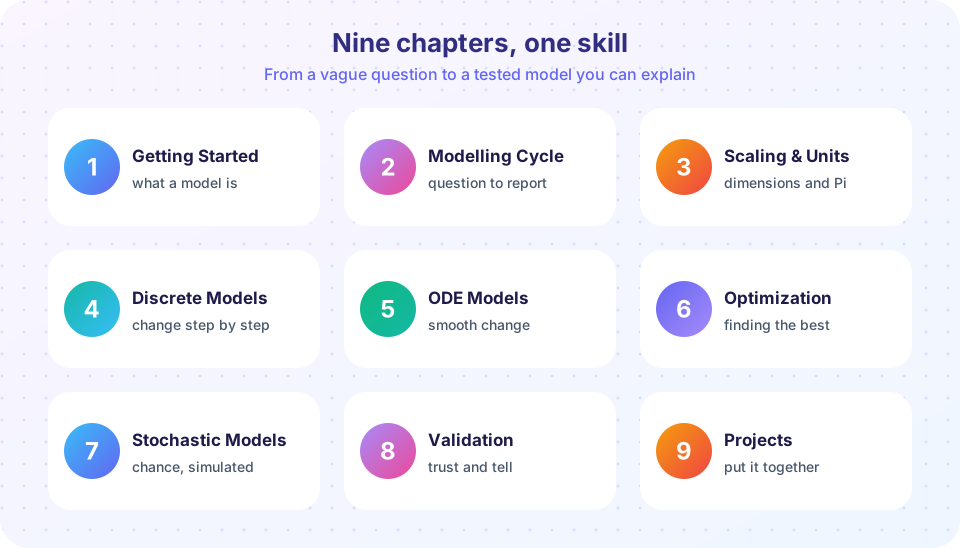
The map: nine chapters
Foundations
- Getting Started
- The Cycle
Units and size
- Scaling
Check units before you solve anything.
Change over time
- Discrete models
- ODE models
Choices and chance
- Optimization
- Stochastic
Trust and practice
- Validation
- Projects
How to study this course
- Run every example. Press the Run button, then change a number and run again. A model you have never broken is a model you do not understand yet.
- Predict before you run. Write down what you expect the plot to look like. The gap between your guess and the result is where the learning happens.
- Keep a modelling notebook. For each model, jot down the question, the assumptions, the equation and what the answer means. Chapter 2 gives you a template.
- Do the quizzes. They are short on purpose and each answer has an explanation.
- Revisit chapter reviews. Each chapter ends with a one-page summary picture and a longer quiz.
Modelling is a craft. Nobody writes a perfect model on the first try, not even professionals. Expect your first version to be too simple, and treat that as normal progress.
Try it
Here is a tiny first model, just so you see the flavor of what is coming. You put 1,000 dollars into an account that grows by a fixed percentage each year. The model is a single rule: next year's balance is this year's balance times (1 + rate).
Press Run (or Ctrl + Enter) to see the result here.
Program input · what you'd type while the program runs
Type the answers before you press Run, one per line. Each time the program reads a line (with input()), it gets the next line from this box.
The next demo is interactive. Drag the slider and see how long money takes to double. Notice that the exact answer and the quick "rule of 70" estimate agree surprisingly well. That is already a model of a model.
Check your understanding
Quick check · 4 questions
of 4 answered You scored / 4 · perfect!
-
1. What is the main goal of mathematical modelling?
Modelling is the whole loop from a real question, through mathematics, back to a useful answer. -
2. Which chapter teaches you to check units before solving?
Chapter 3 is about dimensions, units and scaling, the checks that work before any solving. -
3. What should you do before you press Run on an example?
Predicting first turns running code into a small experiment and shows you where your intuition is off. -
4. Is it normal for a first model to be too simple?
Real modelling is iterative. You build a simple version, test it, and refine it.
Summary
- Mathematical modelling turns real questions into mathematics and back into answers.
- The course has nine chapters, from foundations through scaling, change over time, optimization, chance, validation and projects.
- Run, predict, break and fix every example.
- First versions of models are supposed to be simple. Improvement comes from loops.
Track your progress
Create a free account to tick off lessons and pick up where you left off on any device.
of Mathematical Modelling lessons completed