


















Lesson 7 of 49 · Biological Data and Databases
Sequence databases and accessions
Learn what GenBank, ENA, DDBJ, RefSeq, UniProt, Ensembl and the PDB contain, how accession numbers and versions work, and how to choose the right resource.
When a laboratory determines a new sequence, convention and most journals require it to be deposited in a public archive before the paper is published. That habit, started in the early 1980s, is why you can sit at a laptop and download the genome of a bacterium, a virus or a human without asking anyone. This lesson tours the databases you will use most and teaches you the single most important habit: refer to records by their accession and version.
What you will learn
- The difference between primary archives and curated or derived databases.
- How to read an accession number and why the version matters.
- Which resource to choose for a sequence, a protein, an annotated genome or a structure.
- Basic good practice: citing accessions, noting genome builds and respecting data-access rules.
Key terms
- Accession number: a stable identifier for a database record, for example
U00096.3. - Version: the number after the dot in an accession; it increases when the sequence itself changes.
- Primary database: an archive that stores submitted data as submitted (GenBank, ENA, DDBJ).
- Curated (secondary) database: a database where experts review, merge or annotate records (RefSeq, Swiss-Prot).
- Genome build: a numbered version of a reference genome assembly, such as GRCh38.
The primary archives: INSDC
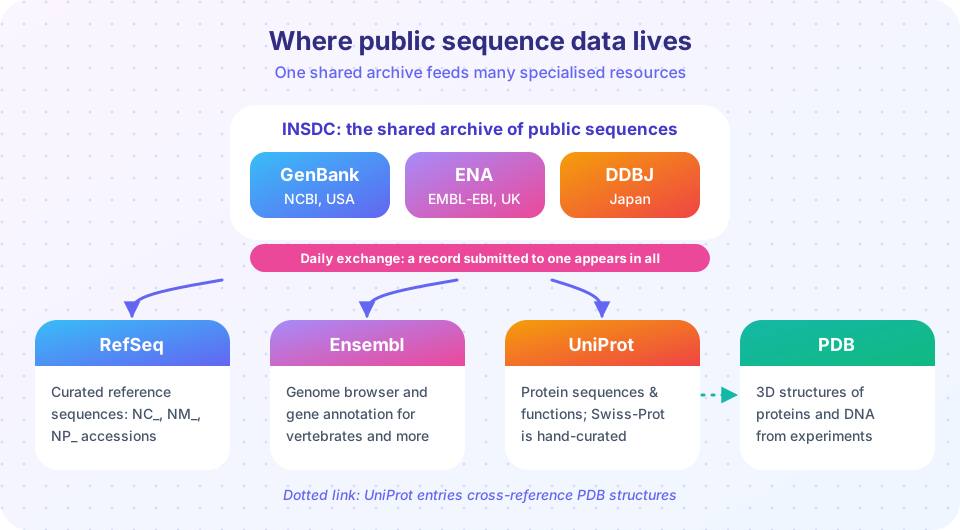
Three organizations run the world's public nucleotide archives: GenBank at the US National Center for Biotechnology Information (NCBI), the European Nucleotide Archive (ENA) at EMBL-EBI in the UK, and the DNA Data Bank of Japan (DDBJ). Together they form the International Nucleotide Sequence Database Collaboration (INSDC). They exchange new records every day, so a sequence submitted to any one soon appears in all three with the same accession. EMBL began collecting sequences in 1980, GenBank in 1982 and DDBJ in 1986.
The archives are deliberately inclusive: they store what a submitter sends, with the submitter's annotation. That makes them complete but uneven. The same gene can appear many times from different labs, some entries are old or contain errors, and a few are contaminated or mislabeled. They are archives, not textbooks.
Curated resources on top
RefSeq (NCBI) builds a curated, non-redundant reference set from the archives. Its accessions start with a prefix that tells you what the record is: NC_ for a complete genomic molecule such as a chromosome or a whole bacterial genome, NM_ for a curated messenger RNA, NR_ for a non-coding RNA, NP_ for a protein, and XM_ or XP_ for model records predicted by computer. If you need "the" reference sequence of a gene, RefSeq is the usual answer.
UniProt is the central resource for proteins. Its UniProtKB has two parts: Swiss-Prot, where experts review each entry and record function, structure, variants and literature, and TrEMBL, which holds computer-annotated entries that have not been reviewed and is far larger. Entries have accessions such as P69905 (human hemoglobin subunit alpha) or P04637 (human p53). Choose Swiss-Prot when you want reliable functional facts.
Ensembl (EMBL-EBI) and the UCSC Genome Browser provide annotated genomes: genes, transcripts, regulatory regions and variants, with a browser to explore them and files to download. Ensembl identifiers begin ENSG (gene), ENST (transcript) and ENSP (protein), as in ENSG00000141510 for the human TP53 gene.
The Protein Data Bank (PDB, managed by the worldwide PDB partnership) stores atomic coordinates of experimentally determined structures from X-ray crystallography, cryo-electron microscopy and NMR. Its identifiers have four characters, such as 1TUP (the p53 core domain bound to DNA). Chapter 7 is devoted to structures.
Reading an accession
An accession has a stable part and a version: NC_000913.3 is RefSeq record NC_000913, version 3. In the archives the primary format is letters followed by digits, for example U00096.3 for the genome of Escherichia coli K-12 substrain MG1655 (the same sequence appears in RefSeq as NC_000913.3). The accession stays the same for the record's whole life. The version increases whenever the sequence itself changes: a corrected base, a closed gap. Annotation changes alone do not change the version.
This is why scientific methods sections should state "accession and version," not just the species name. If you analyze NC_000913.2 and a colleague downloads NC_000913.3, your coordinates may differ. The same applies to genome builds for large genomes: coordinates in the human GRCh38 build differ from those in GRCh37, and the 2022 telomere-to-telomere assembly (T2T-CHM13) differs again. A variant "at position 7,675,088" has no meaning without knowing the build.
Getting data out
You can search and download through a web page, through command-line tools such as NCBI's datasets and efetch, or through programming interfaces (NCBI's Entrez E-utilities, which Biopython wraps in Bio.Entrez, and the ENA, Ensembl and UniProt REST services). In your own code, always put a polite delay between requests, identify yourself with an email address for NCBI, and cache downloads instead of repeating them. The in-browser examples on this site cannot reach the network, so the Entrez snippet below is for reading only.
from Bio import Entrez, SeqIO   # needs Biopython and a network connection

Entrez.email = "[email protected]"          # NCBI asks for a contact address
handle = Entrez.efetch(db="nucleotide", id="NC_000913.3",
                       rettype="fasta", retmode="text")
record = SeqIO.read(handle, "fasta")
print(record.id, len(record.seq))
Good practice and responsibility
Keep three habits. First, record provenance: accession, version, download date and genome build, written next to your results. Second, expect errors: check a surprising hit against a curated record before you build a story on it. Third, respect access rules. Sequence data from people is personal and sensitive. Human genotype and sequence data from research participants usually sits in controlled-access repositories (for example dbGaP at NCBI or the European Genome-phenome Archive), where you must apply and agree to terms of use. Public data is not automatically free of obligations.
A worked example: following one gene
Suppose you are interested in the human tumor suppressor p53. In NCBI Gene it has the gene identifier 7157. Its curated mRNA in RefSeq is an NM_ record, its protein an NP_ record, and its genomic region sits on chromosome 17 in a build such as GRCh38. Ensembl gives the same gene the stable identifier ENSG00000141510. UniProt entry P04637 collects what is known about the protein, including function, domains and variants, and the PDB entry 1TUP shows the core domain bound to DNA. Five resources describe one gene, each with its own identifier, and cross-references link them. Good practice is to choose one resource as your anchor, record its accession and version, and use the cross-references to move between the others. Mapping between identifiers is routine work in bioinformatics, and the services of UniProt, Ensembl and NCBI provide conversion tables for it.
Common misconceptions
- "GenBank is a curated reference." It is an archive of submissions. For a curated reference use RefSeq.
- "An accession number always gives the same sequence." The accession is stable, but the sequence belongs to a specific version.
- "UniProt entries are all hand-checked." Only Swiss-Prot entries are reviewed; TrEMBL is computer-annotated.
- "One gene has one identifier." A gene has different identifiers in Ensembl, NCBI Gene, UniProt and others, and mapping between them is a task of its own.
Try it
Press Run (or Ctrl + Enter) to see the result here.
Program input · what you'd type while the program runs
Type the answers before you press Run, one per line. Each time the program reads a line (with input()), it gets the next line from this box.
Check your understanding
Quick check · 5 questions
of 5 answered You scored / 5 · perfect!
-
1. Which resource would you choose for a curated, non-redundant reference mRNA?
RefSeq provides curated reference sequences such as NM_ mRNA records. -
2. What does the number after the dot in NC_000913.3 mean?
The version increases whenever the sequence itself changes. -
3. Which statement about GenBank, ENA and DDBJ is true?
The three INSDC archives synchronize new records every day. -
4. What distinguishes Swiss-Prot from TrEMBL?
Swiss-Prot is reviewed and smaller; TrEMBL is automatic and much larger. -
5. Why does a variant position need a genome build?
Different assemblies place the same locus at different coordinates.
Summary
- INSDC (GenBank, ENA, DDBJ) archives submitted sequences and shares them daily.
- RefSeq, Swiss-Prot, Ensembl and the PDB add curation, annotation and structures.
- An accession is stable; the version marks the exact sequence. Always cite both, plus the genome build.
- Human data may be controlled-access and carries obligations.
Track your progress
Create a free account to tick off lessons and pick up where you left off on any device.
of Bioinformatics lessons completed