


















Lesson 6 of 49 · Biological Data and Databases
Chapter 2 overview: biological data and databases
Chapter 2 maps the biological data landscape: public sequence databases, the file formats programs expect, and the quality scores that tell you how far to trust a read.
Algorithms are only as good as the data they eat. In bioinformatics that data lives in public databases that anyone can search, and it travels in a small number of plain-text file formats. This chapter is your field guide to both. You will learn which database to ask for which kind of question, how to read the four file formats that account for most daily work, and how to judge the quality of raw sequencing reads before you trust them.
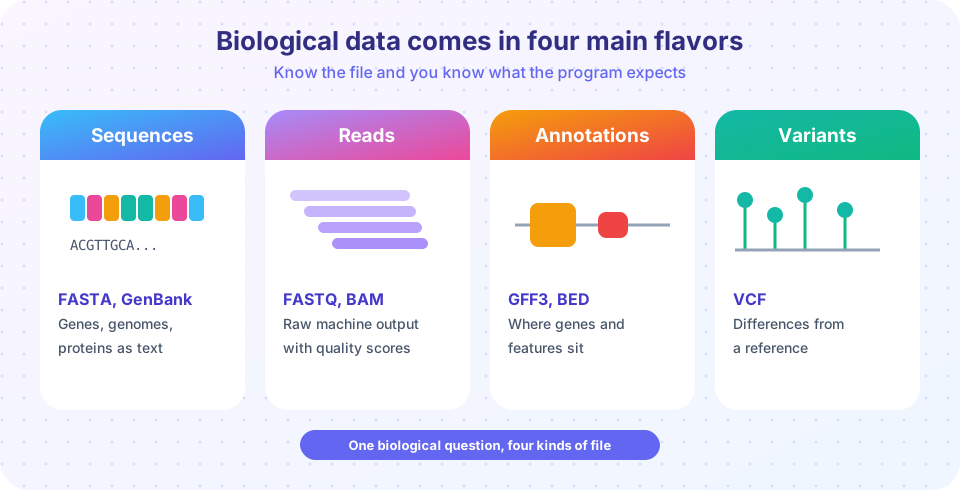
What you will learn
- The four kinds of biological data and the file formats that carry them.
- Which public resource answers which kind of question.
- Why every read comes with a quality score and how to use it.
The big picture
Imagine you sequence a bacterial isolate. The machine gives you reads in FASTQ files. You compare them with a reference sequence stored in FASTA format that you downloaded from a database. You look up annotations, files that say where genes sit on that reference, usually in GFF3. When you find differences, you record them as variants in VCF. Every one of these objects has a name, a format and a home. Knowing them saves hours.
Public sequence data is also a shared scientific resource governed by a simple rule: when you publish a sequence, you deposit it in an archive and quote its accession number, a stable identifier. Anyone can then fetch exactly the same record. Good analysis starts with citing accessions and versions, so that others (and future you) can repeat it.
Four kinds of data
Where it lives
How far to trust it
What each lesson covers
- Sequence databases and accessions explains GenBank, ENA, DDBJ, RefSeq, UniProt, Ensembl and the PDB, and how to read an accession number.
- File formats: FASTA, FASTQ, GFF3, BED and VCF shows each format, with the coordinate conventions that trip up beginners.
- FASTQ and Phred quality scores decodes quality strings, explains why you average probabilities, and trims reads.
- Chapter 2 review gives you a one-page summary and a ten-question quiz.
A day in the life of a dataset
To see why this chapter matters, follow one dataset through a typical project. A laboratory deposits the raw reads of a bacterial isolate in the Sequence Read Archive, which gives them run accessions. A colleague downloads the reads as FASTQ, checks their quality and trims the ends. She then downloads a reference genome from RefSeq, notes its accession and version and aligns the reads to it. The alignment is stored in a compressed file, and variants are written to a VCF file. Finally, a GFF3 annotation tells her which genes the variants fall in, and a UniProt entry tells her what the affected protein does.
Every step names a database, a file format and a quality or provenance question, which are exactly the three themes of this chapter. Notice also how much can go wrong in small ways: a download of the wrong genome version, a quality encoding read with the wrong offset, a coordinate off by one. None of these produce an error message. They produce a plausible but wrong answer, which is why careful habits matter more than clever code.
Common misconceptions
- "If it is in a public database, it is correct." Archive records are submitted by many people and can hold errors, contamination and out-of-date annotation.
- "A file extension tells me the format." A
.txtcan hold FASTA and a.facan be corrupt. Look at the first lines.
Try it
Press Run (or Ctrl + Enter) to see the result here.
Program input · what you'd type while the program runs
Type the answers before you press Run, one per line. Each time the program reads a line (with input()), it gets the next line from this box.
Check your understanding
Quick check · 3 questions
of 3 answered You scored / 3 · perfect!
-
1. Which file format stores sequencing reads together with per-base quality scores?
FASTQ pairs each read's bases with a quality character for every base. -
2. Which kind of file lists where genes sit on a reference sequence?
Annotation files such as GFF3 and BED give the positions of features on a sequence. -
3. Why should you cite the accession and version of a sequence you used?
A version number identifies one exact state of a record, which makes an analysis reproducible.
Summary
- Most data is sequences, reads, annotations or variants, each with a usual format.
- Public archives share records; specialised databases add curation and annotation.
- Quality scores tell you how far to trust each base, which chapter 2 covers in detail.
Track your progress
Create a free account to tick off lessons and pick up where you left off on any device.
of Bioinformatics lessons completed