


















Lesson 49 of 49 · Projects and Practice
Further Study: Where to Go After This Course
Plan your next steps in bioinformatics: the skills to deepen, related tutorials on this site, databases and tools to explore, practice ideas, ethics and a twelve-week plan.
You now understand how a genomics pipeline turns reads into variants, how an RNA-seq experiment turns counts into candidate genes, how structures are stored, compared and predicted, and how machine-learning models are built and judged honestly. That is a real foundation. It is also the point where the most useful question changes from "what is this?" to "what do I want to be able to do?"
This final lesson helps you answer that. It maps the skills that make a bioinformatician stronger, points you to related material on this site, lists the databases and tools you will meet in practice, suggests ways to practice with real data, and ends with a twelve-week plan you can adapt.
What you will learn
- Which skills pay off the most after this course, and where to study them.
- Which public databases and tools to learn first.
- How to practice with real data, and how to choose projects.
- What to consider about ethics, privacy and reproducibility.
Key terms
Workflow manager: software such as Snakemake or Nextflow that runs a pipeline's steps in the right order and records what was run.
Container: a packaged environment (for example Docker) that fixes the software versions so an analysis runs the same everywhere.
Controlled access: data, usually about people, that you may use only after an approval process.
Provenance: the record of how a result was produced: data, versions and commands.
Open science: sharing data, code and methods so others can check and reuse them.
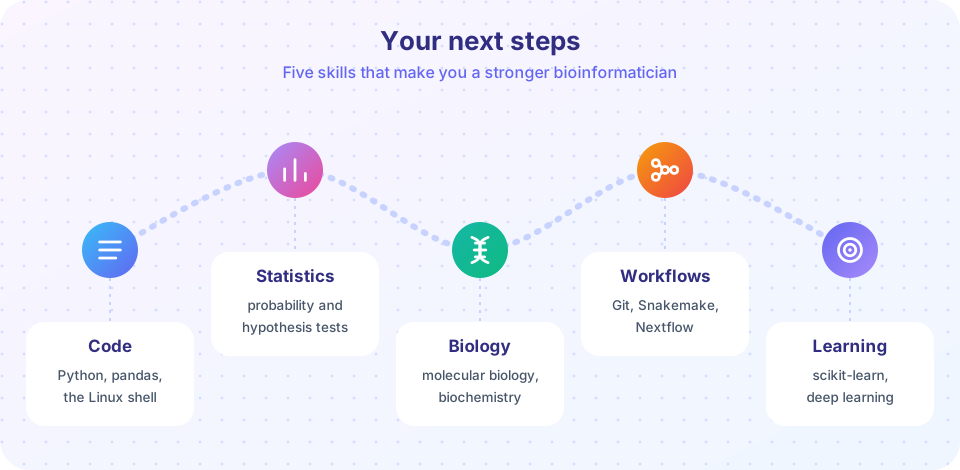
Five skills that compound
1. Code. Fluency in a scripting language is the multiplier for everything else. For most readers that means Python, with NumPy for arrays and pandas for tables, plus enough of the Linux command line to move around servers and chain tools. Many genomics and statistics packages are written in R, so R is worth learning as a second language. Learn Git early: version control is how you keep track of what you did and share it.
2. Statistics. Almost every mistake in this course's later chapters was a statistics mistake: ignoring replicates, forgetting multiple testing, overreading a p-value. A solid course in statistics and probability pays off for years. Then add Bayesian statistics for the logic behind genotype calling and shrinkage, and linear algebra for PCA, SVD and the Kabsch algorithm.
3. Biology. Bioinformatics is not just computing: the best analysts can tell when a result is biologically implausible. Strengthen your base with molecular biology, cells and genetics and biochemistry. If you will work with structures, a course in protein chemistry matters; if you will work with expression, learn about gene regulation.
4. Workflows and reproducibility. Real pipelines run on hundreds of samples, on clusters or in the cloud. Learn a workflow manager (Snakemake or Nextflow), the package manager Bioconda, and containers such as Docker. The nf-core community maintains curated, reusable Nextflow pipelines that are an excellent way to see how experts structure an analysis. Learn enough SQL to query databases of results.
5. Machine learning. Build on chapter 8 with the site's machine learning and scikit-learn tutorials, then deep learning and PyTorch if you want to build neural networks. Pair every new model with the evaluation habits you practiced: baselines, grouped splits and shuffled-label controls. Data visualization and Matplotlib will make your figures clear and honest.
Paths by goal
| If you want to... | Emphasize | Next project |
|---|---|---|
| Analyze sequencing data in a lab | Linux, Python or R, statistics, workflow managers | Re-run a published RNA-seq or variant-calling analysis on public data |
| Work in clinical or population genomics | Genetics, statistics, variant annotation, ethics and privacy | Annotate a public VCF and explain each filtering decision |
| Study proteins and drug design | Biochemistry, structural tools, linear algebra | Superpose homologous structures, then redock a known ligand |
| Build predictive models | Machine learning, deep learning, statistics | Train and honestly evaluate a classifier on a public regulatory-DNA dataset |
| Develop tools and pipelines | Software engineering, testing, containers | Contribute a small fix or a test to an open-source bioinformatics tool |
Databases and tools to know
Make a habit of exploring each of these once, so that their names and layouts are familiar.
- Sequences and genomes: NCBI (GenBank, SRA for raw reads, RefSeq), the European Nucleotide Archive, Ensembl and the UCSC Genome Browser for annotated genomes.
- Proteins: UniProt for sequences and annotation, the RCSB PDB and PDBe for experimental structures, and the AlphaFold Protein Structure Database for predictions.
- Variants and populations: ClinVar for clinical interpretations, gnomAD for population frequencies, dbSNP for variant identifiers.
- Expression and function: the Gene Expression Omnibus (GEO), the Gene Ontology resource, KEGG and Reactome.
- Software ecosystems: Biopython for scripting sequence and structure tasks, Bioconductor for R-based genomics (DESeq2, edgeR and limma live there), samtools and bcftools for alignments and variants, and viewers such as IGV and Mol*.
- Community and practice: Biostars and Bioinformatics Stack Exchange for questions, Rosalind for graded programming problems on bioinformatics topics, and Galaxy for point-and-click pipelines that teach how the steps fit.
How to practice with real data
Simulation, as in the projects, tells you whether your code works. Real data tell you what reality is like. A useful progression:
- Reproduce. Choose a small open paper whose data are in a public archive, and try to recreate one figure. Write down every place your numbers differ and why.
- Vary. Change one decision (a threshold, a normalization, a reference version) and see how the result moves. Learning which choices matter is the heart of the craft.
- Automate. Wrap the analysis in a workflow, with versions recorded, so that a second person can run it with one command.
- Share. Put the code and a README in a public repository. Explaining your work to a stranger reveals gaps in your own understanding.
- Extend. Combine two datasets, or add an orthogonal check such as a structure or a literature search for the top hits.
Ethics, privacy and reproducibility
Biological data about people are different from other data. Genomes are identifying, shared among relatives, and permanent. Many human datasets are held under controlled access and may be used only for approved purposes, with promises about security and non-reidentification. Always check the data use terms. Consider whose data trained a model, and whether it will work equally well for people of different ancestries, because many reference resources and training sets are heavily skewed. Report these limits honestly.
Reproducibility is also an ethical matter. Others must be able to rerun your analysis and reach the same answer, which means sharing code, versions and parameters, using persistent identifiers for data, and not hiding negative results. A transparent analysis that is modest and correct is worth more than an impressive one nobody can check.
This course is educational and does not provide medical, genetic-counseling or clinical guidance. Interpreting human genetic data for health decisions needs qualified professionals and validated procedures.
A twelve-week plan
A plan makes the abstract goal concrete. Adapt the weeks to your pace; the point is a steady rhythm of learning and building.
| Weeks | Focus | Output |
|---|---|---|
| 1 to 2 | Python, NumPy and pandas refresher; Linux and Git basics | A repository with three small scripts that parse FASTQ, SAM and VCF files |
| 3 to 4 | Statistics: tests, multiple testing, confidence intervals | Re-implement BH, a t-test and a permutation test on simulated data |
| 5 to 6 | One real dataset: public RNA-seq or variant data | A reproducible notebook from raw counts or VCF to a figure |
| 7 to 8 | A workflow manager and containers | The same analysis as a Snakemake or Nextflow pipeline with a container |
| 9 to 10 | Machine learning with honest evaluation | A baseline and a model with a family-aware split and a shuffled-label control |
| 11 to 12 | Capstone: combine two ideas and write it up | A short report that states the question, methods, results, limits and next steps |
Try it
The first example generates a personal plan from your self-rated skills, so your first weeks go to your weakest area. The second lets you rate yourself interactively in the browser and see the suggested next focus.
Press Run (or Ctrl + Enter) to see the result here.
Program input · what you'd type while the program runs
Type the answers before you press Run, one per line. Each time the program reads a line (with input()), it gets the next line from this box.
Check your understanding
Quick check · 4 questions
of 4 answered You scored / 4 · perfect!
-
1. Why is a workflow manager such as Snakemake or Nextflow valuable for a genomics analysis?
Workflow managers run the steps in order and record versions and commands. -
2. Which resource provides population allele frequencies for human variants?
gnomAD aggregates population variant frequencies; UniProt covers proteins, PDB structures, Reactome pathways. -
3. What is controlled-access data?
Human genomic data are commonly shared under an approval process with privacy obligations. -
4. A good first step to learn from a published paper's analysis is to:
Reproducing a figure exposes the many decisions hidden between raw data and a result.
Summary
- Deepen five skills: code, statistics, biology, workflows and machine learning; use the site's related tutorials for each.
- Learn the public databases and software ecosystems: NCBI, Ensembl, UniProt, PDB, ClinVar, gnomAD, GEO, Bioconductor, Biopython and samtools.
- Practice by reproducing, varying, automating, sharing and extending real analyses.
- Treat human data with care: controlled access, privacy, fairness and honest reporting; keep every analysis reproducible.
- Build a steady rhythm: a twelve-week plan with something to show each fortnight.
Back to the Bioinformatics course page.
Track your progress
Create a free account to tick off lessons and pick up where you left off on any device.
of Bioinformatics lessons completed