


















Lesson 18 of 49 · Phylogenetics
Chapter 4 overview: phylogenetics
Chapter 4 introduces phylogenetics: evolutionary trees, how sequences reveal ancestry, the main tree-building methods and how to judge confidence in a tree.
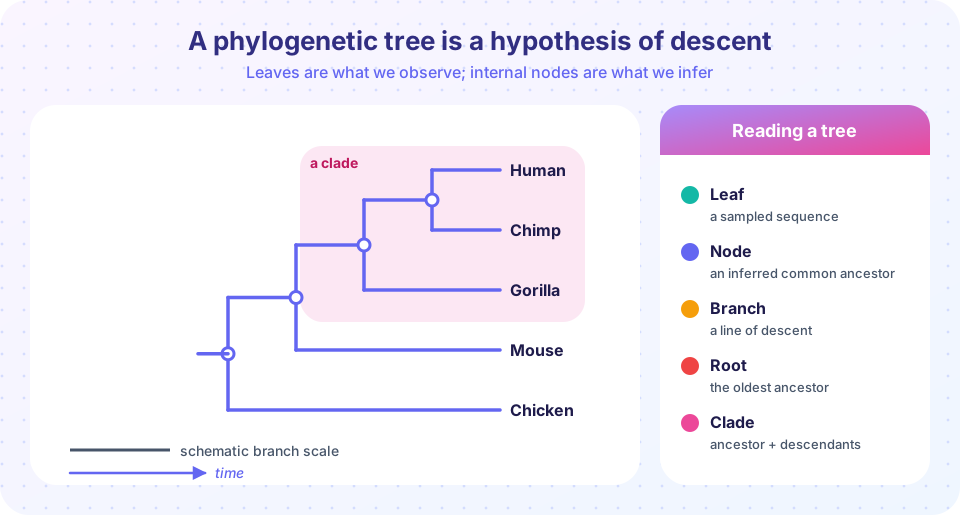
In 1837 Charles Darwin sketched a branching tree in a notebook and wrote above it, "I think." Today a tree of this kind is built from DNA and protein sequences, and it is one of the main products of bioinformatics. A phylogenetic tree shows how a set of genes, organisms or viruses descend from common ancestors. Epidemiologists use trees to trace outbreaks, doctors to follow how a virus changes in a patient, conservation biologists to decide which lineages are most distinct and biologists of every kind to understand where a gene came from.
What you will learn
- The vocabulary of trees: leaves, nodes, branches, root and clade.
- Why inferring a tree from sequences is a statistical problem and not a measurement.
- The families of methods covered in this chapter and how they differ.
- How the lessons of the chapter connect.
The big picture
A tree is a hypothesis. Nobody observed the ancestors, so we infer them from the differences among their living descendants. The logic is that two sequences that share more changes (more derived characters) are probably closer relatives. Building a tree means turning an alignment from chapter 3 into a branching diagram that best explains those shared and unshared changes.
How many trees are there to choose from? For n labeled leaves there are (2n - 5)!! unrooted binary trees (the double factorial multiplies every other odd number). That is 15 trees for five taxa, but 2,027,025 for ten and about 2.2 × 10^20 for twenty. No program can examine them all, so tree-building methods either construct a tree directly from a procedure (distance methods) or search through candidate trees guided by a score (parsimony, likelihood) or a posterior probability (Bayesian).
Distance methods
Character methods
How sure are we?
What each lesson covers
- Distances and UPGMA corrects raw differences for multiple substitutions and builds the simplest tree by clustering.
- Neighbor-joining builds trees without assuming a molecular clock and recovers true trees from additive distances.
- Parsimony and maximum likelihood scores trees by the changes they need or the probability of the data under an evolutionary model.
- Bootstrap support and reading trees shows how to measure confidence, root a tree and avoid common misreadings.
- Chapter 4 review gathers everything into a one-page summary and a ten-question quiz.
Where trees are used
Phylogenetic trees are far more than illustrations for textbooks. During viral outbreaks, sequences from patients are placed on a tree to see whether cases share a recent source, and trees with dated nodes estimate when an epidemic began. In medicine, tumor sequences are arranged on trees to follow how cancer cells diversify. In ecology, trees measure how evolutionarily distinct the species in a habitat are. In genomics, the tree of a gene family shows which members arose by duplication and which by speciation, which in turn helps decide whether two genes are likely to share a function.
Common misconceptions
- "A tree shows that humans descended from chimpanzees." A tree shows shared ancestry; humans and chimpanzees descend from a common ancestor, and neither is the ancestor of the other.
- "The species at the top (or the right) are more advanced." The order of leaves on a page is arbitrary; nodes can be rotated without changing the tree.
- "A gene tree is a species tree." A tree of one gene may differ from the history of the species that carry it, because of gene duplication, loss and horizontal transfer.
Try it
Press Run (or Ctrl + Enter) to see the result here.
Program input · what you'd type while the program runs
Type the answers before you press Run, one per line. Each time the program reads a line (with input()), it gets the next line from this box.
Check your understanding
Quick check · 3 questions
of 3 answered You scored / 3 · perfect!
-
1. What is a clade?
A clade is a monophyletic group: an ancestor and all of its descendants. -
2. Why can't tree-building programs simply examine every possible tree?
Ten leaves already allow over two million unrooted trees, twenty about 2 x 10^20. -
3. A tree shows humans and chimpanzees on neighboring branches. What does this mean?
Neighboring branches imply a shared recent ancestor, not descent of one from the other.
Summary
- A phylogenetic tree is a hypothesis of shared ancestry inferred from sequences.
- The number of possible trees explodes with taxa, so methods construct or search for good trees.
- Chapter 4 covers distance methods, parsimony, likelihood, bootstrap support and tree reading.
Next: Distances and UPGMA
Track your progress
Create a free account to tick off lessons and pick up where you left off on any device.
of Bioinformatics lessons completed