


















Lesson 23 of 49 · Phylogenetics
Chapter 4 review: phylogenetics
Review phylogenetics: distances, Jukes-Cantor, UPGMA, neighbor-joining, parsimony, likelihood, bootstrap and tree reading, with a recap table, practice code and a ten-question quiz.
You can now take an alignment and turn it into an evolutionary tree in several ways, and you know how far to trust the result. This review lines the methods up next to each other, reminds you which assumptions each one makes and gives you a longer quiz that mixes all the lessons of the chapter.
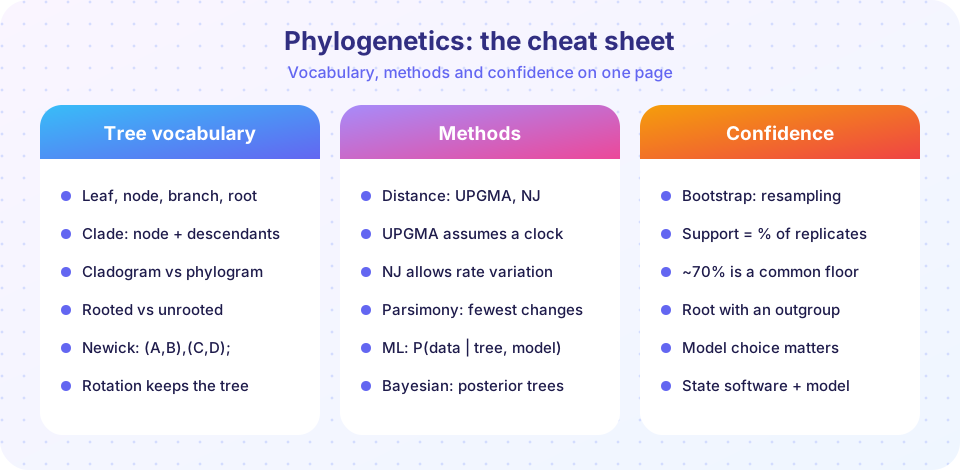
What you will learn
- A recap table of methods, assumptions and formulas.
- How to pick a method for a data set.
- Whether you are ready for genomics pipelines in chapter 5.
The chapter in one table
| Topic | Key facts |
|---|---|
| Tree vocabulary | Leaf, node, branch, root, clade; leaf order is arbitrary |
| Number of trees | Unrooted binary trees for n leaves: (2n - 5)!! |
| p-distance | Fraction of differing sites; underestimates change |
| Jukes-Cantor | d = -3/4 ln(1 - 4p/3); saturates at p = 0.75 |
| UPGMA | Average linkage, node height = distance / 2, assumes a clock, rooted |
| Neighbor-joining | Q = (n-2) d - R_i - R_j; no clock; unrooted; exact for additive distances |
| Parsimony | Fitch counts changes; only informative sites matter; prone to long-branch attraction |
| Maximum likelihood | Probability of the data under a model; JC distance is the ML estimate for two sequences |
| Model choice | AIC = 2k - 2 lnL, BIC = k ln n - 2 lnL; lowest wins |
| Bootstrap | Resample columns with replacement; support = % of replicates with the clade |
| Rooting | Outgroup or midpoint; rotation does not change a tree |
Choosing a method
Quick look at many sequences
Careful analysis
Dating and probabilities
Always
Worked review problems
Work these by hand first.
- Jukes-Cantor. Two 500-base sequences differ at 100 sites, so p = 0.2 and d = -0.75 ln(1 - 0.2667) = 0.233. The corrected distance exceeds p because some substitutions were hidden by later changes.
- UPGMA merge. Cluster X has 3 sequences, cluster Y has 1 sequence, and Z is at distance 8 from X and 12 from Y. After merging X and Y, the distance to Z is (3 x 8 + 1 x 12) / 4 = 9.
- Bootstrap. In 200 bootstrap replicates a clade appears 150 times. Its support is 75%, which passes the common 70% rule of thumb but says nothing about systematic error.
If you slipped on any of these, review the matching lesson before starting chapter 5.
Where people go wrong
- Skipping the alignment check. A poor alignment gives a confident but wrong tree.
- Using p-distances for distant sequences. Correct them (Jukes-Cantor or a better model).
- Reading leaf order as meaning. Only the groupings matter.
- Equating bootstrap with truth. Support measures consistency, not accuracy.
- Reporting a tree without methods. State the alignment program, model, software and version.
Try it
Press Run (or Ctrl + Enter) to see the result here.
Program input · what you'd type while the program runs
Type the answers before you press Run, one per line. Each time the program reads a line (with input()), it gets the next line from this box.
Check your understanding
Quick check · 10 questions
of 10 answered You scored / 10 · perfect!
-
1. How many unrooted binary trees exist for six leaves?
(2 x 6 - 5)!! = 7!! = 7 x 5 x 3 x 1 = 105. -
2. Which method assumes a molecular clock?
UPGMA assumes constant rates, which makes its trees ultrametric. -
3. What does the Jukes-Cantor correction do?
It undoes the effect of multiple hits under an equal-rates model. -
4. In neighbor-joining, what is Q(i,j) for n = 4, d = 7, R_i = 30 and R_j = 24?
Q = (4 - 2)(7) - 30 - 24 = 14 - 54 = -40. -
5. Which sites matter to parsimony?
Only informative sites can favor one tree over another. -
6. What is the maximum-likelihood estimate of the distance between two sequences under JC?
Maximizing L(d) gives d = -3/4 ln(1 - 4p/3). -
7. Which criterion selects the best substitution model?
AIC and BIC balance fit against complexity; lower is better. -
8. A clade has 98% bootstrap support in a parsimony analysis of two long, fast-evolving lineages. What is a sensible reaction?
High consistency can reflect systematic error; confirm with likelihood and a good model. -
9. How do you root a tree?
An outgroup (or midpoint, or a clock model) specifies where the root lies. -
10. 'Reptiles' defined to exclude birds is an example of what kind of group?
It includes an ancestor but omits some descendants (birds).
Summary
- Distance methods (UPGMA, NJ) are fast; character methods (parsimony, likelihood, Bayesian) use every column.
- Correct distances for multiple hits, choose models by AIC or BIC and confirm important results with more than one method.
- Support values measure consistency; root with an outgroup; report methods and software.
- Chapters 5 to 9 apply these foundations to genomes, expression, structures and machine learning.
Next: back to the course map
Track your progress
Create a free account to tick off lessons and pick up where you left off on any device.
of Bioinformatics lessons completed