


















Lesson 5 of 49 · Getting Started
Chapter 1 review: getting started
Review chapter 1 of the bioinformatics course with a one-page recap, a summary table and a ten-question quiz on codons, reverse complements, GC content and k-mers.
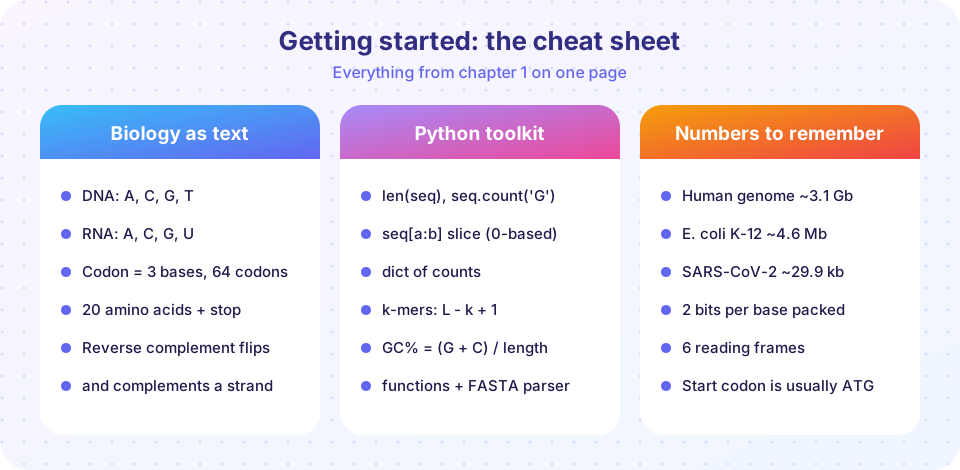
You have now seen how a living molecule becomes a string, how the genetic code turns triplets into proteins and how a few lines of Python can count, slide and parse. This review collects the chapter on one page, shows where each idea reappears later in the course and gives you a longer quiz that mixes everything together.
What you will learn
- A compact recap of the vocabulary and code from chapter 1.
- Where each idea is used later in the course.
- Whether you are ready for chapter 2.
The chapter in one table
| Idea | What to remember | Where it returns |
|---|---|---|
| Base pairing | A-T (U in RNA) and G-C; strands are antiparallel | Primer design, read mapping (chapter 5) |
| Reverse complement | Complement, then reverse | Reads come from either strand (chapter 5) |
| Transcription | mRNA copies the coding strand with T to U | RNA-seq (chapter 6) |
| Genetic code | 64 codons: 20 amino acids and 3 stops; degenerate | Variant effects, protein alignment (chapters 3 and 5) |
| Reading frames | 3 offsets x 2 strands = 6 frames | Gene finding, translated BLAST |
| GC content | (G + C) / length; varies along a genome | Assembly, coverage bias |
| k-mers | L - k + 1 overlapping words; 4^k possible | BLAST seeds, assembly |
| FASTA | > header line, then sequence lines |
Every chapter |
Worked review problems
Try these by hand before running any code, then check the answers.
- Reverse complement and translation. A gene lies on the opposite strand of the sequence
CAGCGGCCCATTACAATGGCCAT. Its reverse complement isATGGCCATTGTAATGGGCCGCTG. Splitting this into codons gives ATG GCC ATT GTA ATG GGC CGC and a leftover TG, so the protein begins M-A-I-V-M-G-R. The two leftover bases are a reminder that a real gene needs a stop codon and a length divisible by three. - GC content. The sequence
GGCCATTAhas four G or C bases out of eight, so its GC content is 50%. Windows of different sizes along a longer sequence can give very different values, so state the window length whenever you report a profile. - k-mer counting. A 30-base read contains 28 overlapping 3-mers and 26 overlapping 5-mers. If a single base is wrong, it changes up to three of the 3-mers but up to five of the 5-mers, which is why longer k-mers are more sensitive to sequencing errors.
If any answer surprised you, return to the matching lesson before moving on.
Where people go wrong
- Forgetting to reverse. A complement alone is not the opposite strand written 5′ to 3′.
- Off-by-one slices. Python is 0-based and end-exclusive; many databases are 1-based and inclusive.
- Assuming one frame. A long stretch needs six-frame translation before you decide what it encodes.
- Trusting a short window. A GC profile with a tiny window is noise.
Try it
Press Run (or Ctrl + Enter) to see the result here.
Program input · what you'd type while the program runs
Type the answers before you press Run, one per line. Each time the program reads a line (with input()), it gets the next line from this box.
Check your understanding
Quick check · 9 questions
of 9 answered You scored / 9 · perfect!
-
1. What is the reverse complement of GATTACA?
Complement GATTACA to CTAATGT, then reverse to get TGTAATC. -
2. The mRNA 5' AUGGCUUAA 3' is translated. What is the protein?
AUG is Met, GCU is Ala and UAA is a stop, so the protein is MA. -
3. How many sense codons (codons that do not signal stop) does the standard code have?
64 codons minus 3 stop codons leaves 61 sense codons. -
4. Which statement about GC content is correct?
GC content varies between species and within a genome, and it affects melting temperature. -
5. How many overlapping 5-mers does a 12-base sequence have?
12 - 5 + 1 = 8. -
6. Which Python expression returns the first codon of seq?
Indexes 0, 1 and 2 form the first codon, so the slice is seq[0:3]. -
7. A gene lies on the opposite strand of the sequence you were given. What should you do before translating?
You need the opposite strand written 5' to 3', which is the reverse complement. -
8. Why is a very long ORF evidence of a real gene in bacteria?
With 3 stops among 64 codons, random DNA rarely stays open for hundreds of codons. -
9. What does the standard-code codon TGA mean in DNA letters?
TGA is a stop codon in the standard code (but codes for Trp in vertebrate mitochondria).
Summary
- Sequences are strings; strands pair antiparallel, so reverse complement means complement plus reverse.
- The genetic code maps 64 triplets onto 20 amino acids and 3 stops, in six possible frames.
- GC content, windows and k-mers are the basic measurements for any sequence.
- You are ready for chapter 2, where you meet the databases and file formats that supply real sequences.
Track your progress
Create a free account to tick off lessons and pick up where you left off on any device.
of Bioinformatics lessons completed