


















Lesson 1 of 49 · Getting Started
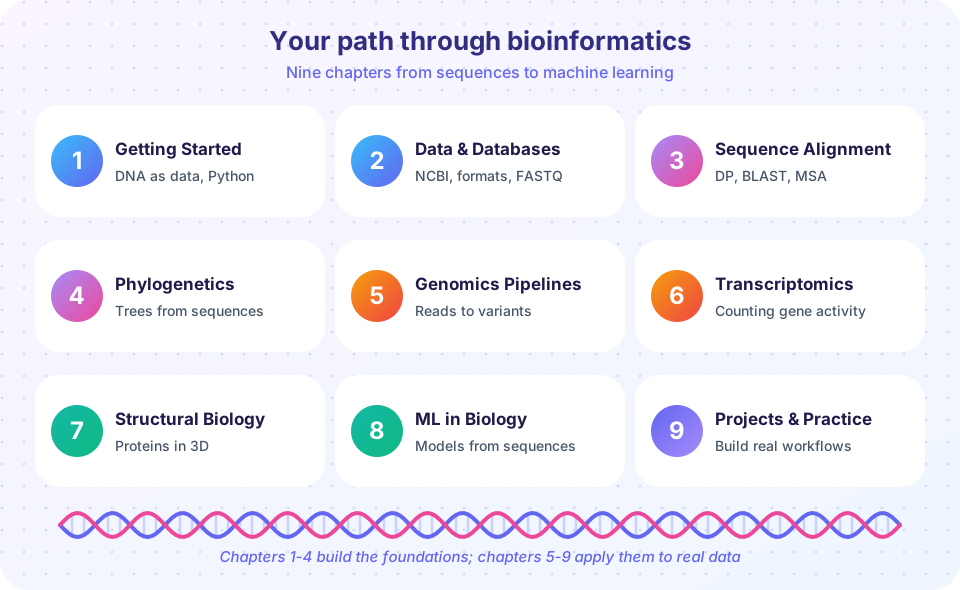
Course map: your path through bioinformatics
See the whole bioinformatics course at a glance: who it is for, how to study it, and what the nine chapters teach, from DNA as data to machine learning and projects.
Bioinformatics is the discipline that uses computation to answer questions about living things. A modern sequencing machine can read billions of DNA letters in a day. Nobody can read that output by eye, so we write programs that search it, compare it, count it and model it. This course teaches those programs from the ground up: the data, the algorithms behind famous tools such as BLAST, and the pipelines that turn raw reads into biological findings.
Educational information only. This course explains how biological data is analyzed. It is not medical or clinical advice, and nothing here can be used to diagnose, treat or predict a health condition. Genetic results about a real person should always be interpreted by a qualified professional.
What you will learn
- Who this course is for and what you need to know before you start.
- How the nine chapters build on each other, from single sequences to whole genomes.
- A study routine that works for a subject that mixes biology, statistics and programming.
- A feeling for the scale of biological data, using three real genome sizes.
Who this course is for
The course is written for learners aged about 14 and up, for first-year university students, and for adults who come from biology and want to learn to code, or from computing and want to learn the biology. It follows the common core of international school and first-year university material: IB Biology and Computer Science options, Cambridge A Level Biology, US AP Biology and AP Computer Science Principles, and introductory university bioinformatics.
You need three things. First, school-level biology: what DNA, a gene and a protein are. Second, a little Python: variables, strings, lists and loops. If you can read a ten-line Python program, you are ready, and chapter 1 revises the rest. Third, comfort with a simple graph. The mathematics stays light, with a few logarithms and probabilities that are explained when they appear.
Why bioinformatics exists
Biology became a data science in stages. In 1977 Frederick Sanger's team read the 5,386 bases of the virus phiX174, one of the first complete genomes. In 1990 the Human Genome Project began, and a first draft of the three-billion-letter human genome appeared in 2001. Around 2005 "next-generation" sequencing made reading DNA cheaper per base by several orders of magnitude. Today a single run can produce more text than a person could read in a thousand lifetimes.
Three questions drive almost everything in this course.
- Where did this sequence come from, and what is it similar to? (alignment, BLAST, databases)
- How are these organisms related? (phylogenetics)
- What is this molecule or cell doing? (variants, expression, structure, machine learning)
Each answer needs an algorithm, and each algorithm needs data in a specific file format. That is the order of the course: data first, algorithms second, pipelines third.
How the nine chapters fit together
Part 1: the foundations
- Getting started
- Data and databases
Part 2: comparing sequences
- Sequence alignment
- Phylogenetics
Part 3: whole genomes and cells
- Genomics pipelines
- Transcriptomics
Part 4: molecules and models
- Structural biology
- Machine learning
- Projects and practice
Chapters 1 to 4 are the first half of the course and the part you are reading now. They give you the data, the databases, the alignment algorithms and the tree-building methods that every later chapter uses. If a later idea feels hard, the explanation almost always lives a chapter or two earlier.
The scale of biological data
A few numbers make the rest of the course easier to picture. The human genome has about 3.1 billion base pairs in one copy (the haploid genome). The bacterium Escherichia coli K-12 has about 4.6 million. The virus SARS-CoV-2 has about 29,900 bases of RNA. Because DNA uses only four letters, each base needs just 2 bits when packed tightly, so the human genome fits in roughly 775 megabytes, smaller than many video games. The hard part is not storing one genome, it is storing, aligning and comparing millions of them, and the reads that come before the finished genome.
Key terms.
- Genome: the complete DNA sequence of an organism.
- Base pair (bp): one rung of the DNA ladder; the unit for measuring sequence length (kb = thousand, Mb = million, Gb = billion).
- Sequence: an ordered string of letters representing DNA, RNA or protein.
- Read: a short piece of sequence produced by a sequencing machine.
- Pipeline: a chain of programs where each step's output is the next step's input.
A study routine that works
- Read with a question. Turn one bullet of the "What you will learn" list into a question you want answered.
- Run the examples. Every runnable example is small. Change a number, predict the result, run it again.
- Do the algorithm by hand once. For alignment and trees, fill a small table with pencil before you read the code. It sticks far better.
- Self-test. Use the quiz at the end of each lesson and the longer review quiz at the end of each chapter.
- Space it out. Revisit old lessons a few days later. Retrieval after a gap beats re-reading.
Common misconceptions
- "Bioinformatics is just using other people's software." Tools matter, but you cannot judge a result without knowing the algorithm and its assumptions. A BLAST hit with a poor E-value is noise no matter how official the output looks.
- "A bigger database always means a better answer." Databases contain errors, duplicates and contaminated entries. Part of the craft is knowing how much to trust each record.
- "The computer finds the truth." Programs find the best answer under a model. Changing the scoring scheme or the evolutionary model can change the answer.
Try it
Press Run (or Ctrl + Enter) to see the result here.
Program input · what you'd type while the program runs
Type the answers before you press Run, one per line. Each time the program reads a line (with input()), it gets the next line from this box.
Check your understanding
Quick check · 4 questions
of 4 answered You scored / 4 · perfect!
-
1. About how many base pairs are in one haploid copy of the human genome?
The haploid human genome is about 3.1 billion base pairs (3.1 Gb). -
2. How many bits does a base need if A, C, G and T are packed as tightly as possible?
Four letters need log2(4) = 2 bits, so a base fits in 2 bits. -
3. What is a sequencing read?
Reads are short fragments of sequence. Assembly or mapping software combines or places them. -
4. Which statement about bioinformatics tools is the best advice?
Results depend on scoring schemes, models and data quality, so you need to know what the tool assumes.
Summary
- Bioinformatics uses computation to analyze sequences, structures and expression data.
- The course moves from data and files to alignment, trees, pipelines, structures and machine learning.
- DNA is a four-letter text, so genomes are easy to store but hard to compare at scale.
- Run every example, do small algorithms by hand once, and test yourself often.
Track your progress
Create a free account to tick off lessons and pick up where you left off on any device.
of Bioinformatics lessons completed