


















Lesson 22 of 49 · Phylogenetics
Bootstrap support and reading trees
Measure confidence in a phylogenetic tree with the bootstrap, understand rooting, Newick format and monophyly, and avoid the most common mistakes when reading trees.
A tree-building program always returns a tree, even from noisy or uninformative data. So the vital follow-up question is "how much should I trust each branch?" The standard answer is the bootstrap, introduced into phylogenetics by Joseph Felsenstein in 1985. Together with a few rules for reading trees correctly (rooting, rotation, monophyly), it turns a pretty picture into a defensible scientific statement.
What you will learn
- How the bootstrap works and how to interpret support values.
- What the bootstrap does not tell you, and the alternatives (UFBoot, posterior probabilities).
- How trees are rooted and why rotating nodes changes nothing.
- The vocabulary of monophyly and the Newick format.
Key terms
- Bootstrap replicate: a new alignment of the original length made by sampling columns with replacement.
- Support value: the percentage of replicates in which a clade appears.
- Outgroup: a taxon known to lie outside the group of interest, used to root the tree.
- Monophyletic group: an ancestor and all its descendants (a clade).
- Paraphyletic and polyphyletic groups: groups that omit some descendants, or that combine lineages with different ancestors.
The bootstrap procedure
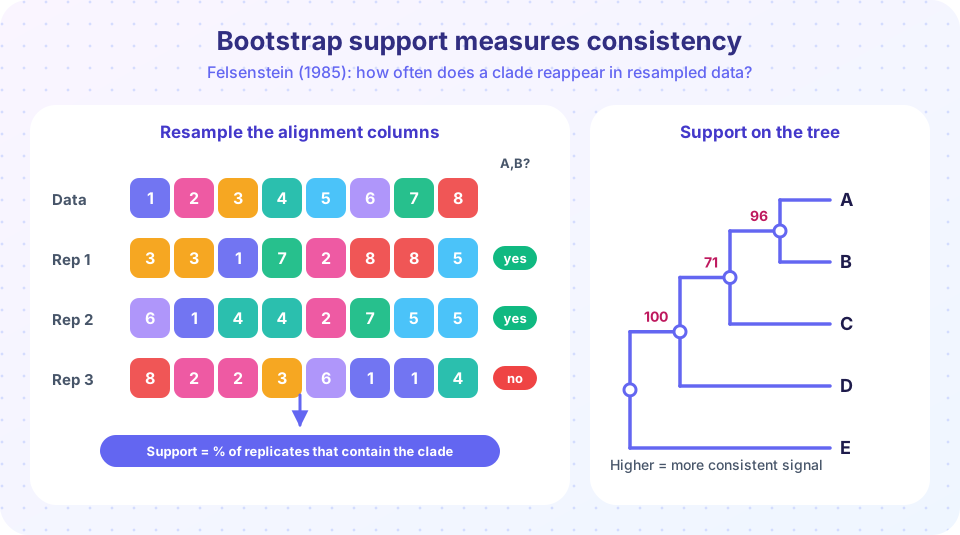
You have an alignment with L columns and a tree built from it. You cannot repeat the evolution, but you can ask how sensitive the tree is to the particular sites you happened to sample. The bootstrap does so by simulation:
- Draw L columns from the alignment with replacement. Some columns appear twice or more; others do not appear at all. On average about 63% of the original columns appear in a replicate (the chance a given column is never drawn is
(1 - 1/L)^L, about 37%). - Build a tree from the resampled alignment using the same method.
- Repeat 100 to 1,000 times.
- For each clade in your original tree, count the percentage of replicate trees that contain it. That percentage is the clade's bootstrap support.
A clade with 100% support appeared in every replicate: the signal for it is spread over many columns. A clade with 40% support depends on a handful of columns, and a different sample of columns would have given another answer. A frequently quoted rule of thumb treats values of 70% or higher as reasonable support, but that figure comes from simulations under particular conditions and is not a probability that the clade is true. Standard bootstrapping is slow for maximum likelihood trees, so IQ-TREE offers the ultrafast bootstrap (UFBoot), whose values are interpreted differently (95% or higher is the common threshold), and the SH-like approximate likelihood ratio test (SH-aLRT, 80% or higher). Bayesian posterior probabilities (0.95 or higher) are another measure, and they tend to be higher than bootstrap values for the same clade.
What support does not tell you
Support measures consistency: whether the data agree with themselves. It does not measure accuracy. If your method or model is biased, for instance parsimony attracted by long branches, or a model that ignores a strong compositional bias, the wrong clade can receive 100% support because the error is systematic and appears in every replicate. A bad alignment, contaminated sequences or paralogs mistaken for orthologs have the same effect. Support also says nothing about how a gene tree relates to the species tree: different genes can truthfully support different trees (incomplete lineage sorting, horizontal transfer, duplication and loss). Use several genes, check the model, and be wary when high support contradicts well-established biology.
Rooting and rotation
Most methods (neighbor-joining, maximum likelihood) give unrooted trees. They tell you who is related to whom but not which way time runs. To root a tree you can:
- add an outgroup: a sequence from a lineage known to have diverged earlier. The root is placed on the branch that leads to the outgroup.
- use midpoint rooting: put the root at the midpoint of the longest path between two leaves. This assumes a rough clock.
- use a molecular clock model, as in dated Bayesian analyses.
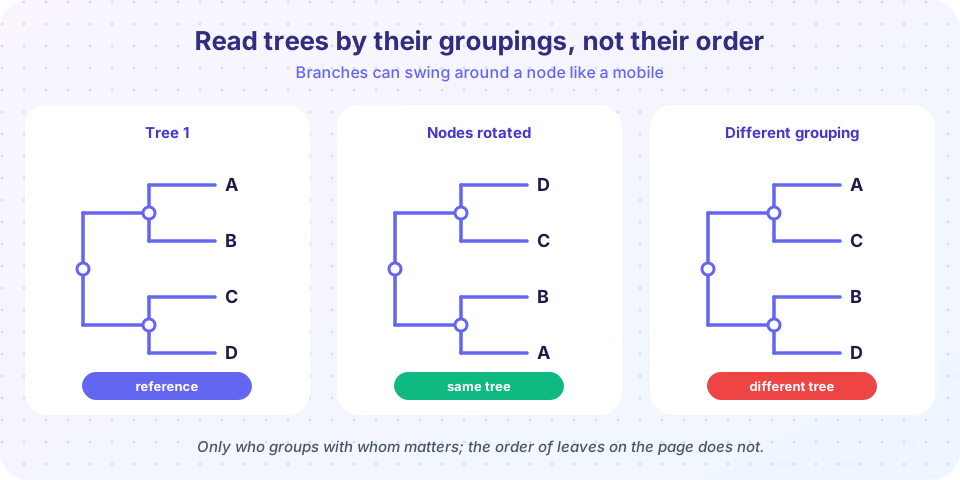
Once the tree is rooted, the order of leaves on the page carries no meaning. Each internal node is like a hinge on a mobile: you can swing its two branches around without changing the tree. What matters is which leaves share a node. Two trees that look different may be identical, and two that look alike may differ. The second picture shows this.
Monophyly, paraphyly and polyphyly
A monophyletic group (clade) includes an ancestor and all its descendants; "mammals" is monophyletic. A paraphyletic group includes an ancestor but leaves out some descendants; "reptiles" excluding birds is the classic example, since birds descend from within reptiles. A polyphyletic group collects lineages that lack a recent shared ancestor within the group, such as "flying vertebrates" (birds, bats, pterosaurs). Modern classification favors monophyletic groups, and a tree is the evidence used to judge them.
Reading branch lengths
In a phylogram, branch lengths are proportional to the amount of change, usually in substitutions per site, with a scale bar. In a cladogram, only the branching order is meaningful. In a chronogram or time tree, lengths are proportional to time. Always read the scale bar before comparing lengths, and never compare the vertical spacing of leaves.
The Newick format
Trees are exchanged as Newick strings: parentheses group relatives, commas separate them, colons attach branch lengths, and node labels such as support values follow the closing parenthesis, as in ((A:0.1,B:0.1)96:0.05,(C:0.2,D:0.2)88:0.05);. Viewers such as FigTree, iTOL and the R package ggtree draw them. Note that for an unrooted tree, programs write a trifurcation at the base; rooting changes the string.
Common misconceptions
- "Bootstrap 95% means the clade has a 95% chance of being true." It means 95% of resampled data sets recovered it; systematic errors can give high support to false clades.
- "Low support means the tree is wrong." It means the data are weak or conflicting at that branch; the inferred branch may still be correct.
- "Leaves at the top are more evolved." Leaf order is arbitrary; all leaves are living (or sampled) tips of equal age.
- "A tree of a gene shows the history of the species." It may differ because of duplication, loss, transfer or incomplete lineage sorting.
Try it
Press Run (or Ctrl + Enter) to see the result here.
Program input · what you'd type while the program runs
Type the answers before you press Run, one per line. Each time the program reads a line (with input()), it gets the next line from this box.
Press Run (or Ctrl + Enter) to see the console output here.
No output.
Check your understanding
Quick check · 5 questions
of 5 answered You scored / 5 · perfect!
-
1. How is a bootstrap replicate of an alignment made?
Columns are drawn with replacement, so some repeat and some are missing. -
2. A clade appears in 87 of 100 bootstrap trees. What is its bootstrap support?
Support is the percentage of replicates that contain the clade. It is not the probability that the clade is true. -
3. Which statement is correct?
Bootstrap measures consistency of the data; a biased method can be consistently wrong. -
4. What is a paraphyletic group?
'Reptiles' excluding birds is a classic paraphyletic group. -
5. How does an outgroup help?
An outgroup lies outside the group of interest, so the root belongs on its branch.
Summary
- The bootstrap resamples alignment columns; support is the percentage of replicates containing a clade.
- Support measures consistency, not accuracy; systematic errors can give high support to wrong clades.
- Root with an outgroup or midpoint; leaf order and node rotation carry no meaning.
- Read clades by monophyly, read branch lengths with the scale bar, and exchange trees in Newick.
Next: Chapter 4 review
Track your progress
Create a free account to tick off lessons and pick up where you left off on any device.
of Bioinformatics lessons completed