
























Bài 50 · Projects and Practice
Cheat Sheet: Nuclear and Particle Physics
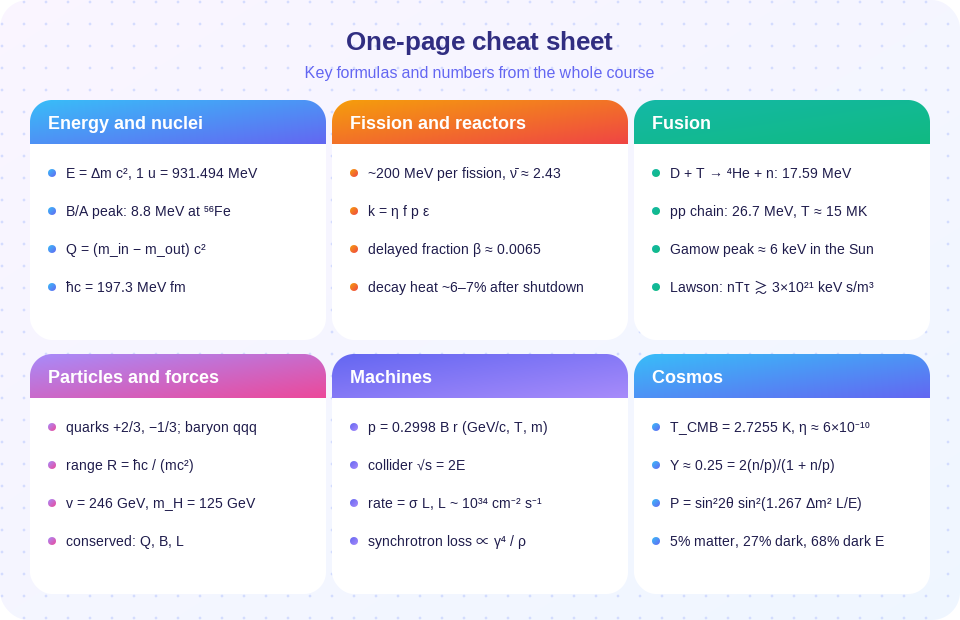
A one-page reference of the key formulas, constants, masses and rules of thumb from fission and fusion, the Standard Model, accelerators, detectors and cosmology.
When you work on a problem, you want the main formulas and numbers in one place. This page is that place: a poster for a quick overview, followed by tables of constants and masses, rules of thumb and a few handy converters. Everything on it is explained in the lessons, so follow the links in the tables if a formula looks unfamiliar.
What you will learn
- Where to find the key constants and conversion factors quickly.
- Which formula belongs to which kind of problem.
- Typical sizes of energies, lengths and times in nuclear and particle physics.
Key terms
Natural units: setting ħ = c = 1 so that energy, momentum, mass, inverse length and inverse time all use the same unit (eV or GeV).
Rest energy: mc², the energy equivalent of a particle's mass.
Reduced mass: for two bodies, m_r = m₁m₂/(m₁ + m₂).
Constants and conversions
| Quantity | Value |
|---|---|
Speed of light c |
2.998×10⁸ m/s |
ħc |
197.327 MeV fm |
hc |
1239.84 MeV fm |
Fine-structure constant α |
1/137.036 |
Elementary charge e |
1.602×10⁻¹⁹ C |
| 1 eV | 1.602×10⁻¹⁹ J |
| 1 u | 931.494 MeV/c² = 1.6605×10⁻²⁷ kg |
k_B |
8.617×10⁻⁵ eV/K (1 keV ↔ 11.6 million K) |
| 1 fm | 10⁻¹⁵ m |
| 1 barn | 10⁻²⁸ m² (1 pb = 10⁻³⁶ cm²) |
Avogadro N_A |
6.022×10²³ mol⁻¹ |
| 1 pc | 3.086×10¹⁶ m |
Masses (rest energies)
| Particle | Mass | Particle | Mass |
|---|---|---|---|
| electron | 0.511 MeV | proton | 938.272 MeV |
| muon | 105.658 MeV | neutron | 939.565 MeV |
| tau | 1776.9 MeV | π± / π⁰ | 139.57 / 134.98 MeV |
| W | 80.377 GeV | K± | 493.68 MeV |
| Z | 91.1876 GeV | top quark | 172.6 GeV |
| Higgs | 125.25 GeV | neutrinos | below about 0.1 eV each |
Formulas by topic
| Topic | Formula | Lesson |
|---|---|---|
| Mass defect and Q | Q = (Σm_in − Σm_out) c² |
Big picture |
| Fission | ~200 MeV per fission; ν̄ ≈ 2.43; k = η f p ε |
Fission, Reactors |
| Reactivity | ρ = (k − 1)/k; prompt critical at ρ = β ≈ 0.0065 |
Reactors |
| Stellar fusion | E₀ = (E_G (kT)²/4)^(1/3), E_G = 2 m_r c² (π α Z₁Z₂)² |
Fusion in stars |
| Fusion power | D–T 17.59 MeV; n T τ_E ≳ 3×10²¹ keV s m⁻³ |
Fusion power |
| Force range | R = ħc/(mc²) |
Forces |
| Two-body decay | p = √[(M² − (m₁+m₂)²)(M² − (m₁−m₂)²)] / (2M) |
Conservation |
| Time dilation | τ_lab = γ τ |
Conservation |
| Bending | p [GeV/c] = 0.2998 B [T] r [m] |
Accelerators |
| Collision energy | collider √s = 2E; fixed target √s ≈ √(2mc²E) |
Big picture |
| Event rate | rate = σ L |
Accelerators |
| Synchrotron loss | ΔE ∝ γ⁴/ρ; electrons: 0.0885 E⁴[GeV]/ρ[m] MeV |
Accelerators |
| Cherenkov | cos θ = 1/(nβ) |
Detectors |
| Invariant mass | m² = (ΣE)² − (Σp)² (c = 1) |
Detectors |
| Temperature and time | kT ≈ 1.3 MeV / √t[s] (radiation era) |
Cosmic big picture |
| Helium fraction | Y = 2(n/p)/(1 + n/p) |
Nucleosynthesis |
| Oscillation | P = 1 − sin²2θ sin²(1.267 Δm² L/E) |
Neutrinos |
| CMB scaling | T = 2.7255 K (1 + z) |
Cosmic big picture |
| Larmor radius | r = E / (Z e c B) |
Cosmic rays |
Rules of thumb
- Scale ladder: eV (chemistry) → keV (stellar plasma, X-rays) → MeV (nuclei) → GeV (hadrons) → TeV (LHC) → 10²⁰ eV (cosmic rays).
- Length from energy:
1 GeV ↔ 0.197 fm, so a 100 GeV probe resolves about 0.002 fm. - Lifetimes: strong 10⁻²³ s, electromagnetic 10⁻¹⁶ s, weak 10⁻¹³ s to minutes.
- Charges: u-type +2/3, d-type −1/3; baryons are qqq, mesons q q̄.
- Conserved: energy, momentum, charge, baryon number, lepton family numbers (weak force breaks flavor and strangeness).
- Budget of the universe: 5% ordinary matter, 27% dark matter, 68% dark energy.
Try it
Press Run (or Ctrl + Enter) to see the result here.
Program input · what you'd type while the program runs
Type the answers before you press Run, one per line. Each time the program reads a line (with input()), it gets the next line from this box.
Press Run (or Ctrl + Enter) to see the console output here.
No output.
Check your understanding
Quick check · 5 questions
of 5 answered You scored / 5 · perfect!
-
1. What is 1 keV in kelvin (as kT)?
1 keV / (8.617×10⁻⁵ eV/K) = 1.16×10⁷ K. -
2. A force carrier has mass 10 GeV/c². Its range is about...
R = 197.3 MeV fm / 10,000 MeV ≈ 0.0197 fm = 2×10⁻¹⁷ m. -
3. Which formula gives the momentum of a charged particle in a magnetic field?
p [GeV/c] = 0.2998 B [T] r [m]. -
4. What is the typical lifetime scale of a weak decay?
Weak decays are slowest: from about 10⁻¹³ s to minutes (neutron: 880 s). -
5. Which is the correct split of the cosmic energy budget?
Ordinary matter is only about 5% of the total.
Summary
- Keep
ħc = 197.3 MeV fm,1 u = 931.5 MeV/c²andk_B = 8.617×10⁻⁵ eV/Kat your fingertips. - Choose formulas by problem type: Q-value, k and reactivity, Gamow and Lawson, range, bending radius, √s and rates, Y and oscillations.
- Check scale: energies run from eV to 10²⁰ eV and lifetimes from 10⁻²³ s to minutes.
Theo dõi tiến độ của bạn
Tạo tài khoản miễn phí để đánh dấu bài đã học và tiếp tục từ chỗ bạn dừng lại trên mọi thiết bị.