
























Bài 39 · Accelerators and Detectors
Chapter Review: Accelerators and Detectors
A one-page recap of how particle accelerators and detectors work, with the key formulas, a self-check calculator and a mixed ten-question quiz.
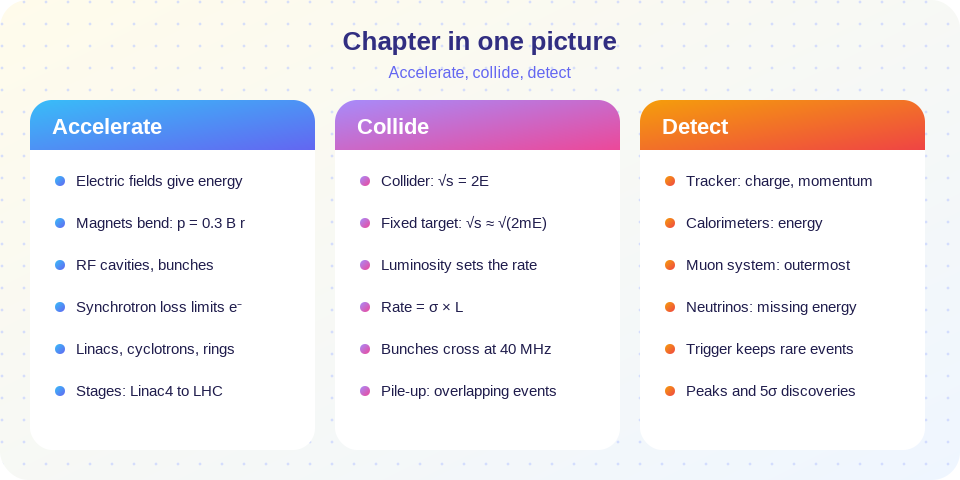
This chapter followed a proton from a bottle of hydrogen through the CERN accelerator chain to a collision, and then followed the debris through the layers of a detector to a peak in a histogram. Here are the main formulas and ideas in one place.
Recap
| Lesson | Main ideas | Formulas |
|---|---|---|
| The big picture | Wavelength, mass creation, colliders vs fixed target, detector layers | λ = hc / pc; √s = 2E vs √(2mc²E) |
| How accelerators work | RF cavities, dipoles, quadrupoles, synchrotron radiation, luminosity | p = 0.2998 B r; ΔE ∝ γ⁴/ρ; rate = σ L |
| How detectors work | Tracking, calorimetry, muons, Cherenkov, invariant mass, 5σ | p_T = 0.2998 B r; cos θ_C = 1/(nβ); m² = (ΣE)² − (Σp)² |
Habits to build
- Convert units early. GeV for energy, GeV/c for momentum, GeV/c² for mass; tesla and meters for the bending rule.
- Ask what is limiting. An accelerator is limited by magnet strength and radius (protons) or by radiation (electrons); a detector by resolution; an analysis by background.
- Check the scale. The LHC dipoles are about 8 T and the ring radius is a few kilometres; if your result gives a mountain-sized ring or a micro-tesla field, something is off.
Accelerate
Collide
Detect
Try it
Press Run (or Ctrl + Enter) to see the result here.
Program input · what you'd type while the program runs
Type the answers before you press Run, one per line. Each time the program reads a line (with input()), it gets the next line from this box.
Press Run (or Ctrl + Enter) to see the console output here.
No output.
Check your understanding
Quick check · 10 questions
of 10 answered You scored / 10 · perfect!
-
1. A particle beam has pc = 0.1 GeV. Its de Broglie wavelength is about...
λ = 1.24 GeV fm / 0.1 GeV ≈ 12 fm. -
2. For two equal beams head-on, what is √s?
Equal and opposite momenta cancel, so the total energy of both beams is available. -
3. Which component adds energy to a circulating beam?
Only an electric field changes the energy. RF cavities supply it. -
4. Why do high-energy electron synchrotrons lose so much energy?
γ is large for light particles, so the radiated energy per turn is large. -
5. A collider has L = 10³⁴ cm⁻² s⁻¹. What is the rate for σ = 1 pb?
1 pb = 10⁻³⁶ cm², so the rate is 10⁻² per second, or one per 100 seconds. -
6. Which detector component measures the energy of electrons and photons?
The ECAL absorbs them in a shower and measures the total light. -
7. A neutrino produced in a collision is identified by...
Neutrinos escape unseen; the momentum imbalance shows them. -
8. A particle with β = 0.9 travels in water (n = 1.33). Does it emit Cherenkov light?
The condition is β > 1/n. Here 0.9 > 0.75, so a cone of light is emitted. -
9. Why is 5σ used for discoveries?
A 5σ excess has a one-sided p-value of about 3×10⁻⁷ for background alone. -
10. The LHC dipoles are 8.33 T and the bending radius is 2,804 m. Momentum per beam?
0.2998 × 8.33 × 2804 ≈ 7,000 GeV/c.
Summary
- Short wavelengths need high momentum; heavy particles need high energy; colliders give
√s = 2E. - RF cavities accelerate, dipoles bend, quadrupoles focus;
p = 0.2998 B rlimits rings. - Electrons lose energy as
γ⁴/ρto synchrotron radiation; protons do not. - Trackers measure momentum and charge, calorimeters measure energy, the muon system identifies muons, missing momentum signals neutrinos.
- Invariant-mass peaks and 5σ significance turn events into discoveries.
Theo dõi tiến độ của bạn
Tạo tài khoản miễn phí để đánh dấu bài đã học và tiếp tục từ chỗ bạn dừng lại trên mọi thiết bị.