
























Bài 44 · Projects and Practice
Glossary of analog electronics
A searchable glossary of 45 analog electronics terms from gain and bias to op-amps, filters, oscillators and power supplies, each with a short definition and a lesson link.
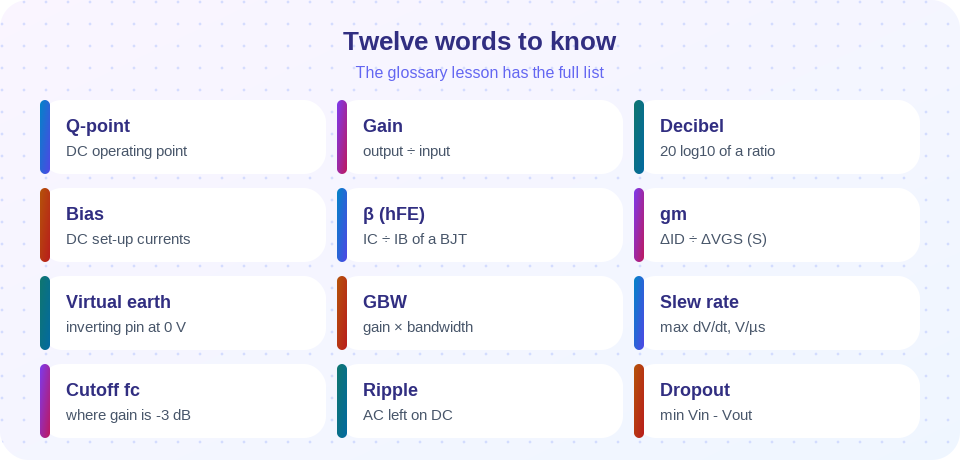
Analog electronics comes with a lot of vocabulary, and much of it is easy to mix up: gain and loop gain, bandwidth and cutoff, ripple and noise. This glossary collects the terms from chapters 5 to 8 with one-line definitions and a pointer to the lesson where each is explained. Use the search box below to find a term quickly, or the flashcard tool to quiz yourself.
What you will learn
- Recall the precise meaning of the main terms in amplifier, op-amp, filter and power-supply design.
- Distinguish look-alike terms.
- Find the lesson that explains each one.
Terms A to F
| Term | Meaning | Lesson |
|---|---|---|
| Active filter | A filter that uses an amplifier (usually an op-amp) as well as resistors and capacitors | Active filters |
| Active region | The BJT operating region where IC ≈ β·IB and the collector-base junction is reverse biased |
Biasing |
| Amplifier | A circuit that makes a larger copy of a signal using power from a supply | Chapter 5 overview |
| Anti-aliasing filter | A low-pass filter placed before an ADC to remove frequencies above half the sampling rate | Sensor chain |
| Bandwidth | The range of frequencies over which a circuit's gain stays within 3 dB of its mid-band value | Real op-amp limits |
| Barkhausen criteria | For sustained oscillation, loop gain of magnitude 1 and phase 0° (or 360°) | Oscillators |
| Bias | The DC currents and voltages that set a transistor's operating point | Biasing |
| Bode plot | A graph of gain (dB) and phase against frequency on a logarithmic axis | RC filters |
| Bridge rectifier | Four diodes that convert AC into pulsating DC using both half-cycles | Ripple |
| Buck converter | A switching regulator that steps a voltage down, Vout = D · Vin |
Switching regulators |
| Bypass capacitor | A capacitor that gives AC a short path around a resistor, such as RE | Common emitter |
| CMRR | Common-mode rejection ratio: differential gain divided by common-mode gain, usually in dB | Op-amp circuits |
| Closed-loop gain | The gain of an amplifier with its feedback network connected | Chapter 6 overview |
| Common-emitter stage | A BJT amplifier with input at the base, output at the collector, voltage gain about -RC / re |
Common emitter |
| Coupling capacitor | A capacitor that passes AC and blocks DC between stages | Common emitter |
| Cutoff frequency | The frequency where a filter's gain has fallen by 3 dB (to 0.707) | RC filters |
| Decibel | Ten times the base-10 logarithm of a power ratio, or twenty times for a voltage ratio | Gain and decibels |
| Decoupling capacitor | A capacitor across a chip's supply pins that supplies fast current and absorbs noise | Switching regulators |
| Dropout voltage | The minimum Vin - Vout a linear regulator needs to stay in regulation |
Linear regulators |
| Duty cycle | The fraction of a switching period during which the switch is on | Switching regulators |
| Feedback | Returning part of the output to the input; negative feedback opposes the change | Ideal op-amp |
| Full-power bandwidth | The highest frequency at which the full output amplitude is undistorted, SR / (2π Vp) |
Real op-amp limits |
Terms G to R
| Term | Meaning | Lesson |
|---|---|---|
| Gain | Output divided by input (voltage, current or power) | Gain and decibels |
| GBW | Gain-bandwidth product: closed-loop gain times bandwidth, constant for a voltage-feedback op-amp | Real op-amp limits |
| Input offset voltage | The small DC voltage between the inputs needed to zero the output | Real op-amp limits |
| Instrumentation amplifier | A high-CMRR, high-input-resistance difference amplifier, usually with three op-amps | Sensor chain |
| LDO | Low-dropout linear regulator: needs only a few hundred millivolts of headroom | Linear regulators |
| Load line | The straight line of all IC-VCE combinations the external circuit allows |
Biasing |
| Loop gain | The product A · β of amplifier gain and feedback fraction around the loop |
Oscillators |
| Noise gain | 1 + Rf / Rin: the gain seen by offsets and noise at the input |
Real op-amp limits |
| Op-amp | A high-gain differential amplifier designed to be used with feedback | Chapter 6 overview |
| Open-loop gain | The gain of the bare op-amp without feedback (about 100,000 at DC) | Chapter 6 overview |
| Oscillator | A circuit that generates a repeating signal from a DC supply | Oscillators |
| Q (quality factor) | How sharply a second-order filter or resonator peaks; related to damping by ζ = 1/(2Q) |
Active filters |
| Q-point | The quiescent DC values of IC and VCE with no signal |
Biasing |
| re | A BJT's small-signal emitter resistance, 25 mV / IE |
Common emitter |
| Ripple | The small AC variation left on a filtered DC supply, ≈ I / (fr · C) |
Ripple |
| Roll-off | How fast gain falls beyond the cutoff, in dB per decade (20 dB per pole) | RC filters |
Terms S to Z
| Term | Meaning | Lesson |
|---|---|---|
| Sallen-Key | A popular second-order active filter with one op-amp, two resistors and two capacitors | Active filters |
| Slew rate | The maximum rate of change of an op-amp's output, in V/µs | Real op-amp limits |
| Time constant | τ = R C: the time to reach 63% of the final value |
RC filters |
| Virtual earth | A node held at 0 V by feedback without being connected to ground | Ideal op-amp |
| Voltage follower | A non-inverting amplifier with gain 1 that buffers a source | Ideal op-amp |
| Wien bridge | An RC network with gain 1/3 at f = 1/(2πRC) used in sine oscillators |
Oscillators |
| Zener diode | A diode designed to conduct in reverse breakdown at a defined voltage, used for references and simple regulators | Linear regulators |
Look-alike terms
Gain versus loop gain. Gain is what the whole circuit does to a signal from input to output; loop gain is the gain once around the feedback loop (it decides stability and oscillation).
Bandwidth versus cutoff frequency. For a low-pass filter they are the same number; for a band-pass, bandwidth is the width of the passband between two cutoffs.
Ripple versus noise. Ripple is a periodic, predictable variation at the rectifier or switching frequency; noise is random and broadband.
Bias current versus bias (voltage). "Bias" for a transistor is the DC operating point; "input bias current" for an op-amp is the small current flowing into its input pins.
Try it
The first tool is a searchable glossary of the most important terms. Type part of a word and the list narrows.
The second tool is a set of flashcards. Click a card to flip it, then mark whether you knew the answer.
Check your understanding
Quick check · 4 questions
of 4 answered You scored / 4 · perfect!
-
1. Which term describes the gain of the signal once around a feedback loop?
Loop gain is A·β, the product of the amplifier gain and the feedback fraction. -
2. A node held at 0 V by feedback but not connected to ground is called:
It is the inverting input of an inverting op-amp amplifier. -
3. What distinguishes ripple from noise?
Ripple is predictable and tied to the mains or switching frequency. -
4. What is the quiescent operating point of a transistor called?
Q stands for quiescent: the DC values with no signal.
Summary
- Learn the vocabulary in pairs of look-alike terms: gain vs loop gain, ripple vs noise, bias vs bias current.
- Every term here links to its lesson; use the glossary as an index.
- Re-read the lesson when a definition feels vague.
Theo dõi tiến độ của bạn
Tạo tài khoản miễn phí để đánh dấu bài đã học và tiếp tục từ chỗ bạn dừng lại trên mọi thiết bị.