See what this English speaking tutorial covers, how to practice alone or with a partner, what the exercises can and cannot do, and how to set your first goal.
Speaking is a skill you do, not only a subject you know. You can understand grammar well and still freeze when a neighbor says "How's it going?" This course gives you ready phrases, short model conversations and practice routines so that words come out more easily.
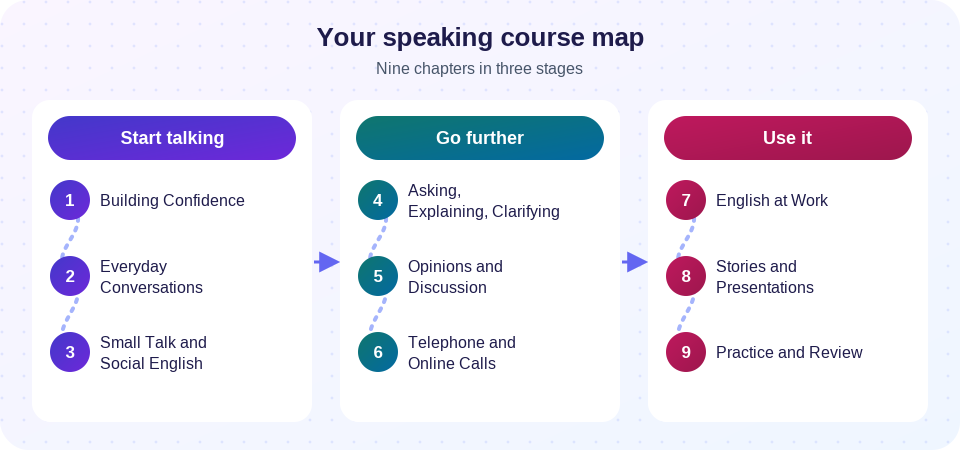
This first lesson is your map. It shows what is in each chapter, how a lesson works, and how to practice so that reading turns into talking.
The course moves from calm first sentences to longer, more demanding speaking.
Each lesson has explanations, worked examples, common mistakes, exercises and a short quiz. Reading is only the first step. Use this routine:
Read the model conversation silently so that you understand it.
Read it aloud twice. Take one role, then the other.
Cover the page and say the conversation again in your own words. It does not need to match.
Change one detail. Order tea instead of coffee, or ask for the library instead of the station.
Use one phrase in real life, or imagine exactly when you will.
Changing details matters. If you only memorize a fixed script, you may get lost when the other person says something unexpected. If you swap details often, you learn a flexible pattern.
A: Excuse me, is there a bank near here?
B: Yes, there's one next to the supermarket.
A: Great, thank you.
Now make three new versions. Change the place (a pharmacy, a bus stop). Change the answer ("Sorry, I'm not from here"). Change your last line ("No problem, thanks anyway"). In a few minutes you have practiced many sentences with one pattern.
The practice boxes on these pages work with clicks and typing. They can check whether you chose a reply or typed a phrase from the lesson, show model answers, and run a timer. They cannot hear you, record you, grade your pronunciation or score your speaking.
That means you are the listener. These tools can help you outside this page:
Your phone's voice recorder. Record 30 seconds, then listen once for one thing only.
A practice partner. A friend, classmate or family member can play the other role.
A teacher or conversation group. They can tell you what is hard to understand, which you may not notice yourself.
If you record a conversation with another person, ask for permission first. Rules about recording differ from place to place, and asking is also polite.
Choose the practice habit that is most likely to help in each situation.
Choose a useful practice habit
<!doctypehtml><style>body{font-family: system-ui, sans-serif;margin: 0;padding: 14px;background:linear-gradient(135deg, #faf5ff, #eff6ff);color: #1e1b4b;}.card{background: #fff;border-radius: 14px;padding: 14px 16px;box-shadow: 0 6px 18px rgba(49, 46, 129, .12);margin-bottom: 10px;}button{font: inherit;border: 1px solid #c7d2fe;background: #eef2ff;color: #1e1b4b;border-radius: 10px;padding: 8px 12px;margin: 4px 4px 0 0;cursor: pointer;text-align: left;}button.main{background:linear-gradient(135deg, #4f46e5, #7c3aed);color: #fff;border: 0;}button.good{background: #d1fae5;border-color: #10b981;}button.bad{background: #fee2e2;border-color: #ef4444;}input, select{font: inherit;padding: 6px 8px;border: 1px solid #a5b4fc;border-radius: 8px;max-width: 100%;}.muted{color: #475569;font-size: 14px;}.fb{margin-top: 8px;min-height: 1.4em;}</style><divclass="card"><divid="n"class="muted"></div><pid="q"></p><divid="opts"></div><divid="fb"class="fb"></div></div><buttonclass="main"id="next"type="button">Next situation</button><script>const data =[["You read a model conversation about buying a train ticket. What should you do next?",["Read it aloud, taking each role","Read it silently five more times","Skip to the next chapter"],0,"Saying both roles turns reading into speaking practice."],["You can repeat a script perfectly. How can you make the practice more flexible?",["Change the place, time or item and say it again","Say the same script faster and faster","Memorize the punctuation"],0,"New details force you to build sentences, not only remember them."],["You want to know how clear you sound. What can help?",["Ask a patient listener, or record yourself and listen back","Count the quiz answers on this page","Type the sentence correctly"],0,"This page cannot hear you, so use your own ears or another person."],["Which goal is the easiest to act on?",["Ask one question in English at the cafe on Tuesday","Become fluent","Stop making mistakes"],0,"It names a small action and a time."]];const$=(id)=> document.getElementById(id);constmake=(tag, text, cls)=>{const el = document.createElement(tag);
el.textContent = text;if(cls) el.className = cls;return el;};let i =0, right =0, answered =false;functionshow(){const[question, options, best, why]= data[i];
answered =false;$('n').textContent ='Situation '+(i +1)+' of '+ data.length +' | Best first choices: '+ right;$('q').textContent = question;$('fb').textContent ='';$('opts').replaceChildren();const order = options.map((_, k)=> k).sort(()=> Math.random()-0.5);
order.forEach((k)=>{const b =make('button', options[k]);
b.type ='button';
b.style.display ='block';
b.onclick=()=>{
b.className = k === best ?'good':'bad';if(!answered && k === best) right++;
answered =true;$('fb').textContent = k === best ?'Good choice. '+ why :'Not the best fit here. Try another one.';$('n').textContent ='Situation '+(i +1)+' of '+ data.length +' | Best first choices: '+ right;};$('opts').append(b);});}$('next').onclick=()=>{ i =(i +1)% data.length;if(i ===0) right =0;show();};show();</script>
Now take one minute to say your own goal. Use the prompts and the checklist.
Say your goal aloud
<!doctypehtml><style>body{font-family: system-ui, sans-serif;margin: 0;padding: 14px;background:linear-gradient(135deg, #faf5ff, #eff6ff);color: #1e1b4b;}.card{background: #fff;border-radius: 14px;padding: 14px 16px;box-shadow: 0 6px 18px rgba(49, 46, 129, .12);margin-bottom: 10px;}button{font: inherit;border: 1px solid #c7d2fe;background: #eef2ff;color: #1e1b4b;border-radius: 10px;padding: 8px 12px;margin: 4px 4px 0 0;cursor: pointer;text-align: left;}button.main{background:linear-gradient(135deg, #4f46e5, #7c3aed);color: #fff;border: 0;}button.good{background: #d1fae5;border-color: #10b981;}button.bad{background: #fee2e2;border-color: #ef4444;}input, select{font: inherit;padding: 6px 8px;border: 1px solid #a5b4fc;border-radius: 8px;max-width: 100%;}.muted{color: #475569;font-size: 14px;}.fb{margin-top: 8px;min-height: 1.4em;}</style><divclass="card"><pid="prompt"style="font-size:18px"></p><divid="clock"style="font-size:34px;font-weight:700"></div><progressid="bar"max="1"value="0"style="width:100%"></progress></div><buttonclass="main"id="start"type="button">Start speaking</button><buttonid="stop"type="button">Stop</button><buttonid="new"type="button">New prompt</button><divclass="card"style="margin-top:10px"><strong>After you stop, tick what you did</strong><divid="checks"></div><divid="fb"class="fb muted"></div></div><script>const data ={"seconds":60,"prompts":["Why do you want to speak English? Give two reasons.","Where will you use English this month? Describe one situation.","What is your first small speaking goal, and when will you try it?"],"checks":["I spoke aloud, not only in my head","I kept going after a pause or a mistake","I gave at least one detail or example","I finished with a complete sentence"]};const$=(id)=> document.getElementById(id);constmake=(tag, text, cls)=>{const el = document.createElement(tag);
el.textContent = text;if(cls) el.className = cls;return el;};let index =0, left = data.seconds, handle =null;constdraw=()=>{$('clock').textContent = left +' s';$('bar').value =1- left / data.seconds;};functionreset(){clearInterval(handle);
handle =null;
left = data.seconds;$('prompt').textContent = data.prompts[index];draw();}$('start').onclick=()=>{if(handle)return;if(left ===0) left = data.seconds;
handle =setInterval(()=>{
left--;draw();if(left <=0){clearInterval(handle); handle =null;$('clock').textContent ='Time. Finish your sentence.';}},1000);};$('stop').onclick=()=>{clearInterval(handle); handle =null;};$('new').onclick=()=>{
index =(index +1)% data.prompts.length;
document.querySelectorAll('#checks input').forEach((c)=>{ c.checked =false;});$('fb').textContent ='';reset();};
data.checks.forEach((text)=>{const label = document.createElement('label');
label.style.display ='block';const box = document.createElement('input');
box.type ='checkbox';
box.onchange=()=>{const n = document.querySelectorAll('#checks input:checked').length;$('fb').textContent ='You ticked '+ n +' of '+ data.checks.length +'. Choose one unticked point for your next try.';};
label.append(box,' '+ text);$('checks').append(label);});reset();</script>